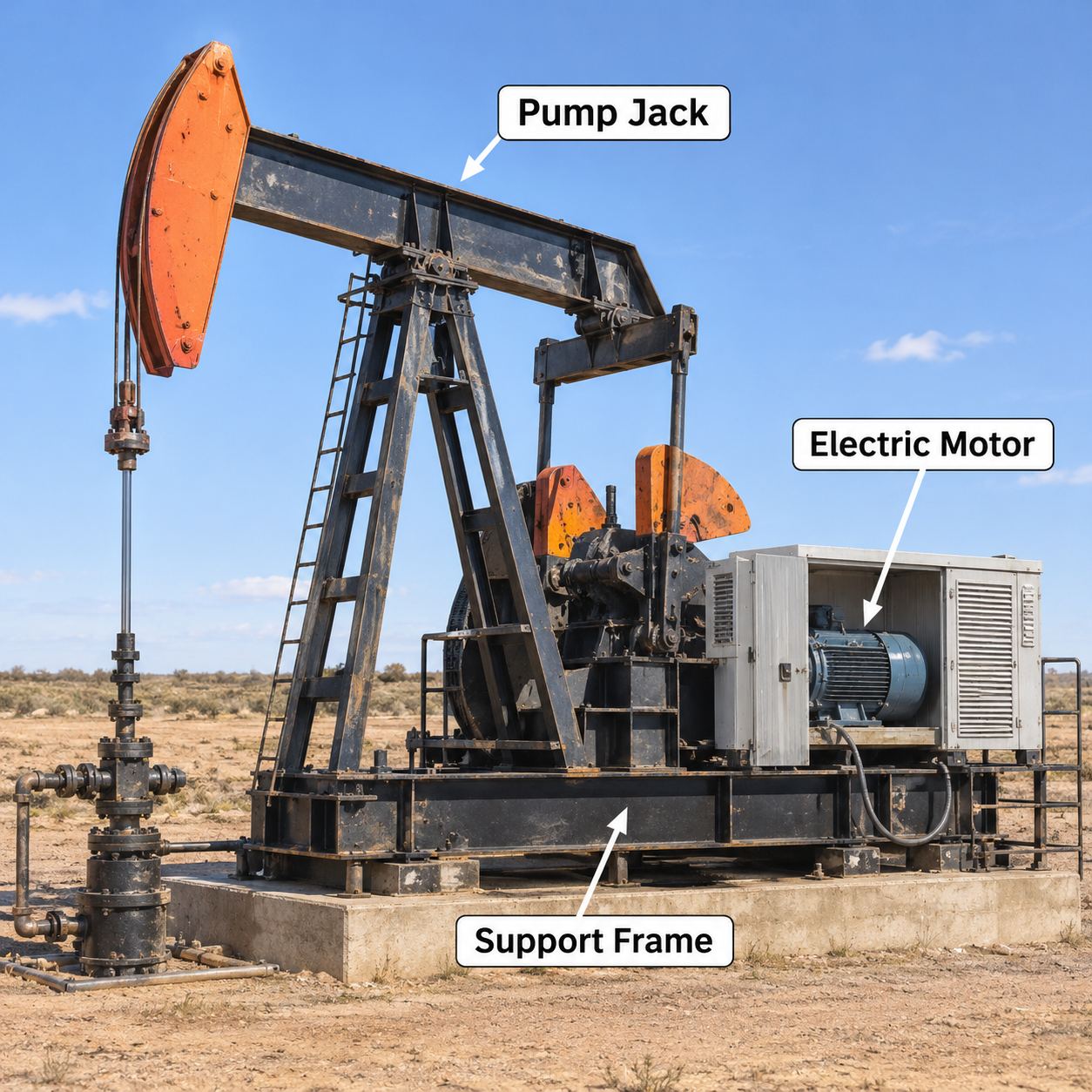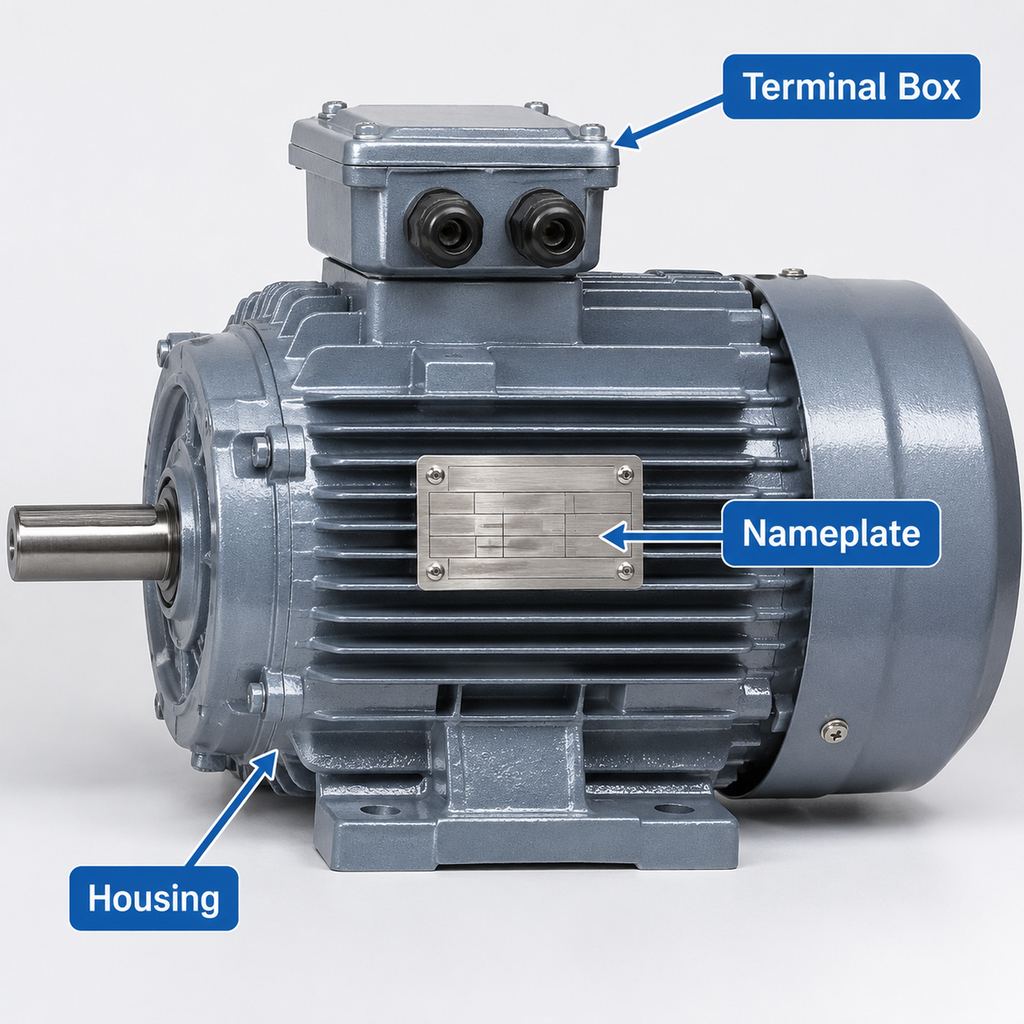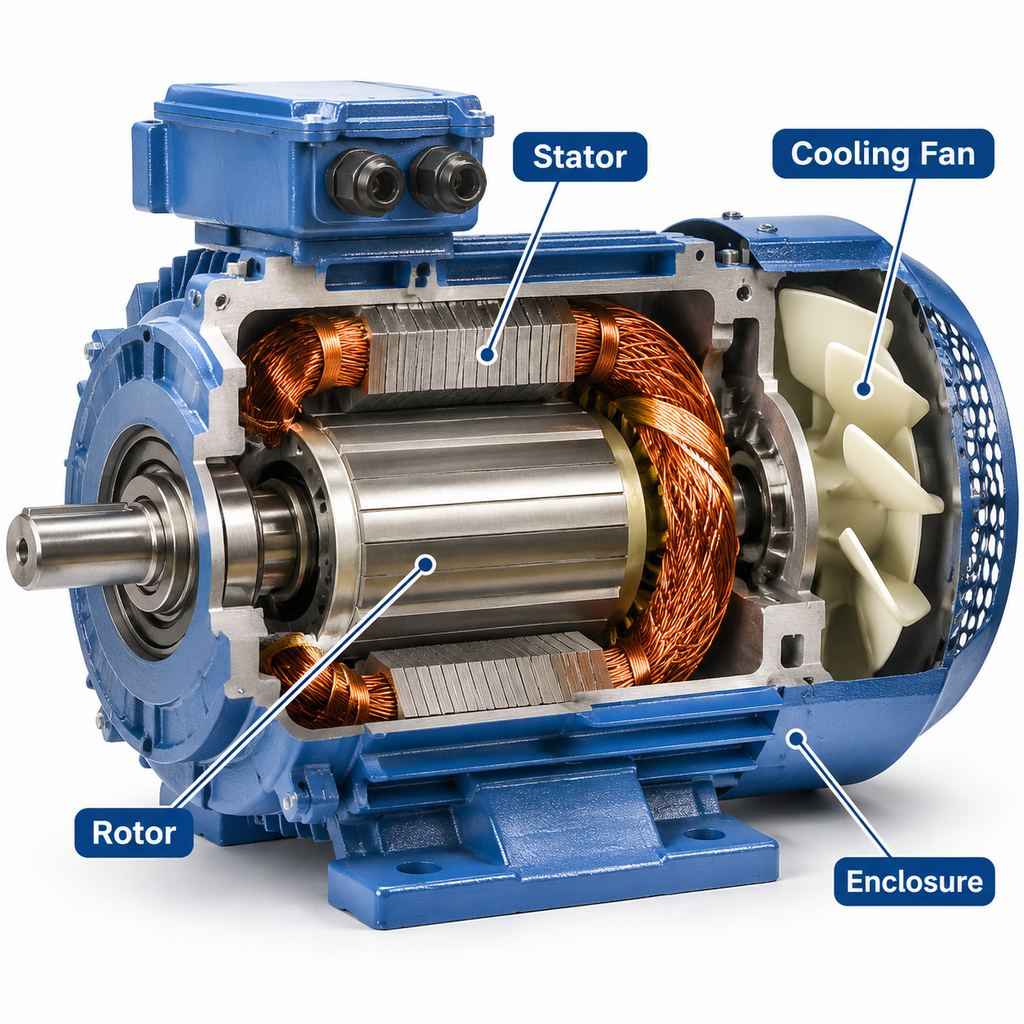
An electric motor turns electrical energy into rotating mechanical power. Current in the motor produces torque on the shaft, and that shaft drives a pump, fan, conveyor or other machine. In industrial plants this is almost always a three-phase induction motor or a packaged variant of one (brake motor, multi-speed motor or gear motor).
How the magnetic field and rotor interact is explained in Understanding the Operation of Electric Motors in Industrial Applications. This page does not repeat that principle. It maps common equipment to motor series and to the specifications you should confirm on an RFQ. For type definitions see what is a three-phase motor.
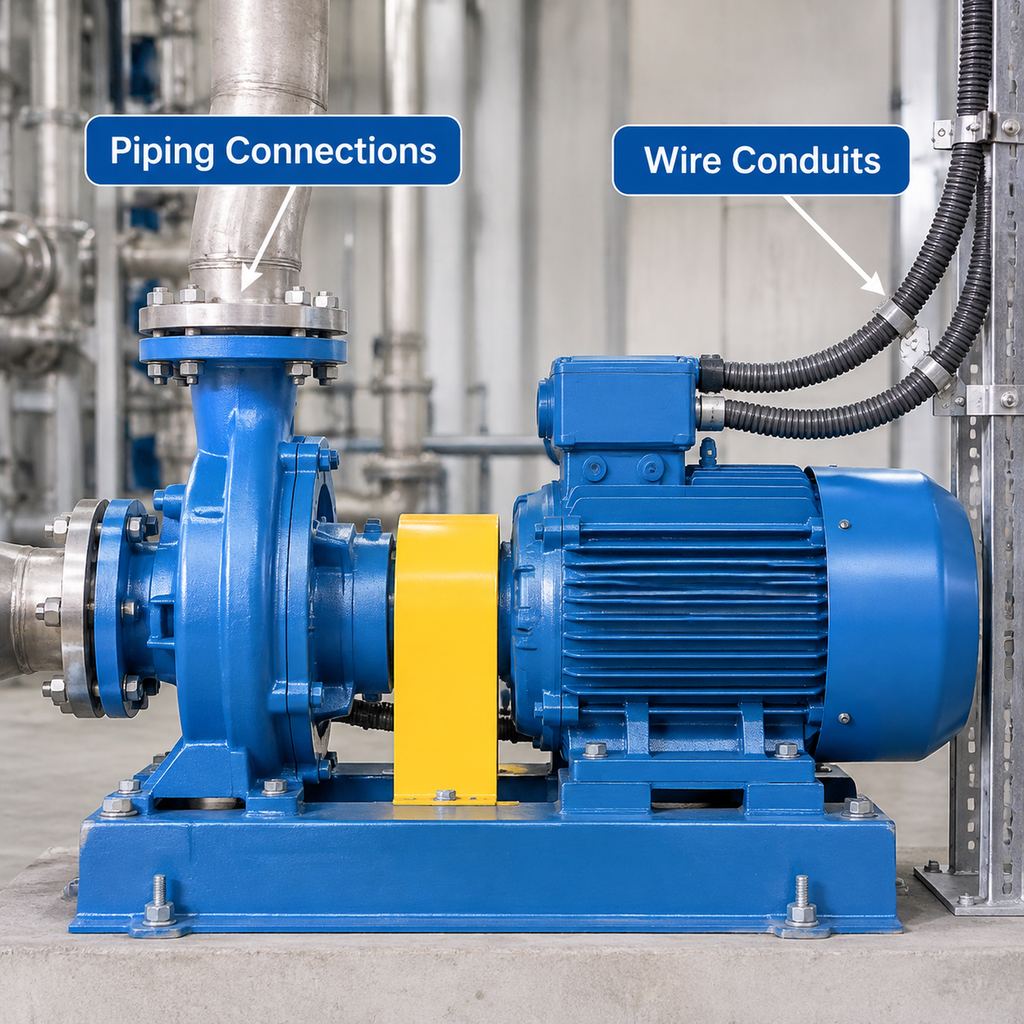
Pumps and Fans: YE3 / YE4, or YVF2 with a VFD
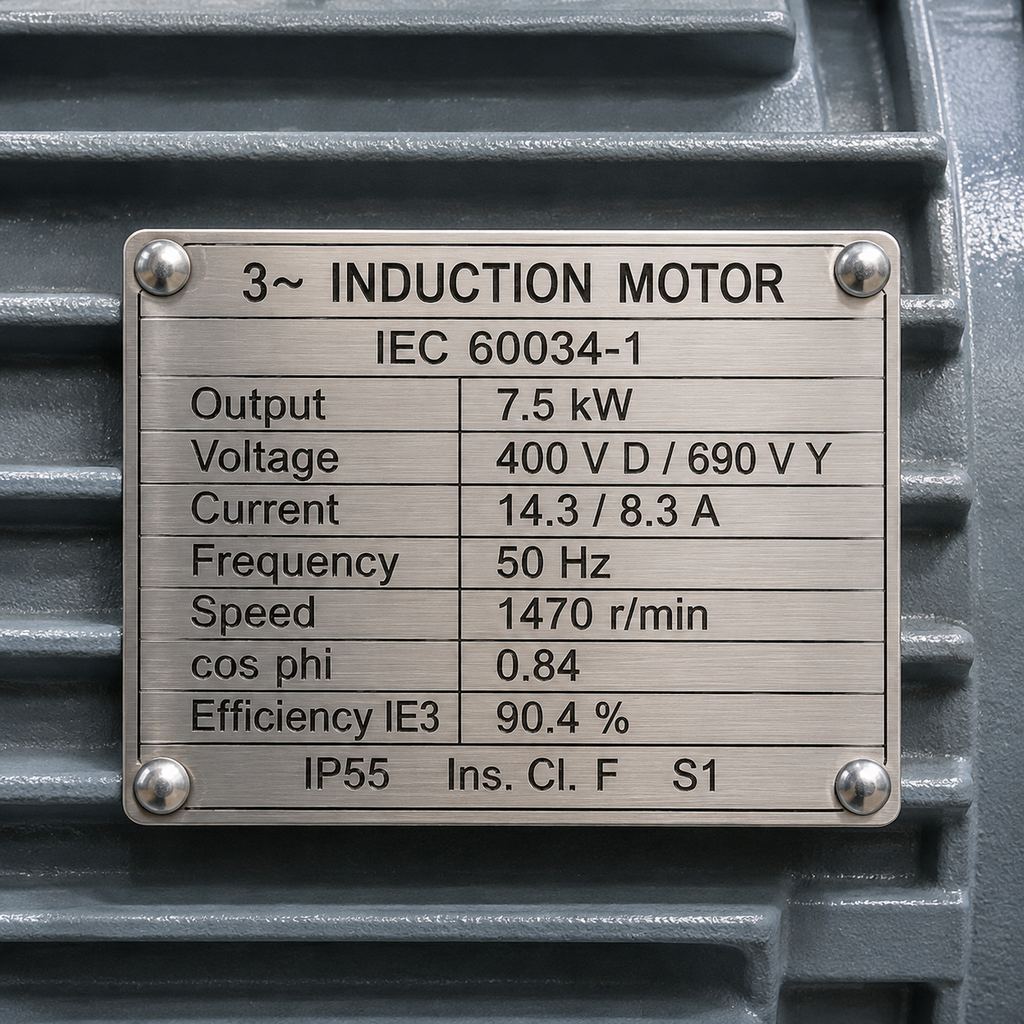
Centrifugal pumps and fans usually present a variable-torque load: required torque falls as speed falls. For continuous, roughly fixed-speed duty, cast-iron YE3 or YE4 general-purpose motors are the usual starting point. Confirm absorbed shaft power at the duty point, supply voltage and frequency, S1 duty if the machine runs continuously, and mounting (often B3 or B5).
When flow is controlled by dampers or throttling valves, a variable-frequency drive plus a motor suitable for inverter supply is often the better energy approach. That is the role of the YVF2 series, used with a VFD; see what is a VFD drive for HVAC fans and pumps. Check the continuous speed range and cooling at low speed, not only full-load kW. Application pages: water and wastewater and HVAC and ventilation.
Compressors
Many compressors are closer to constant-torque or have a demanding start (loaded start, high inertia). A YE3 or YE4 motor is still often used, but you must confirm starting method, allowable starts per hour, and whether the compressor supplier specifies a minimum locked-rotor or breakdown torque. Do not size from running kW alone if the machine starts against pressure or a large flywheel.
Conveyors and Lines
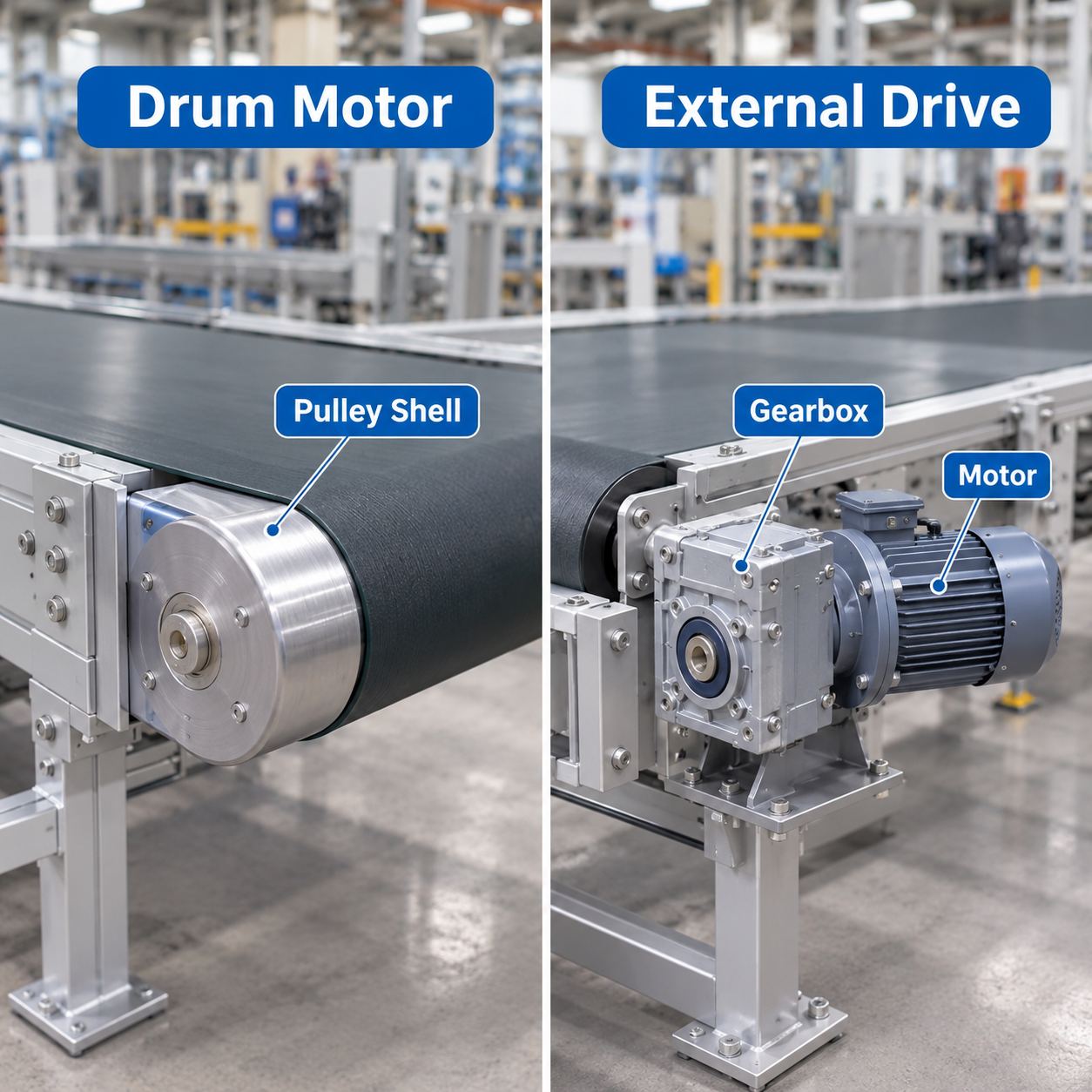
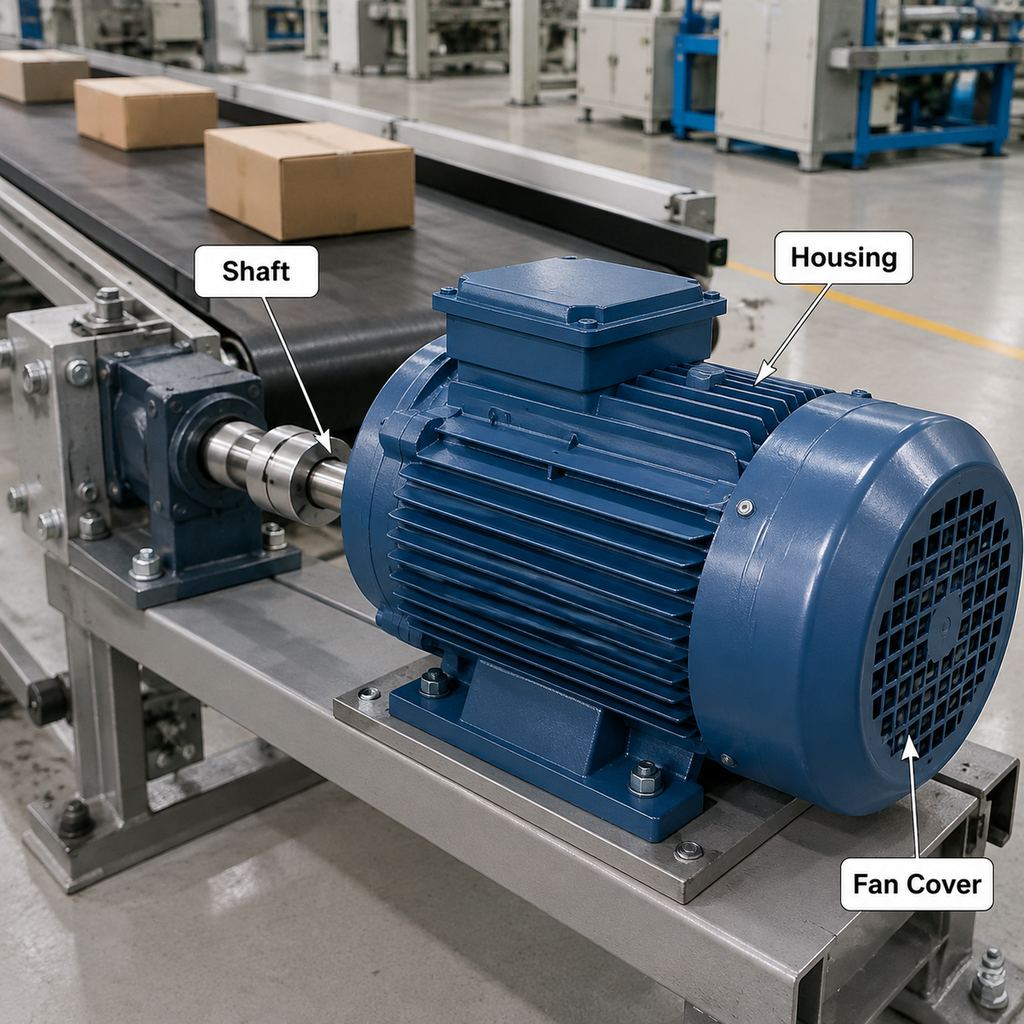
Conveyors are typically constant-torque: torque stays significant even at low speed, especially on an incline or when starting loaded. A general-purpose YE3/YE4 motor may drive the reducer directly. If the line needs a wide speed range, discuss YVF2 and the drive. If the conveyor itself is slow and the torque at the output shaft is high, an R/F/K/S gear motor is often the cleaner package. Frequent stops may call for a brake motor rather than relying on a coast-down. See material handling.
Mixers
Mixers often need high torque at low shaft speed and can start in a thick product. A gear motor (R, F, K or S, according to the mounting and shaft arrangement) is the usual match. Confirm output torque, ratio, start-up condition (empty or full), and any shaft loads. A standard high-speed motor without a correctly sized reducer is a poor substitute for a specified mixer duty.
Hoisting and Fast Stopping: YEJ Brake Motors
Lifting, lowering and some indexing conveyors need a motor that can hold or stop quickly. YEJ brake motors add an electromagnetic brake on a three-phase induction motor. Specify brake duty (holding versus stopping), how often it applies, and any safety-function requirements separately—the brake on a standard YEJ is not automatically a certified safety brake. Background: what is a brake motor.
Multi-Speed: YD
When the machine needs two (or more) discrete speeds rather than a continuous speed range, a YD multi-speed motor can be appropriate—for example a fan with a high and a low fixed speed. Each speed has its own power and torque rating; confirm both. If you need smooth variation across a wide range, a VFD and YVF2 is usually the more flexible choice.
Machine Tools
Spindles, feeds and auxiliaries differ widely. Some tools run a general-purpose motor at fixed speed; others need discrete YD speeds or inverter control. Confirm duty cycle, speed range, starting frequency, enclosure and whether the machine builder already specifies a frame or flange. Do not assume a pump-style variable-torque VFD setup covers a constant-torque tool axis.
Low Speed and High Torque: R / F / K / S Gear Motors
When the machine shaft must turn slowly with high torque, a packaged gear motor avoids a separate motor-plus-reducer alignment exercise. R, F, K and S describe different housing and shaft arrangements; selection is covered in what is a gear motor. State the required output speed and torque, not only motor kW, and the mounting the machine actually has.
Equipment, Load Type and Series at a Glance
| Equipment | Typical load | Series to discuss | Key specs to confirm |
|---|---|---|---|
| Pumps and fans (fixed speed) | Often variable torque (centrifugal) | YE3, YE4 | Duty-point shaft power, voltage/frequency, S1 if continuous, mounting, efficiency class |
| Pumps and fans (variable flow) | Variable torque over a speed range | YVF2 with a VFD | Speed range, low-speed cooling, cable/drive arrangement |
| Compressors | Often constant torque; check the start | YE3, YE4 | Starting method, starts per hour, required torque, duty |
| Conveyors and lines | Typically constant torque | YE3/YE4, gear motor, YVF2 or YEJ as the line requires | Loaded start, speed, stopping/holding, reducer ratio if used |
| Mixers | High torque at low speed; start in product | R/F/K/S gear motors | Output torque and speed, start condition, shaft loads, mounting |
| Hoisting / fast stopping | Constant torque plus brake duty | YEJ | Brake holding vs stopping, duty cycle, any safety requirement |
| Multi-speed machines | Discrete speeds | YD | Power and torque at each speed, changeover method |
| Machine tools | Duty-specific; often constant torque on axes | YE3/YE4, YD or YVF2 as specified | Speed range, duty cycle, frame/flange, enclosure |
| Low-speed, high-torque driven machines | Constant torque at the output shaft | R/F/K/S | Output torque, ratio, mounting, service factor of the gearbox |
These are starting points, not automatic selections. A loaded inclined conveyor, a mixer that starts full, or a compressor that starts on load can invalidate a “same kW as the old motor” choice. Use the motor selection checklist and RFQ guide to record load, duty, mounting and environment.
FAQ
What does a motor do?
It converts electrical energy into rotating mechanical power—torque on a shaft—so a driven machine can run.
What is the function of an electric motor in a plant?
It is the prime mover for pumps, fans, compressors, conveyors, mixers, hoists and machine tools. The series you choose depends on load type, speed and stopping needs, not only on kW.
Do all of these applications use the same motor?
No. A general-purpose YE3/YE4 covers many continuous duties. Variable speed, discrete speeds, braking and high output torque point to YVF2, YD, YEJ or a gear motor instead.
Request a Match, Not Just a kW
Browse general-purpose motors, special-purpose motors and gear motors, or the full product list. If the machine needs a non-standard shaft, flange or brake duty, send the requirements through customization rather than ordering by series name alone.