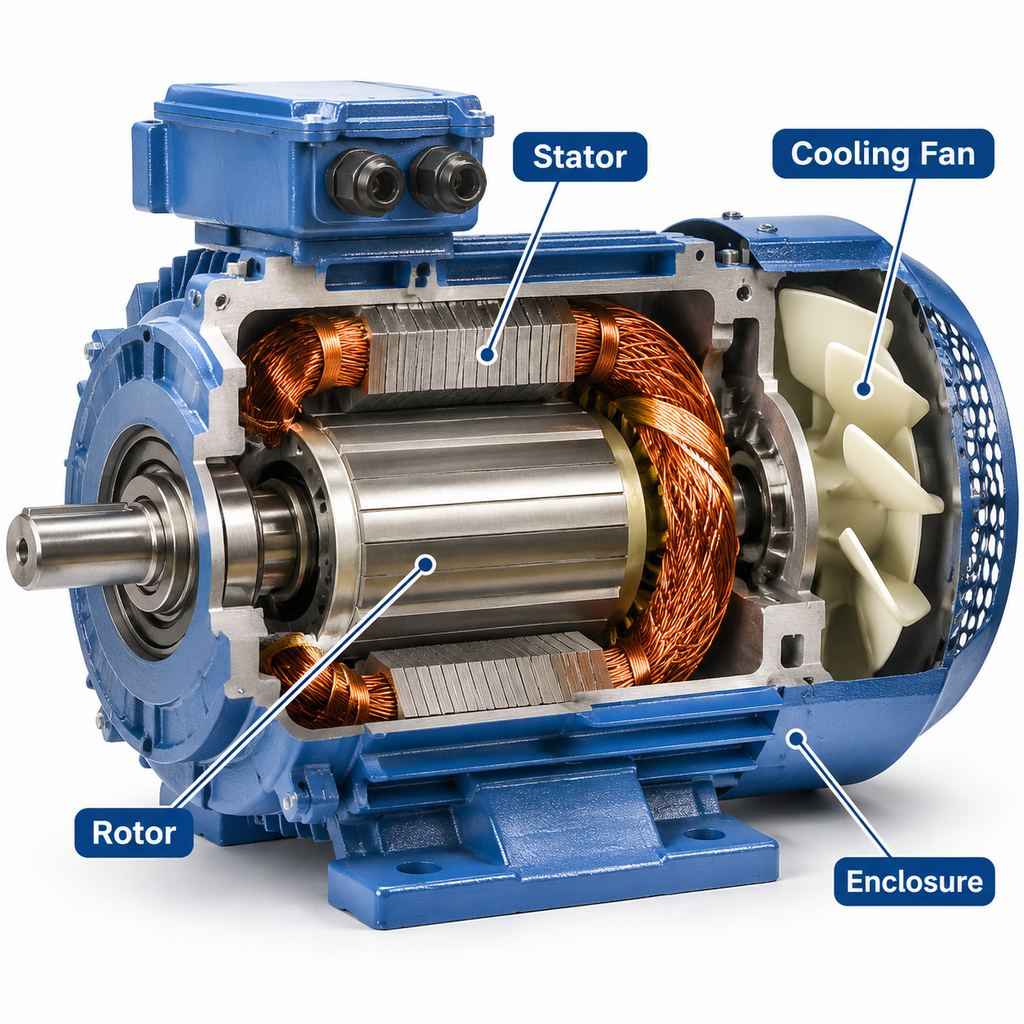
A single-phase motor is an AC electric motor designed to run from a single-phase supply—typically the line-and-neutral (or two-line) service found in homes, farms and small workshops. The most common industrial-adjacent type is the single-phase induction motor. It still has a squirrel-cage rotor, but only one main (run) winding on the stator.
That main winding alone cannot start the motor. At standstill it produces a pulsating, back-and-forth field, not the rotating field that a three-phase winding creates naturally. With no starting torque, the rotor would sit and hum. Every practical single-phase induction motor therefore adds a starting method: a second winding, a capacitor, a shading coil, or a combination of these. Once the motor is up to speed, some designs disconnect the start circuit and continue to run on the main winding.
This is not the same as single phasing, which is a fault condition on a three-phase motor that has lost one supply phase. A single-phase motor is built for a one-phase supply; single phasing is an abnormal loss of a phase on a three-phase machine.
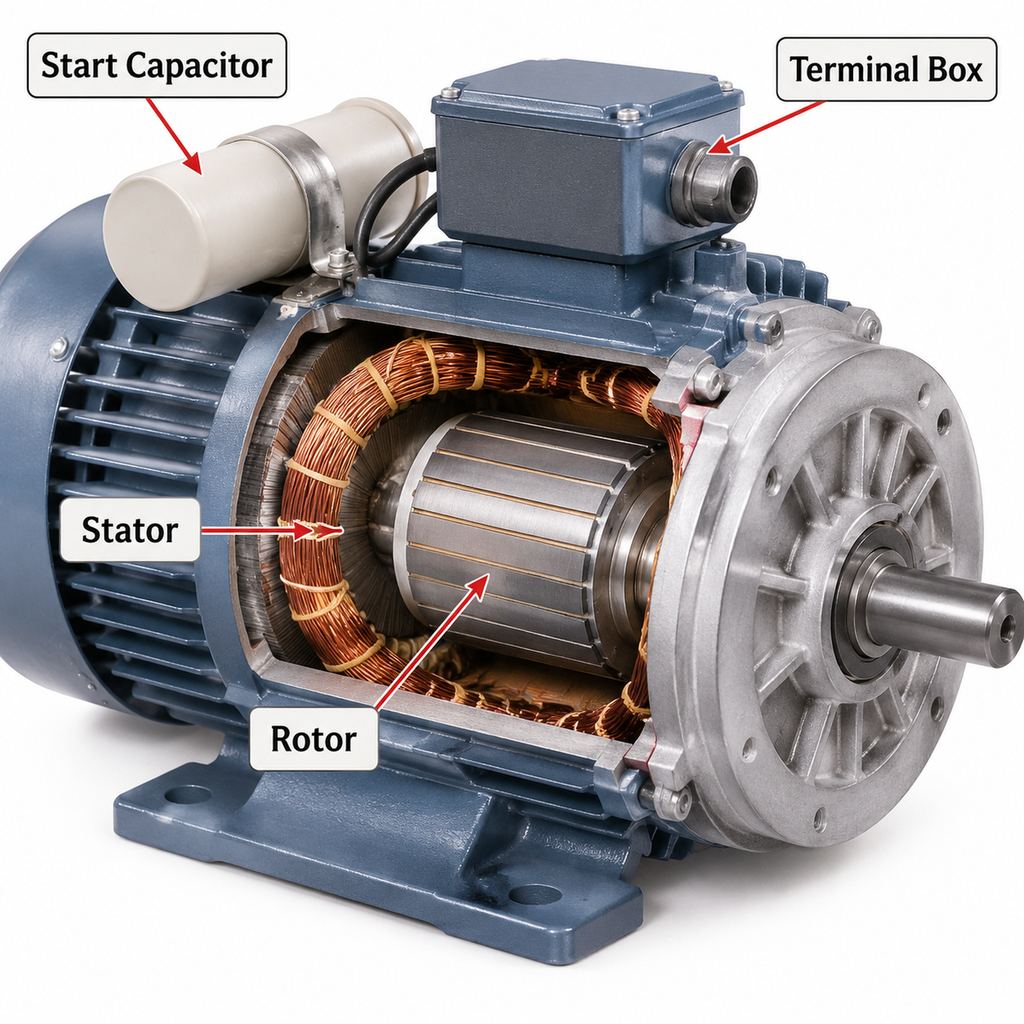
Why a Starting Method Is Needed
A balanced three-phase stator produces a rotating field from the 120° displacement of the three currents, so a three-phase induction motor is inherently self-starting. A single-phase main winding does not. Designers therefore place an auxiliary (start) winding at an angle to the main winding and shift its current in time—by using different winding resistance, a capacitor, or a shading coil—so the two fields are out of step and a weak or strong rotating field appears at start. Details of three-phase behaviour are in what is a three-phase motor; this page does not repeat that article.
Common Types of Single-Phase Motors
If you are asked for three everyday examples, typical answers are a shaded-pole bathroom or refrigerator fan, a PSC (capacitor-run) HVAC blower, and a capacitor-start workshop compressor or pump. The types below explain why those examples are chosen.
| Type | How it starts / runs | Typical examples | Notes |
|---|---|---|---|
| Split-phase | A start winding of higher resistance is energised with the main winding, then a centrifugal switch or relay drops the start winding out | Small washing-machine drives, some small fans and blowers, light pumps | Moderate starting torque; no start capacitor |
| Capacitor-start | A start capacitor in series with the start winding gives a larger phase shift; the start circuit is switched out at speed | Compressors, air conditioners, some pumps and tools that need a harder start | Higher starting torque than split-phase |
| Capacitor-run (PSC) | A run capacitor stays in circuit with the auxiliary winding; usually no start switch | Permanent-split-capacitor furnace and air-handler blowers, many direct-drive fans | Smoother running, modest starting torque |
| Capacitor-start / capacitor-run | A large start capacitor is switched out; a smaller run capacitor stays in with the auxiliary winding | Some larger pumps, commercial HVAC compressors | Combines a strong start with better running performance |
| Shaded pole | A shorted copper shading coil on part of each salient pole lags the flux and produces a weak rotating field | Small desk and bathroom fans, refrigerator evaporator fans, some appliance blowers | Simple and inexpensive; low torque and low efficiency; used only on small loads |
Universal (AC/DC brush) motors appear in many portable tools and appliances, but they are a different construction from the induction types above. This guide stays with single-phase induction motors, which is what plant buyers usually mean when comparing them with industrial three-phase machines.
Why Industry Usually Uses Three-Phase Motors
On a factory floor, three-phase motors are the default for pumps, fans, conveyors and compressors once a three-phase supply is available. They start without a capacitor or centrifugal switch, deliver smoother torque, and are readily available in efficient IEC frames over a wide power range. Maintenance is also simpler: there is no start switch or electrolytic start capacitor to fail.
Single-phase motors remain the right choice when the load is small and only a single-phase supply exists—farm workshops, remote pump houses, light commercial HVAC and household equipment. As power rises, starting current, cable size and motor cost become less attractive than bringing in three-phase service or using a properly engineered converter. Those options are discussed in how to get three-phase power at home and how to convert a 3-phase motor to single-phase; this article does not repeat those methods. A standard three-phase motor should not simply be connected to a single-phase outlet.
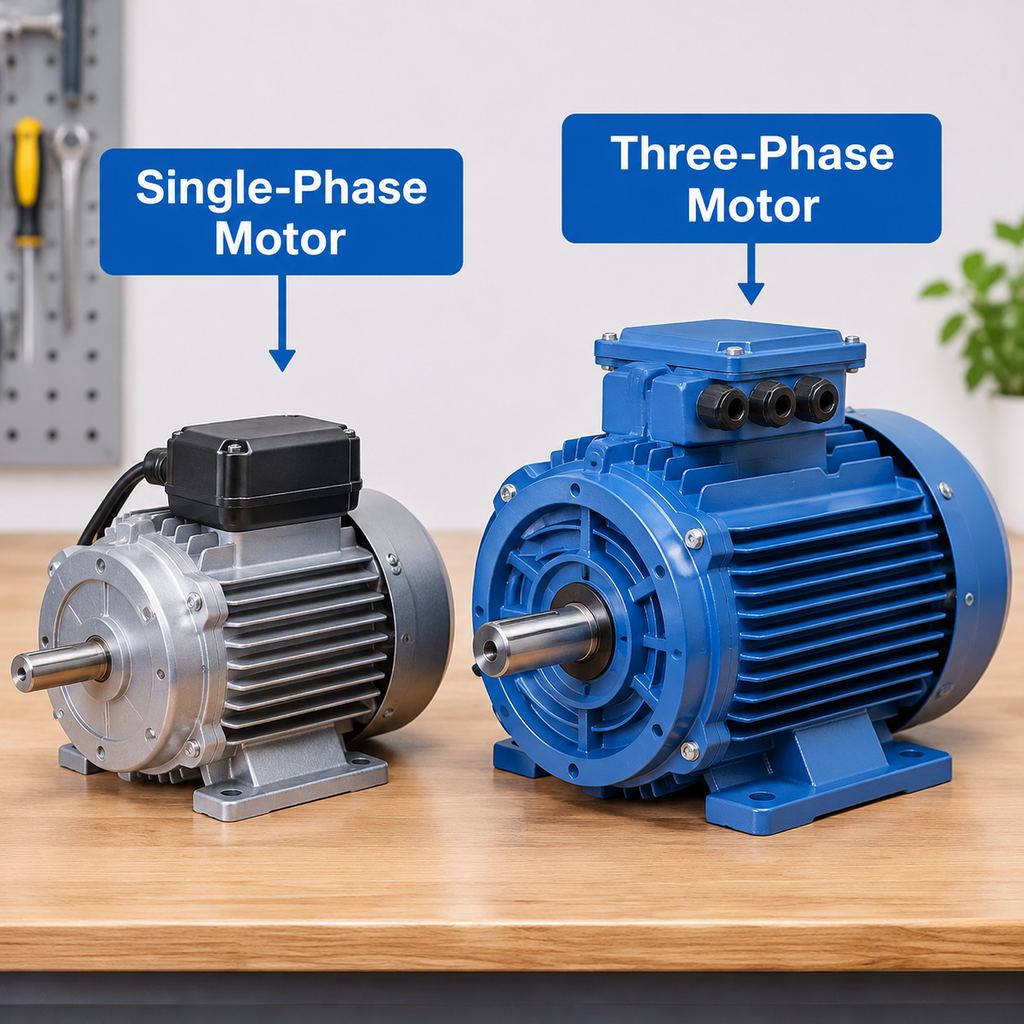
Single-Phase vs Three-Phase Motors
| Point | Single-phase induction motor | Three-phase induction motor |
|---|---|---|
| Supply | One-phase AC (typical building or farm service) | Three-phase AC (typical plant service) |
| Starting | Needs an auxiliary method (start winding, capacitor, shading coil) | Inherently self-starting on a balanced three-phase supply |
| Torque delivery | More pulsating; design-dependent start torque | Smoother rotating field and torque |
| Efficiency and size range | Generally less efficient; most often small and fractional-kilowatt machines | Higher-efficiency IEC frames are widely used from small to large kW |
| Typical maintenance items | Start capacitors, centrifugal switches or relays (where fitted) | No start capacitor; protection and bearings still need attention |
| Best fit | Small loads where only single-phase power is available | Industrial continuous and heavier duties when three-phase power is available |
FAQ
What is a single-phase electric motor?
A motor built to run from a single-phase AC supply. Induction types need a starting method because the main winding alone does not produce starting torque.
What are three examples of single-phase electric motors?
A shaded-pole refrigerator or bathroom fan, a PSC (capacitor-run) HVAC blower, and a capacitor-start compressor or well pump.
Is single phasing the same as a single-phase motor?
No. Single phasing is a supply fault on a three-phase motor. A single-phase motor is a machine designed for one-phase power.
Can I use a three-phase motor if I only have single-phase power?
Not as a direct hook-up. Use a motor built for single-phase service, or an engineered conversion or new three-phase supply as discussed in the linked articles.
If You Have Three-Phase Power, Specify a Three-Phase Motor
JWMotor’s general-purpose catalogue is three-phase: the Y2 (IE2) and YE3 (IE3) cast-iron ranges, listed under general-purpose motors. If a project has a three-phase supply, those frames are usually the better fit for pumps, fans and conveyors. For non-standard voltages or accessories, use customization or browse all products.