
Overview of Converting a 3-Phase Motor to Single-Phase
Converting a three-phase motor to run on a single-phase power supply is a practical solution for scenarios where three-phase power isn’t accessible but there’s a need to operate industrial equipment originally designed for it. This need often arises in workshops, remote locations, or retrofit situations where converting the infrastructure to support three-phase power would be prohibitively expensive. To bridge this gap, engineers and technicians have several approaches, ranging from capacitor-based methods to phase converters and advanced Variable Frequency Drives (VFDs).
Each conversion method has its trade-offs. For example, capacitors can synthesize a displaced phase electrically but typically result in reduced power efficiency and torque availability. Rotary and static phase converters offer better stability for heavy-duty applications but come with higher upfront costs. Meanwhile, single-phase input VFDs, which convert direct current (DC) back into three-phase alternating current (AC), are widely used because of their efficiency and motor control capabilities. Choosing the right method depends on factors like the application’s power requirements, torque sensitivity, and budget constraints.
As these techniques often involve modifying electrical configurations or introducing new components, it’s essential to understand the limitations of converted systems and whether performance losses due to derating are acceptable. This overview will explore commonly used methods and their suitability for various setups, helping you make an informed decision.
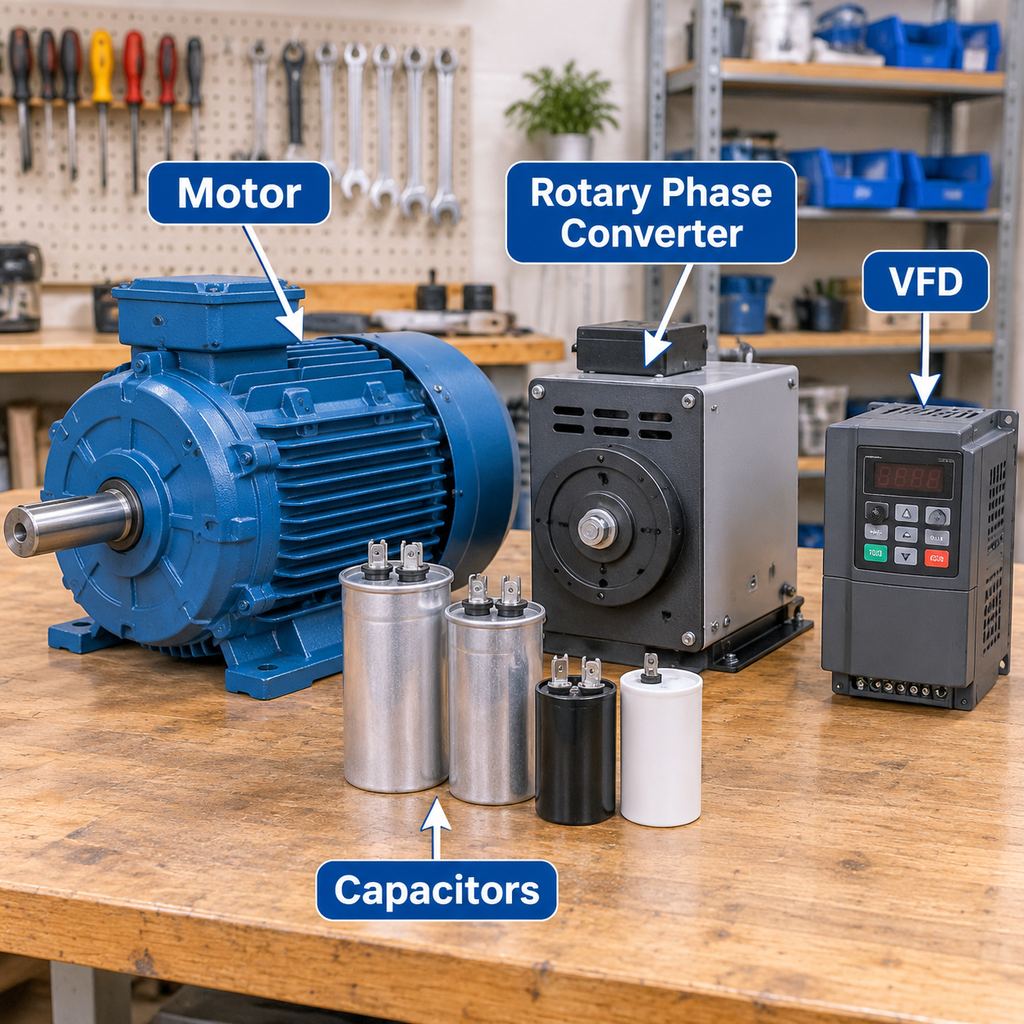
Wide-angle shot of a three-phase motor and components on a workshop table
Methods for Conversion: Advantages and Limitations
1. Using a Variable Frequency Drive (VFD)
A VFD with single-phase input and three-phase output is generally the most versatile option. It takes single-phase power, converts it to DC, and then generates a three-phase AC output. This method typically maintains close to full rated power and allowing for variable speed control. It suits setups that need adjustable motor operation, such as agriculture or woodworking applications, requiring fine-tuned motor operation. The limitation here is cost, as VFDs are more expensive than static methods. They also require basic parameter setup, for example when used with brake motors such as the YEJ series.
2. Static Phase Converters
Static phase converters use capacitors to jump-start the motor and create a third phase to keep it running. These are cost-effective for motors with low start-up loads that can handle reduced power output after startup. The main drawback is that they only provide about 60–70% of the motor’s rated power, making them unsuitable for continuous heavy-duty operations. Static converters are simple to install but provide limited flexibility compared to VFDs. Use them for applications with low starting current requirements and minimal torque sensitivity, such as light-duty fans or pumps.
3. Rotary Phase Converters
A rotary phase converter (RPC) generates three-phase power by spinning an idler motor. This method offers nearly full power and consistent voltage levels, making it suitable for heavy-duty or high-starting torque applications like in industrial conveyors or larger compressors. However, RPCs are bulky, expensive, and inefficient compared to VFDs, drawing significant power even during idle periods. Their output is more consistent than static converters, but they lack the fine control achievable with a VFD and are more complex to install.
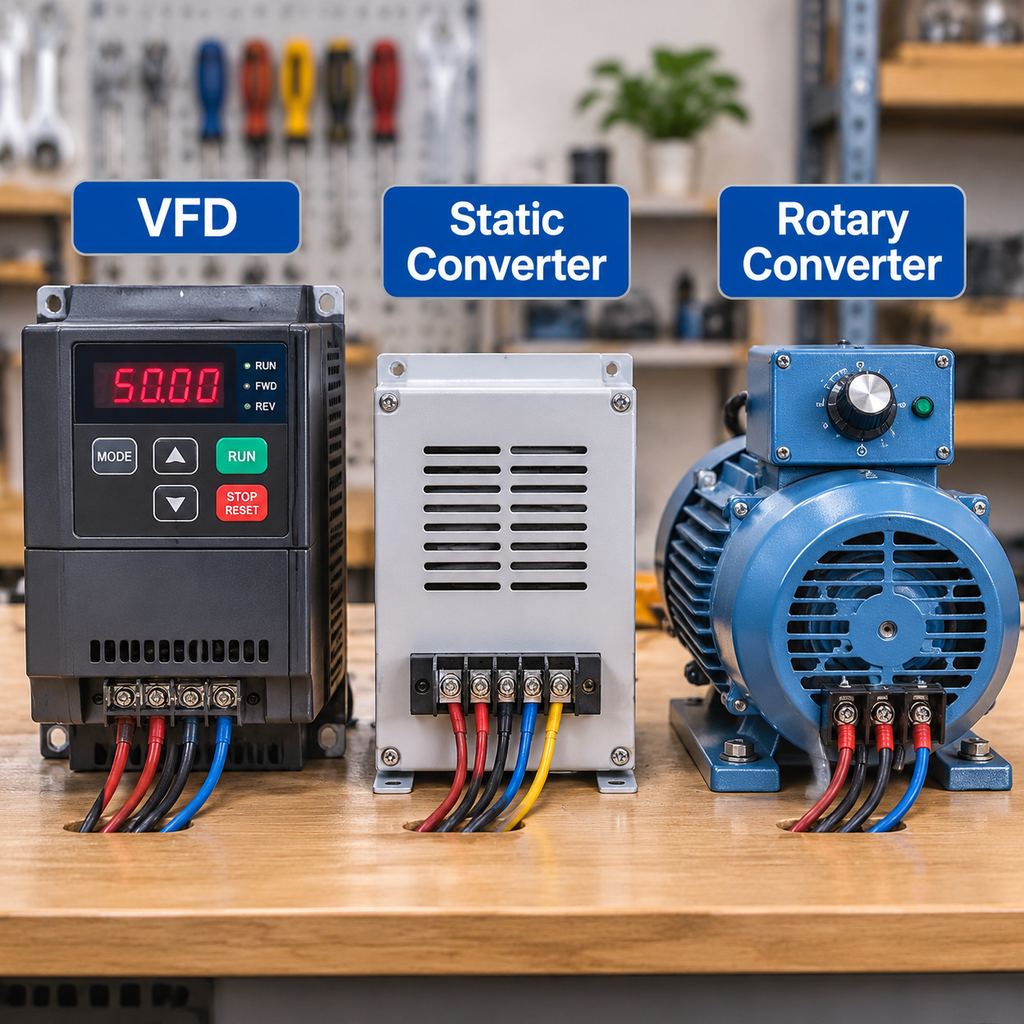
Comparison of VFD, static, and rotary phase converters on a workbench
Using Variable Frequency Drives (VFDs) for Conversion
- What is a VFD and How Does It Work? A Variable Frequency Drive (VFD) is an electronic device that takes single-phase input power, converts it to DC, and then inverts it back to a three-phase AC output. This enables you to use a three-phase motor on a single-phase power supply without significant derating or excessive torque loss. VFDs offer benefits beyond compatibility; they allow for precise speed control, energy savings, and soft starting, which minimizes the high inrush currents typically associated with motor startups.
- Which Motors Work Best with VFDs? Most modern three-phase motors, including general-purpose cast-iron units like the Y2 series (IE2, TEFC), are compatible with VFDs, as are high-efficiency designs such as the YE3 series. For long cable runs or frequent low-speed operation, check that the motor’s insulation system is rated for inverter duty. Applications with braking or frequent stops and starts may use a brake motor, such as the YEJ series, with a suitably configured drive.
- Applications of VFDs in Industrial Settings VFDs are commonly used where speed control matters, such as in agriculture and woodworking. Motors designed for VFD use, such as the YVF2 series, are typically applied to fans, pumps, and conveyors, where matching speed to demand can reduce energy use and mechanical wear.
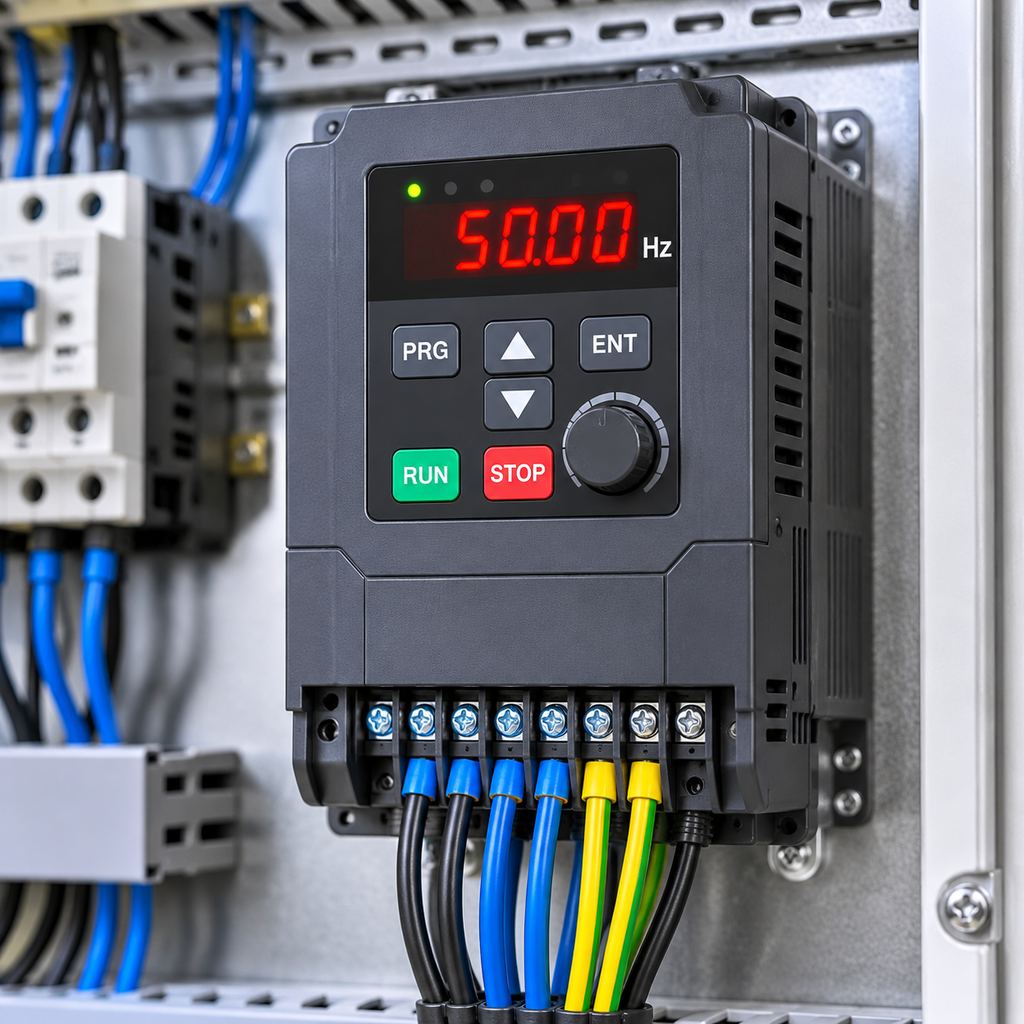
Close-up of a VFD on an industrial panel with visible wiring
Capacitor Method for Converting 3-Phase to Single-Phase
The capacitor method (often called a static capacitor or “capacitor start/run” connection) wires one or more capacitors to an existing three-phase motor so it can start and run from a single-phase supply. Two motor terminals are connected across the single-phase line, and the third terminal is fed through a capacitor. The capacitor shifts the current in that winding out of phase with the supply, producing a rotating magnetic field that approximates—though does not reproduce—true three-phase operation.
Run and Start Capacitors
- Run capacitor: A continuously connected capacitor (typically a metallized polypropylene motor-run type) that keeps the motor turning once it is up to speed.
- Start capacitor: A larger electrolytic capacitor connected in parallel with the run capacitor only during starting, then disconnected by a centrifugal switch, current relay, or timer once the motor approaches running speed. Start capacitors are rated for short duty and will fail if left in circuit.
- Voltage rating: Capacitors should be rated well above the supply voltage; for a 230 V supply, 370–450 V AC rated capacitors are commonly used.
Typical Sizing Rules of Thumb
Capacitor values depend on the motor’s design, winding connection, and load, so the figures below are approximate starting points rather than exact values. Check the motor manufacturer’s guidance where available.
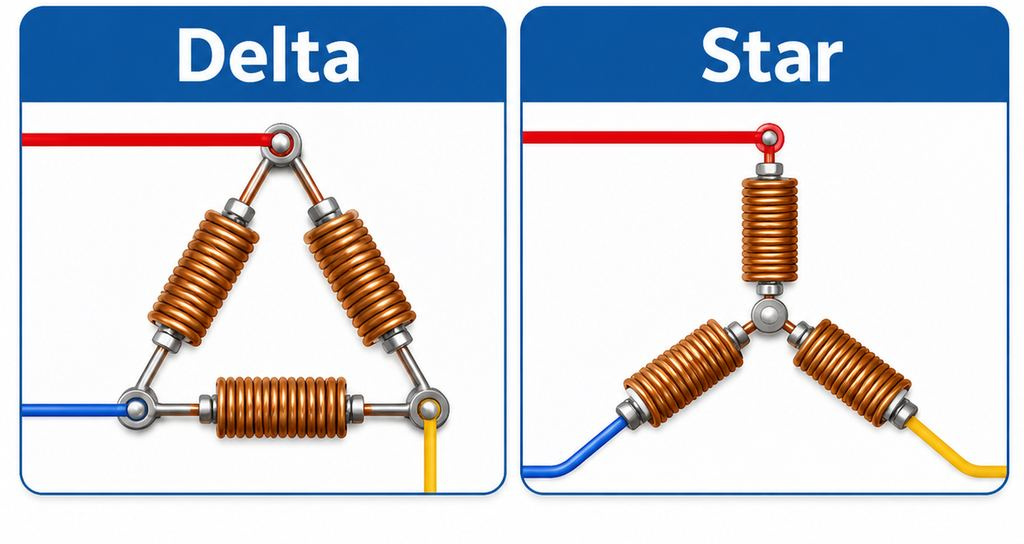
- Run capacitance: A commonly cited rule of thumb is about 50–70 µF per kW of motor rating on a 230 V supply (with the motor connected in delta).
- Start capacitance: Often several times the run value—frequently quoted as roughly two to three times—connected only for the first second or so of starting.
- Fine-tuning: Too little capacitance gives weak starting and running torque; too much causes excess current and heating in the capacitor-fed winding. Measuring the current in each winding under the actual load and adjusting toward the most balanced reading is a common practical approach.
- Discharge: Start capacitors are often fitted with a bleed resistor (for example, a few tens of kΩ) so they do not retain a charge after switching.
Derating and Performance
Because the capacitor-fed phase is not a true third phase, a motor on this connection typically delivers roughly one-half to two-thirds of its rated power. Its windings carry unbalanced currents, which produces extra heating, and the balance is only reasonable near one particular load point. Starting torque is also considerably lower than on a three-phase supply, especially without a start capacitor.
Real-World Example
A typical use is a small workshop or farm machine that came with a three-phase motor but sits where only single-phase power is available—for example, a drill press with a 0.75 kW (1 HP) motor, or a small 1.5 kW (2 HP) water-transfer pump. Using the rule of thumb above, a 0.75 kW motor would start from roughly 40–50 µF of run capacitance at 230 V, with a start capacitor added if the machine is slow to come up to speed. Since a drill press usually starts unloaded and a centrifugal pump has a light starting load, both tolerate the reduced torque, provided the expected output stays within the derated capacity.
Limitations
- Poor starting torque; not suitable for heavy-start loads such as loaded compressors, conveyors, crushers, or machines with high inertia.
- Unbalanced winding currents and additional heat, which can shorten motor life if the motor is run near its original rating.
- Fixed capacitance is only well matched to one load condition, so performance varies as load changes.
- Generally practical only for small motors, typically up to a few kilowatts.
Safety note: Capacitors can hold a dangerous charge after power is removed. Isolate and lock out the supply, discharge capacitors safely before handling, use correctly rated components, and protect the motor with an overload device sized for its derated current. If you are not qualified to work on mains wiring, have the work done by a licensed electrician.
Comparison of Conversion Methods
| Feature | Variable Frequency Drive (VFD) | Static Phase Converter | Rotary Phase Converter | Capacitor Method |
|---|---|---|---|---|
| Power Efficiency | High, retains near-original efficiency levels. | Medium, typically operates at 60-70% of motor power. | Medium to High, depending on the load and configuration. | Low, significant performance loss (50-70% of original power). |
| Cost | High initial cost; may reduce energy use over time. | Low, more budget-friendly for low-power applications. | Medium to High, costs more for heavy-duty configurations. | Lowest cost among all methods. |
| Ease of Installation | Requires programming knowledge; relatively easy physical installation. | Simpler, requires basic electrical connections. | Moderate complexity, heavier setup may demand professional installation. | Easiest, no specialized equipment needed beyond capacitors. |
| Application Suitability | Suited to variable speed control applications such as woodworking. | Best for small, low-load motors running intermittently. | Suited to continuous-duty heavy loads such as larger fans and pumps. | Suitable for very light-duty and occasional use. |
| Customizability | Highly customizable for speed, torque, and efficiency optimization. | Limited; no control over speed or performance. | Moderate; can be scaled for different motor sizes. | Minimal; fixed performance dictated by capacitor size. |
| Compatibility with Motor Types | Works well with motors designed for VFD use, such as the YVF2 series and YE3 motors. | Compatible with older or simpler induction motors. | Works with most three-phase motors. | Limited compatibility; best suited for general-purpose induction motors. |
Frequently Asked Questions
Can a 3-phase motor run on single-phase power?
Yes, a 3-phase motor can operate on single-phase power by using a conversion method such as a Variable Frequency Drive (VFD), rotary phase converter, static phase converter, or capacitor-based setup. However, efficiency, power output, and torque may be reduced depending on the method chosen.
What is the most efficient method to convert a 3-phase motor to single-phase?
A VFD with single-phase input and three-phase output is generally the most efficient method for conversion. It allows full or near-full power while enabling variable speed control. This makes it a common choice where control and efficiency matter.
What are the limitations of capacitor-based conversion for 3-phase motors?
Capacitor-based conversion reduces the motor’s operating power to roughly one-half to two-thirds of its rated capacity. This is due to the artificial phase created by the capacitors not delivering the same current as a true three-phase supply, limiting the motor’s torque and efficiency.
Can I use a rotary phase converter for continuous heavy-duty operations?
Yes, rotary phase converters are well-suited for continuous heavy-duty applications. They provide stable and balanced power, mimicking true three-phase supply. However, they require higher upfront costs and space compared to other methods.
Is it cost-effective to replace a three-phase motor with a single-phase motor instead of converting it?
Replacing a three-phase motor with a single-phase motor might be cost-effective for small systems or if only basic power requirements are needed. However, for large, high-torque applications, a conversion method such as a VFD may be more practical than replacement, since single-phase motors above a few kilowatts are less common.
Safety Considerations and Best Practices
When attempting to convert a three-phase motor for single-phase power supply, safety must be a top priority. As with any electrical project, failing to follow best practices can lead to equipment damage, inefficiencies, or even severe injury. Below are some key safety considerations when undertaking such conversions:
-
Perform a Full Power Analysis: Before any conversion, ensure the available single-phase power supply can handle the electrical demands of the motor, including starting current requirements, which can be significant. Learn more about induction motor starting currents and how they might impact your system.
-
De-energize Equipment: Always disconnect the power supply and lock out the circuit before opening any electrical panels or starting the conversion process. Working on live circuits is not only dangerous but can also severely damage electrical components.
-
Use Proper Personal Protective Equipment (PPE): High-voltage electricity presents an arc-flash risk. Always use insulating gloves, safety glasses, and flame-resistant clothing when performing electrical work.
-
Verify Grounding and Connections: Ensure that the motor and all associated components are properly grounded. Double-check wiring configurations and connections against the specific conversion method to prevent short circuits or electrical faults.
-
Select Compatible Components: Not all capacitors, VFDs, or phase converters are suited for every motor. For instance, a high-efficiency motor such as the YE3 series may have specific insulation or voltage compatibility requirements for safe operation.
-
Be Aware of Derating Effects: Many conversion methods lead to power loss, typically leaving the motor with reduced torque and efficiency. For applications like woodworking or industrial tasks, consider whether a different motor is more appropriate if full performance is required; see the product overview for the motor types discussed here.
-
Avoid Overloading the Motor: A converted motor is usually unable to deliver its full rated power. Overloading the motor can cause overheating, wear, and potential failure.
-
Conduct Proper Testing: After conversion, test the motor thoroughly under real operating conditions to ensure its performance meets the application requirements and that no overheating or vibration issues arise.
-
Adhere to Local Regulations: In the U.S., ensure compliance with National Electrical Code (NEC) standards for motor installations and conversions. Local regulations may also impose additional requirements.
-
Seek Professional Assistance if Uncertain: If you lack expertise in motor modifications, consult a qualified electrical technician or engineer. Errors in conversion can escalate operational costs and increase the risk of accidents.
Following proper safety protocols and best practices not only ensures efficient motor operation but also protects equipment and personnel from harm. Where a VFD is used, pairing it with a motor designed for inverter duty, such as the YVF2 series, can simplify the setup.
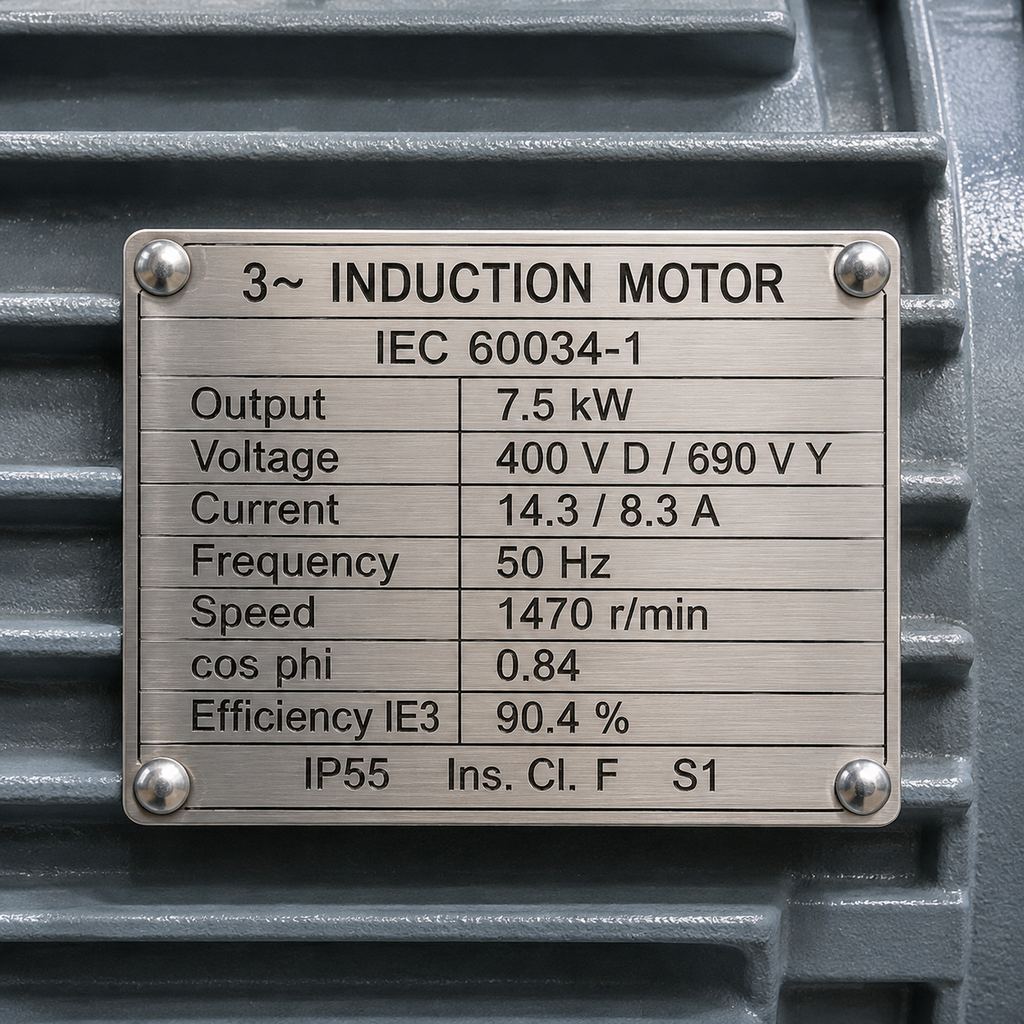


2 thoughts on “How to Convert a 3 Phase Motor to Single Phase: Methods Explained”