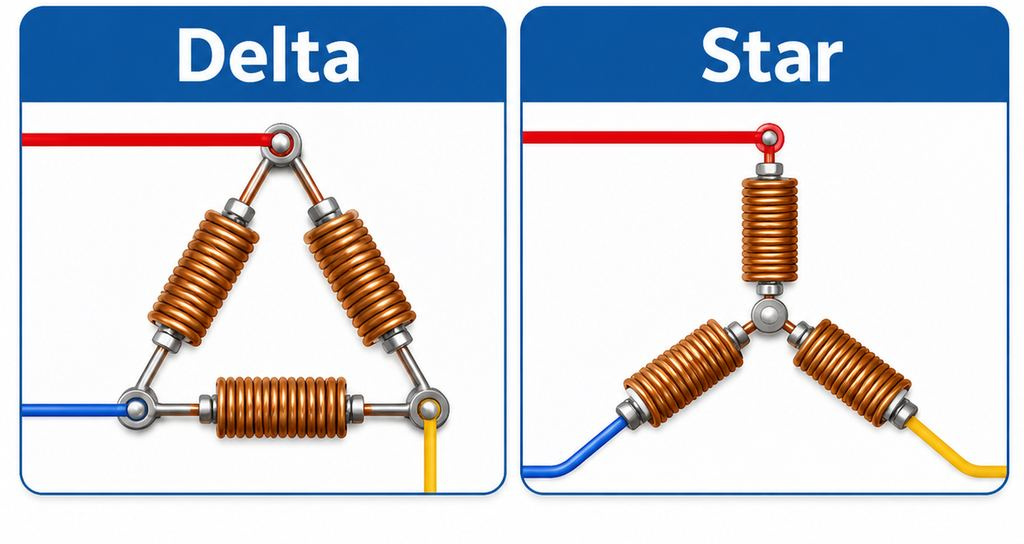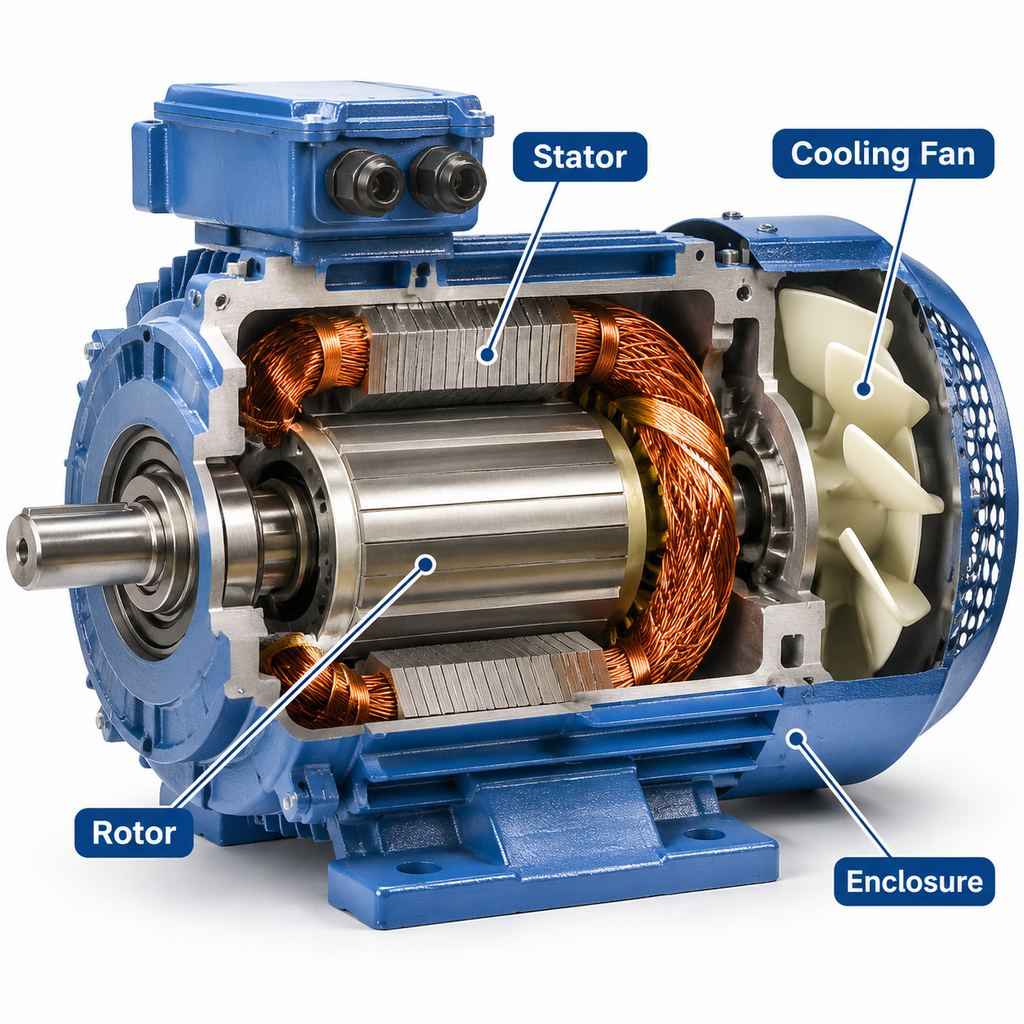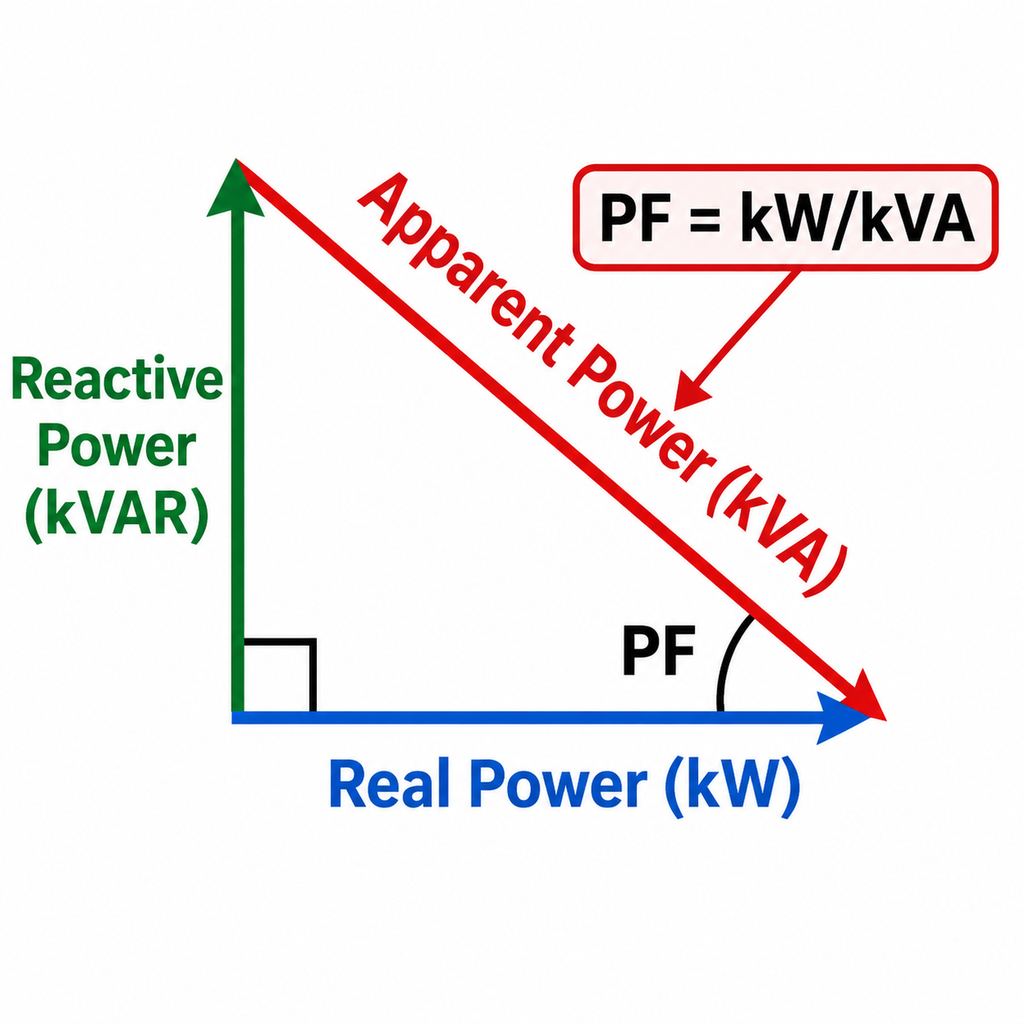
A wound rotor induction motor is used when a machine needs high starting torque with controlled current and a deliberately engineered acceleration sequence—particularly on heavy or high-inertia loads. Crushers, ball mills, cranes and large fans are familiar examples, but the machine name alone does not establish that a slip-ring motor is necessary. The decision depends on the load torque curve, inertia, supply constraints, operating duty and installed equipment.
JWMotor does not manufacture wound rotor or slip-ring motors. This guide explains where they remain useful and how to assess squirrel-cage alternatives. JWMotor options discussed below are alternative motor configurations for an engineered system, not direct replacements guaranteed to match an existing wound-rotor installation.
Construction: Rotor Windings, Slip Rings and External Resistors
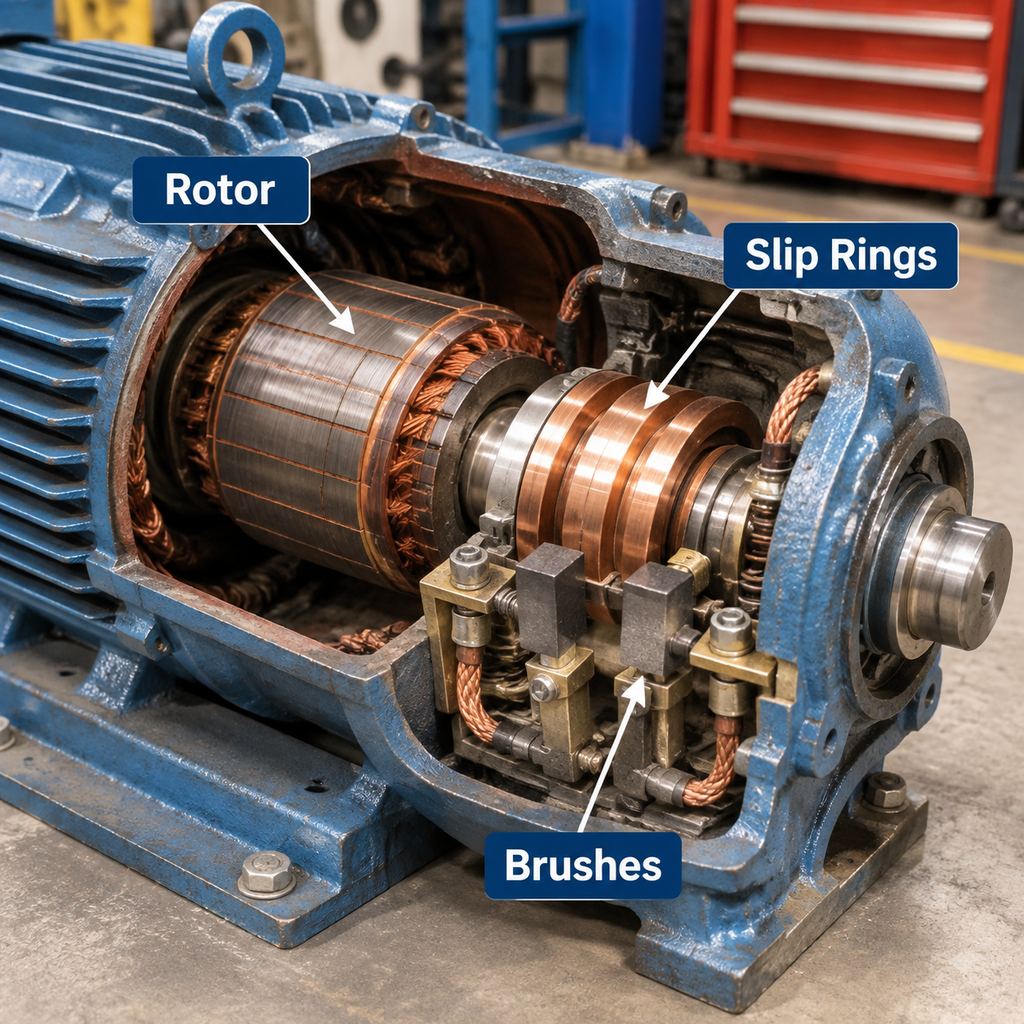
Unlike a squirrel-cage rotor’s bars and end rings, a wound rotor has insulated windings brought out to slip rings. Stationary brushes contact the rings and connect the rotor circuit to an external resistance system. Suitable resistance changes the torque-speed characteristic so substantial starting torque can be obtained while limiting current compared with an equivalent direct-on-line cage-motor start.
The resistance is progressively reduced as the machine accelerates, and is normally shorted out for full-speed running. The resistor bank, switching equipment and motor must all be rated for the actual acceleration energy and frequency of starts. Leaving resistance in circuit can reduce operating speed, but it dissipates slip power as heat and does not provide the efficient, precise regulation associated with a suitable VFD.
The motor remains asynchronous: see slip in an induction motor. For the alternative rotor construction, use the squirrel-cage motor guide; the wider three-phase motor overview places both types in context.
Wound Rotor Induction Motor Applications
| Application | Why a slip-ring motor may fit | What must be checked |
|---|---|---|
| Crushers | High breakaway torque and controlled acceleration where the process permits starting under load | Loaded-start requirements, jams, peak torque and permitted starts |
| Ball mills and grinding equipment | Large inertia and a demanding acceleration duty | Charge condition, torque throughout acceleration and resistor thermal capacity |
| Cranes and hoists | Established systems using rotor-resistance control for demanding starts and load handling | Braking, lowering, reversing, duty cycle and safety requirements—not just starting torque |
| Large fans | Long acceleration of a high-inertia impeller while managing supply demand | Torque-speed curve, acceleration time, cooling and start frequency |
For mining and aggregates, distinguish a difficult start from a need for variable-speed operation throughout production. A machine that only needs controlled acceleration may call for a different solution from one that needs continuous torque control across a wide speed range.
Wound Rotor vs Squirrel Cage Motor
The comparison must include the control package. A bare direct-on-line cage motor, a cage motor with a soft starter and a cage motor with a VFD do not have the same starting or speed-control capability.
| Selection factor | Wound rotor with external resistance | Squirrel cage and appropriate controls |
|---|---|---|
| Starting torque | Can provide high, adjustable torque through engineered rotor resistance | Depends on rotor design and supply; a properly selected VFD can provide controlled torque. A soft starter reduces voltage and therefore available torque. |
| Starting current | Resistance can limit current while maintaining useful starting torque | Direct-on-line current can be substantial; VFD or soft-starter performance must be checked against the load |
| Speed control | Resistance-based control is limited and load-dependent, with energy dissipated in resistors | A VFD offers continuous speed regulation; a soft starter does not |
| Maintenance | Brushes, rings, rotor connections and resistance equipment require attention | No rotor brushes or rings; motor bearings, cooling and electronic controls still need maintenance |
| Cost | More specialized motor and associated equipment; retaining a sound existing package can avoid conversion costs | Often lower motor and maintenance cost, but a large drive, filters, cooling and integration can alter installed cost |
| Efficiency | Continuous resistance speed control wastes slip power; full-speed performance depends on the actual design | Efficient motor options are available; a VFD adds conversion losses but may improve process energy use |
For starting-current background, see what happens to current when an induction motor starts. For the equipment choices rather than their detailed operating principles, see motor controllers.
When a Wound Rotor Is Still the Right Choice
Retaining or procuring a wound-rotor package can be justified where a proven installation already matches the load, its resistor controller is serviceable and specialist maintenance is available. Replacing the motor alone may be less disruptive than redesigning the drive, mechanical interfaces and plant control system.
It can also be justified for a demanding start where a specialist study shows that the wound-rotor system best meets torque, current and acceleration requirements. Verify the motor and resistor thermal duty, repeated-start capability, maintenance access and spares support. High inertia alone is not proof that only this technology will work.
Source an actual wound-rotor requirement from a specialist supplier. JWMotor’s squirrel-cage range should not be presented as fulfilling a specification that explicitly requires rotor windings and slip rings.
When Squirrel Cage + VFD Is Better Value
For a new installation needing continuous speed variation, a suitably selected cage motor and VFD often offer better control and lower routine mechanical maintenance. Removing brushes and slip rings eliminates those wear points, which can improve availability when the rest of the drive system is correctly engineered.
Check torque across the operating speed range, low-speed cooling, acceleration and overload duty, cable and insulation requirements, braking energy and the site supply. The inverter-duty motor guide explains the motor-side considerations. The conclusion should follow a complete quotation and lifecycle assessment, not an assumption that a VFD conversion is always cheaper.
When a Soft Starter Is Enough—and When It Is Not
A soft starter can be an economical choice when the machine runs at fixed speed and only needs a managed start. A YE3 or YE4 motor with a correctly matched soft starter may suit the duty if reduced-voltage torque still exceeds the machine’s load torque throughout acceleration.
A soft starter does not increase a cage motor’s inherent starting torque and does not provide continuous running-speed control. For a heavily loaded crusher or a long mill acceleration, current limiting may leave insufficient torque and prolong heating. Compare the actual motor/load curves and permitted start time before recommending it.
JWMotor Alternatives to Discuss
| Requirement | Option to assess | Important boundary |
|---|---|---|
| Continuous variable-frequency operation | YVF2 with a matched VFD | Confirm torque, cooling and speed range; not a slip-ring motor |
| Fixed-speed operation with controlled acceleration | YE3/YE4 with an appropriately rated soft starter | Must retain adequate starting torque and satisfy thermal limits |
| Stopping/holding for suitable lifting machinery | YEJ brake motor within an engineered hoisting system | Confirm brake duty and safety requirements; no automatic hoist approval or drop-in replacement claim |
Explore the special-purpose motor range and brake motor guide. Brake torque, lowering control and emergency or safety functions must be assessed separately from motor running power.
FAQ
When is a wound rotor induction motor to be used?
When an engineered rotor-resistance system suits a heavy start, restricted current or an existing machine’s requirements better than the alternatives. It is an application decision, not a universal rule for mills, crushers or cranes.
Is a slip-ring motor the same as a wound rotor induction motor?
In this industrial induction-motor context, yes. The term refers to access to the rotor windings through slip rings and brushes; it should not be confused with every rotating electrical machine that happens to use slip rings.
Can a soft starter replace the external resistors?
Not as a direct substitution. A soft starter acts on the stator supply, whereas the resistors change the rotor circuit. Replacing the complete drive requires a torque, acceleration and thermal assessment.
Does JWMotor supply wound rotor motors?
No. JWMotor does not manufacture wound rotor/slip-ring motors. Its options discussed here are squirrel-cage alternatives that require application-specific engineering.
Send the Duty, Not Just the Existing kW
Use the motor selection and RFQ checklist. Include the existing motor and controller details, supply limitations, load torque-speed curve, inertia, required acceleration, starts per hour, operating speed range, braking needs and environment.
For an assessment of a JWMotor squirrel-cage alternative, send those requirements through the inquiry and customization route. State clearly if the original installation is wound rotor; obtain written confirmation of the proposed alternative’s duty and interfaces before changing the system.