
Understanding Inverter Duty Motors
An inverter duty motor is an AC induction motor designed to run from a variable frequency drive (VFD), also called an inverter. A VFD changes motor speed by changing the frequency and voltage it supplies. To do that, it builds its output from fast-switching transistors using pulse width modulation (PWM). That switched waveform puts electrical and thermal stresses on a motor that it would not see on a plain sine-wave utility supply.
A standard general-purpose motor is designed mainly for fixed-speed operation directly on line power. An inverter duty motor keeps the same basic induction-motor principle. It adds design changes so it can handle the voltage spikes, reduced self-cooling, and shaft currents that come with drive operation over a wide speed range. Motors designed for VFD use, such as the YVF2 series variable frequency motors, are an example of this category.
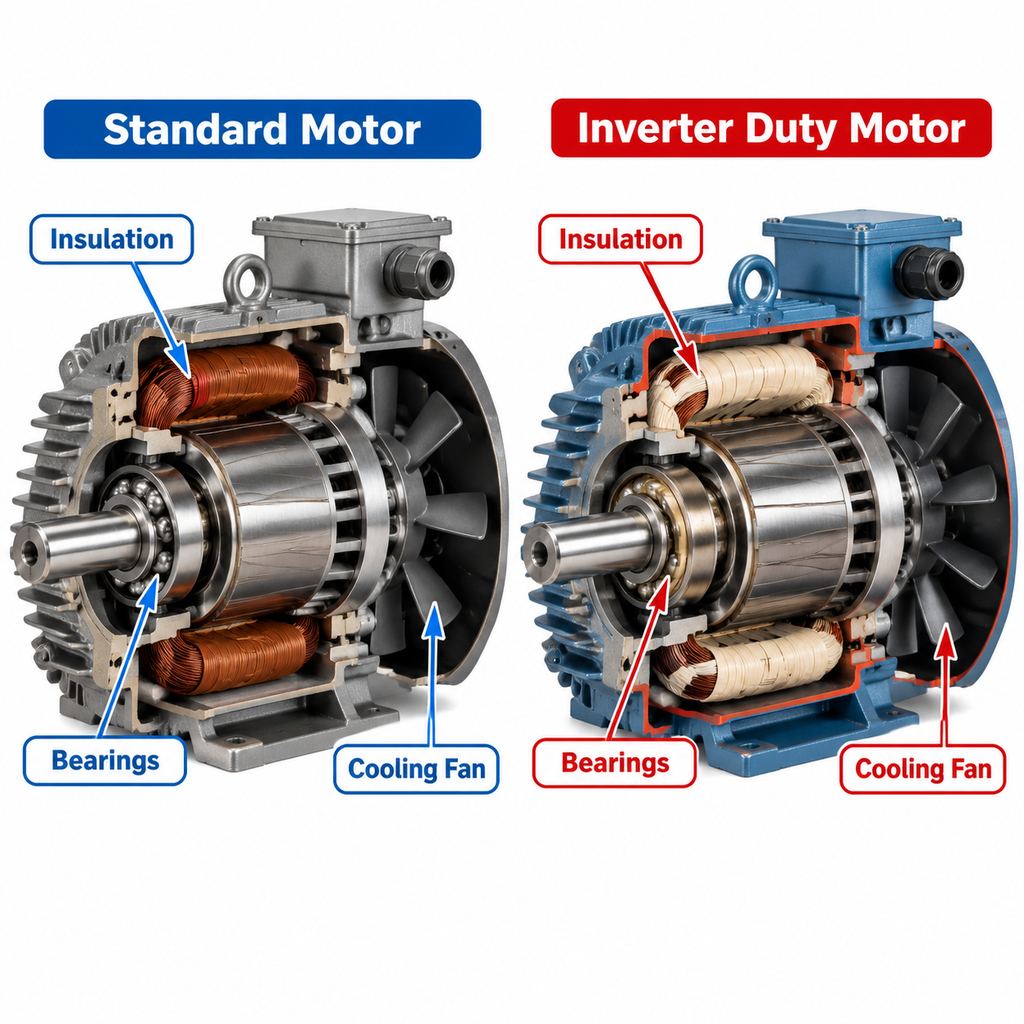
Comparison of standard motor and inverter duty motor cross-sections
How Does a VFD Control Motor Speed?
An induction motor’s speed follows the frequency of its supply. On a 60 Hz supply, a 4-pole motor has a synchronous speed of 1,800 rpm, and it runs slightly slower than that under load because of slip. A VFD works in three stages:
- Rectifier: converts incoming AC to DC.
- DC bus: smooths and stores the DC with capacitors.
- Inverter: switches the DC on and off thousands of times per second (the carrier frequency) to create a variable-frequency, variable-voltage output.
Below base speed, the drive keeps the voltage-to-frequency (V/Hz) ratio roughly constant. This keeps magnetic flux, and therefore available torque, roughly constant. Above base frequency, voltage cannot rise further, so the motor runs in a constant-horsepower region where available torque falls as speed rises. Because a VFD can also take single-phase input and give three-phase output, drives are also used for phase conversion, as explained in how to convert a 3 phase motor to single phase.
Key Features of Inverter Duty Motors
Reinforced insulation for high-frequency voltage spikes
Each PWM pulse has a very fast voltage rise (high dV/dt). Along the cable between drive and motor, impedance mismatch can cause reflected waves, which can push peak voltage at the motor terminals well above the nominal supply, especially with long cable runs. These spikes concentrate on the first turns of the winding and can cause partial discharge that slowly erodes conventional enamel.
Inverter duty designs address this with inverter-grade magnet wire, extra phase-to-phase and slot insulation, and more thorough varnish impregnation. This is different from the thermal insulation class (such as Class F or H). Thermal class rates how hot the winding can run. It does not on its own guarantee resistance to voltage spikes. Many VFD-rated motors combine both. Robust winding insulation also matters in other drive-fed designs, such as brake motors like the YEJ series when they are run on a VFD.
Separately powered (independent) cooling fan
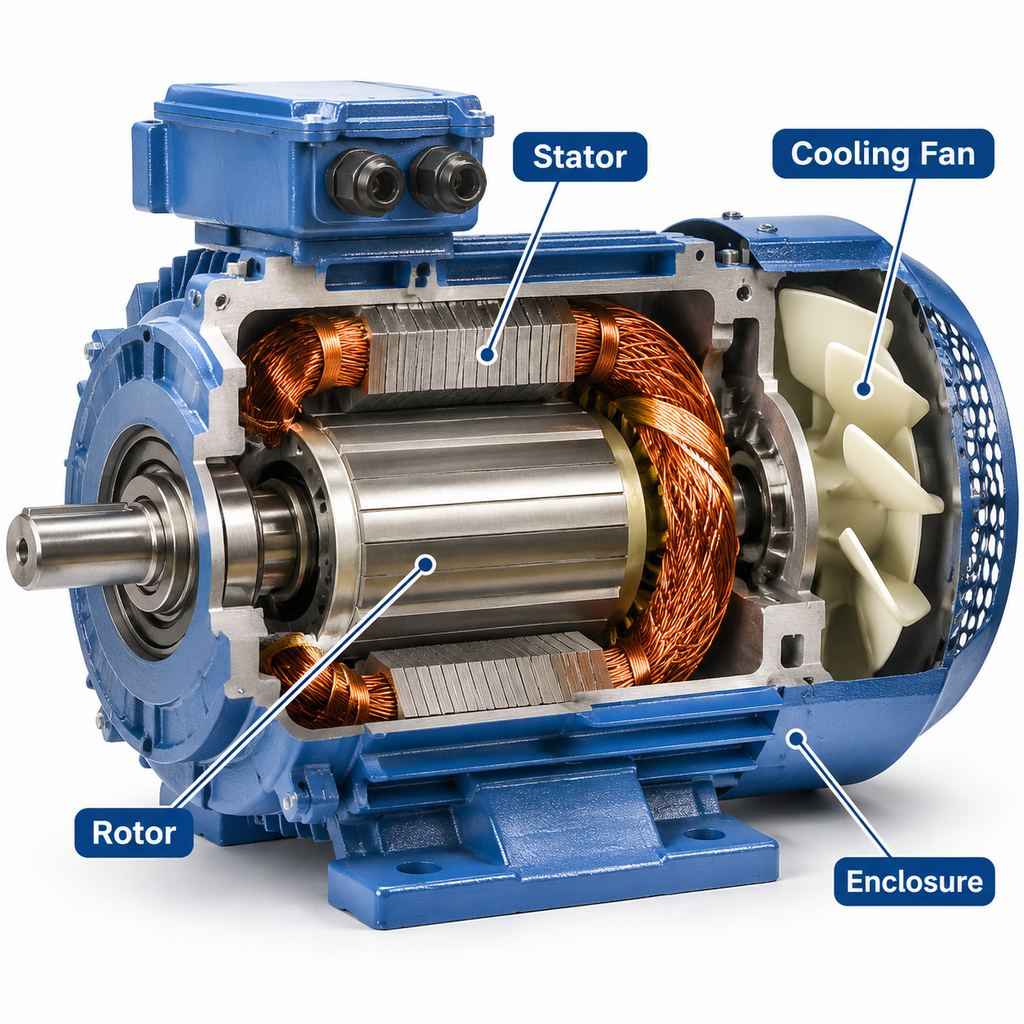
A standard TEFC motor cools itself with a fan mounted on its own shaft. As speed drops, airflow drops sharply, but a constant-torque load still draws close to full current and heats the motor. Many inverter duty motors use a separately powered blower that runs at full speed whatever the shaft speed. This lets the motor deliver rated torque at low speed without overheating. Some designs instead use extra thermal margin (a larger frame or higher insulation class) and are rated for a limited turndown without a blower.
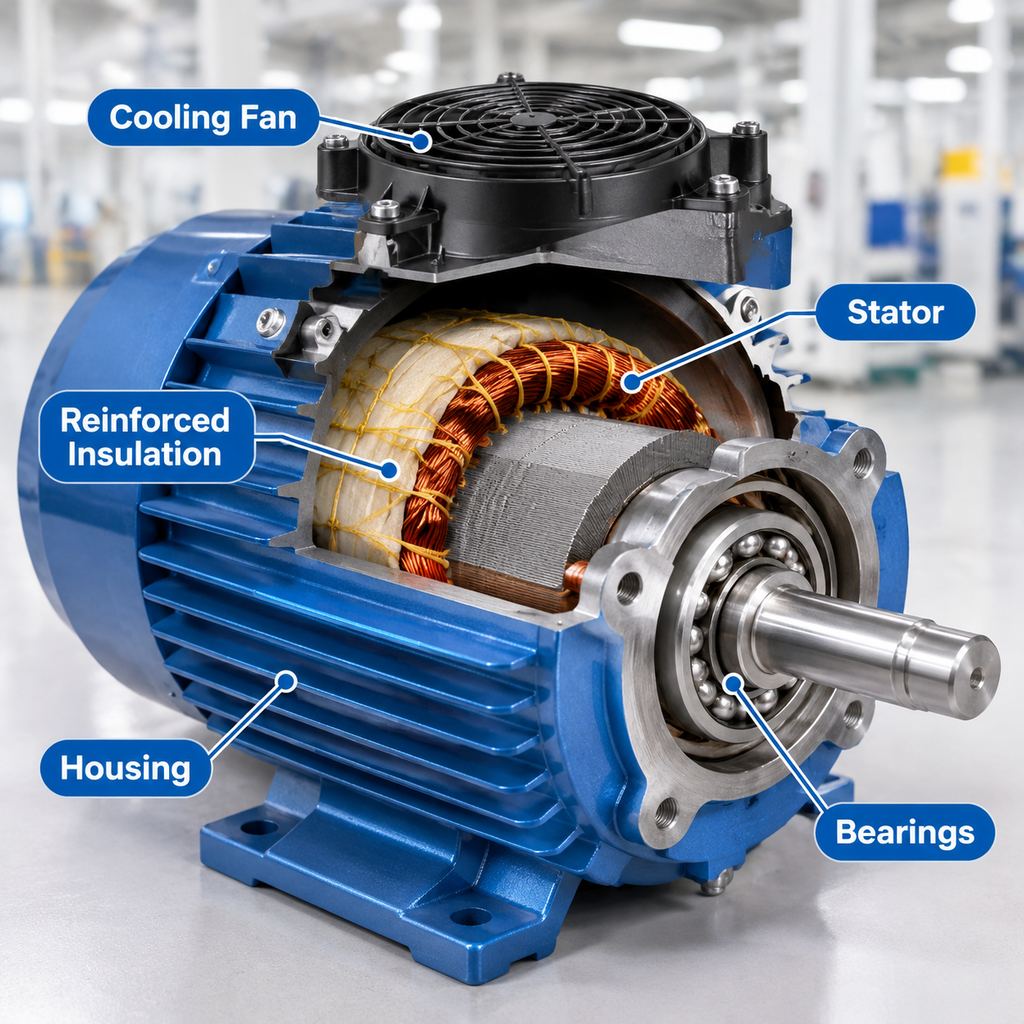
Close-up of inverter duty motor focusing on insulation and cooling fan
Bearing protection against shaft currents
PWM switching creates common-mode voltage that can couple onto the rotor and build up as shaft voltage. When it discharges through the bearing’s lubricant film, it causes electrical discharge machining (EDM). This leaves frosting and fluting on the races, which shows up as noise, vibration, and early bearing failure. Common countermeasures are:
- Insulated bearings or an insulated bearing housing (often on the non-drive end) to break the current path
- Ceramic (hybrid) rolling elements
- Shaft grounding rings or brushes to divert current safely to the frame
- Good installation practice: symmetrical shielded VFD cable and proper grounding and bonding
Constant-torque speed range
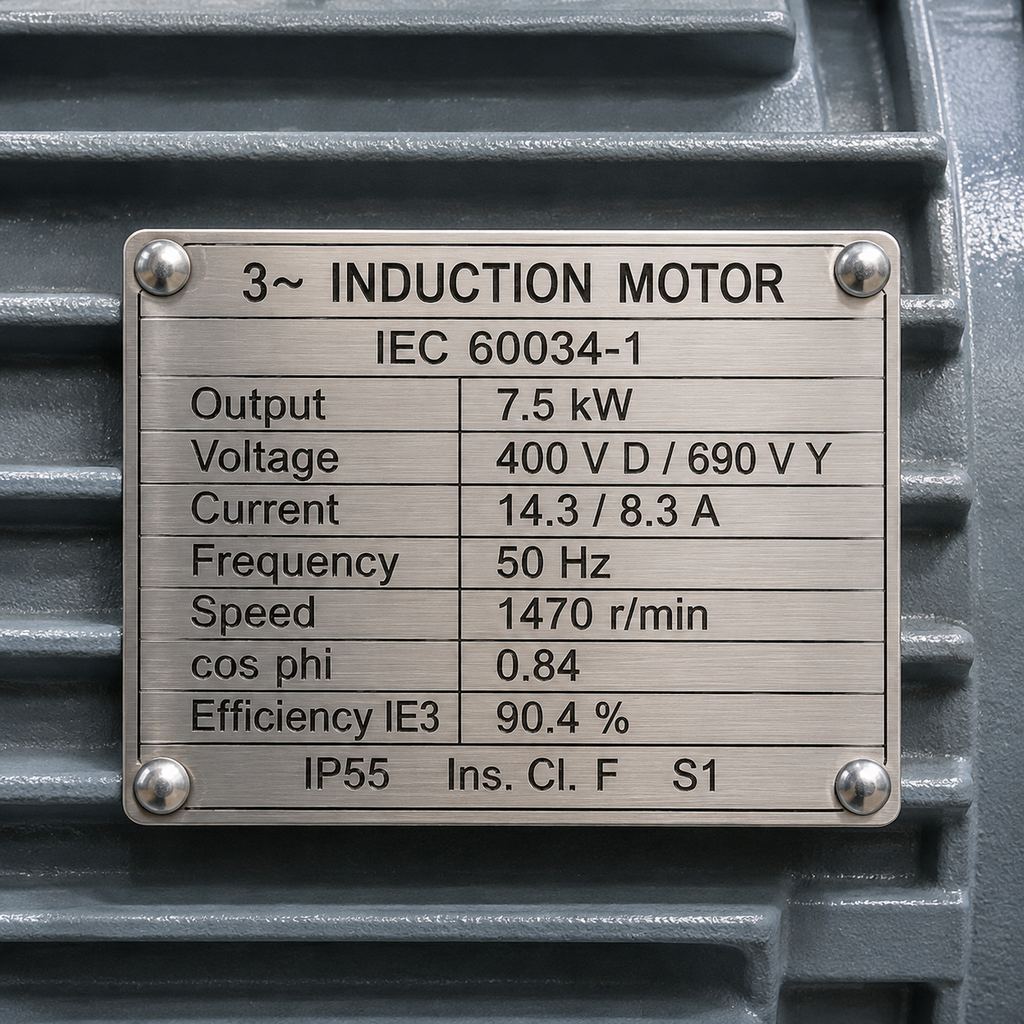
Inverter duty motors are typically rated for a constant-torque speed range, often stated as a turndown ratio such as 10:1 or 20:1, or down to near zero speed with a separate blower. The nameplate or datasheet should state this range. It is the main figure to check against a load that needs full torque at low speed.
Inverter Duty vs. Standard Motors
| Aspect | Standard motor | Inverter duty motor |
|---|---|---|
| Intended supply | Sine-wave line power, fixed speed | PWM output of a VFD, variable speed |
| Winding insulation | Conventional enamel and varnish | Inverter-grade wire, extra phase and slot insulation for voltage spikes |
| Cooling | Shaft-mounted fan; airflow falls with speed | Often a separately powered fan, or extra thermal margin |
| Bearings | Standard bearings | Insulated or hybrid bearings, or shaft grounding options |
| Low-speed torque | Limited by heating at reduced speed | Rated constant-torque range on the nameplate |
Variable Speed Electric Motor Applications
Variable speed operation is common wherever process flow, pressure, or line speed must change with demand:
- Fans and HVAC: fan load torque falls sharply with speed, so motors run cool at low speed. VFD-driven fans in HVAC and ventilation systems are often a moderate duty for the motor.
- Pumps: centrifugal pumps behave much like fans. In water and wastewater plants, VFD pumps hold pressure or level. Still, long cable runs to submersible or remote pumps can make voltage spikes more severe.
- Constant-torque machines: conveyors, extruders, mixers, hoists, and positive-displacement pumps need near-full torque at low speed. This is where independent cooling and a rated constant-torque range matter most.
Applications with unusual mounting, environment, or duty may need special purpose motors built for both the drive and the conditions.
Variable Speed Motor Selection: When a Standard Motor with a VFD Is Enough
A standard motor is often acceptable on a VFD when all of these are true:
- The load is variable torque (centrifugal fan or pump), so torque and heating fall as speed drops.
- The speed range is modest. For example, the motor rarely runs far below base speed for long.
- The cable between drive and motor is short, and the supply voltage is lower (for example, 230 V or 460 V, not 575 V or higher).
- The motor’s manufacturer confirms it is suitable for VFD use. In the US, NEMA MG 1 Part 31 sets the voltage-spike and performance criteria for definite-purpose inverter-fed motors, and many general-purpose motors list a VFD-compatible speed range.
A load reactor or dV/dt filter at the drive output, a lower carrier frequency, and shaft grounding can also make an existing standard motor more tolerant of VFD operation. An inverter duty motor is the safer choice for constant-torque loads at low speed, long cable runs, higher supply voltages, or critical equipment where an unplanned failure is costly.
Frequently Asked Questions about Inverter Duty Motors
What is the purpose of an inverter?
In motor control, an inverter (the output stage of a VFD) converts DC into AC of adjustable frequency and voltage. This lets a motor run at variable speed and torque instead of a single fixed speed.
What is the difference between constant torque and variable torque?
A constant-torque load, such as a conveyor or extruder, needs roughly the same torque at every speed. A variable-torque load, such as a centrifugal fan or pump, needs torque that falls sharply as speed drops. Constant-torque loads are harder on a motor’s cooling at low speed.
Can I run a standard motor on a VFD?
Often yes, especially for fan and pump loads over a moderate speed range with short cables. Check the manufacturer’s VFD rating, and consider output filtering and bearing protection.
Do inverter duty motors need a special cable?
They do not strictly need one, but symmetrical shielded VFD cable with proper grounding reduces voltage reflections and common-mode currents. This protects both the insulation and the bearings.


4 thoughts on “What Is an Inverter Duty Motor?”