
Understanding AC Motor Testing
Testing an AC motor is a critical step in ensuring its proper function and diagnosing potential issues before failures occur. Whether for a new installation, routine maintenance, or troubleshooting a malfunction, accurate testing not only verifies the motor’s health but also prevents costly downtime and equipment damage. A digital multimeter is an essential tool in this process, allowing engineers to measure key parameters like resistance, voltage, and continuity. These basic tests can reveal issues such as winding errors, short circuits, or open circuits. As an accessible, easy-to-use device, the multimeter is a trusted companion for technicians and maintenance teams, bridging the gap between complex diagnostic tools and practical fieldwork. Understanding how to effectively utilize a multimeter for AC motor testing is foundational for ensuring system reliability and operational efficiency.

Technician testing an AC motor with a digital multimeter in a workshop.
Step-by-Step Guide to Testing an AC Motor with a Multimeter
- Disconnect the motor from its power supply and ensure that no live voltage is present. Use your multimeter to verify zero voltage before proceeding with tests to ensure safety.
- Set the multimeter to measure resistance (ohms) and prepare it for testing the motor windings. Typically, this involves selecting the “Ω” symbol on the multimeter and testing its functionality by touching the probes together to confirm a stable reading.
- Test the motor windings by measuring the resistance between the three leads (for three-phase motors, typically labeled U, V, and W). Each pair should show consistent resistance values within the manufacturer’s specifications. Significant deviations could indicate an internal fault such as a short circuit or open winding.
- Inspect the insulation by conducting a winding-to-ground test. Set the multimeter to its highest resistance range and check between each winding terminal and the motor’s frame or grounding point. If the resistance is below 1 MΩ, there may be insulation degradation or damage.
- Perform a continuity test to ensure that connectivity exists between the windings and terminals. Switch the multimeter to the continuity setting, if available, and check that the device beeps or displays continuity between appropriate connections. Absence of continuity indicates a broken connection.
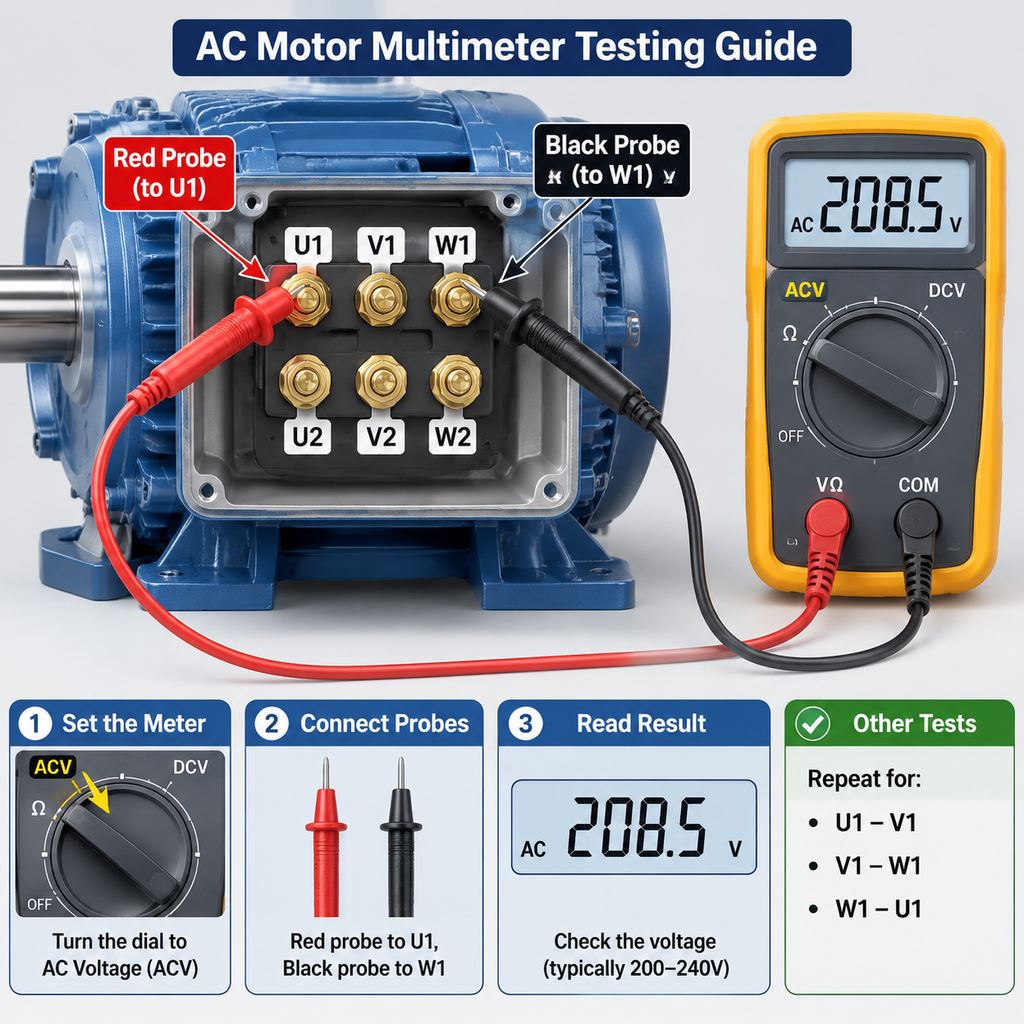
Diagram showing multimeter probe positions on motor terminals.
Common Issues Revealed by Testing
By testing an AC motor with a multimeter, engineers can uncover a range of common issues that compromise motor performance or even lead to complete failure if left unchecked. One frequent problem is winding failures, where the motor’s internal coils either short or break, disrupting the magnetic fields needed for proper operation. During resistance tests, uneven readings between the motor’s winding leads—such as unexpected zero or infinite values—often point to such faults.
Insulation breakdown is another critical issue. The insulation separating the windings or between the windings and the motor frame can degrade over time due to heat, contamination, or mechanical stress. A winding-to-ground test with a multimeter can detect this, showing low resistance where high levels are expected, which signifies leakage paths that endanger the safety of the motor and connected equipment.
Additionally, phase imbalance might be revealed. For three-phase motors, imbalanced resistance readings between phases could indicate improper wiring or internal damage, which could lead to reduced efficiency and overheating.
By identifying these issues early, multimeter testing serves as a preventive measure, minimizing costly repairs or downtime, and ensuring the motor operates within its intended electrical and mechanical specifications.
Frequently Asked Questions
What does testing an AC motor with a multimeter reveal?
Multimeter tests can reveal issues such as winding faults, insulation breakdown, or phase imbalances. These problems can lead to motor inefficiency, overheating, or catastrophic failure if not addressed. Resistance, continuity, and ground tests offer valuable insights about the motor’s health.
How do I ensure safety when testing an AC motor?
Before testing, disconnect the motor from its power source and verify that no live voltage is present. Use the multimeter to confirm zero voltage and follow proper lockout-tagout procedures to prevent accidental energization.
What resistance values are considered normal during motor winding tests?
For three-phase motors, the resistance between winding leads (e.g., U-V, V-W, W-U) should be nearly identical and within the manufacturer’s specifications. Significant deviations may indicate winding shorts or breakages.
Safety Precautions When Testing AC Motors
When testing an AC motor with a multimeter, safety must always be the primary consideration. Begin by ensuring the motor is completely disconnected from its power source. Verify zero voltage at the terminals using the multimeter before proceeding with any tests. This step prevents accidental shocks or equipment damage.
Always adhere to lockout/tagout procedures to isolate the motor from live circuits securely. This practice is crucial in industrial settings where multiple systems may share the same power source.
Wear appropriate personal protective equipment (PPE), such as insulated gloves and safety glasses, especially when working near energized components or high-voltage motors. Additionally, confirm that the multimeter being used is rated for the voltage and current expected in the motor tests.
Remember, testing should never be conducted in wet or humid environments to reduce the risk of electrical hazards. These precautions ensure a safe and effective testing process, protecting both personnel and equipment.
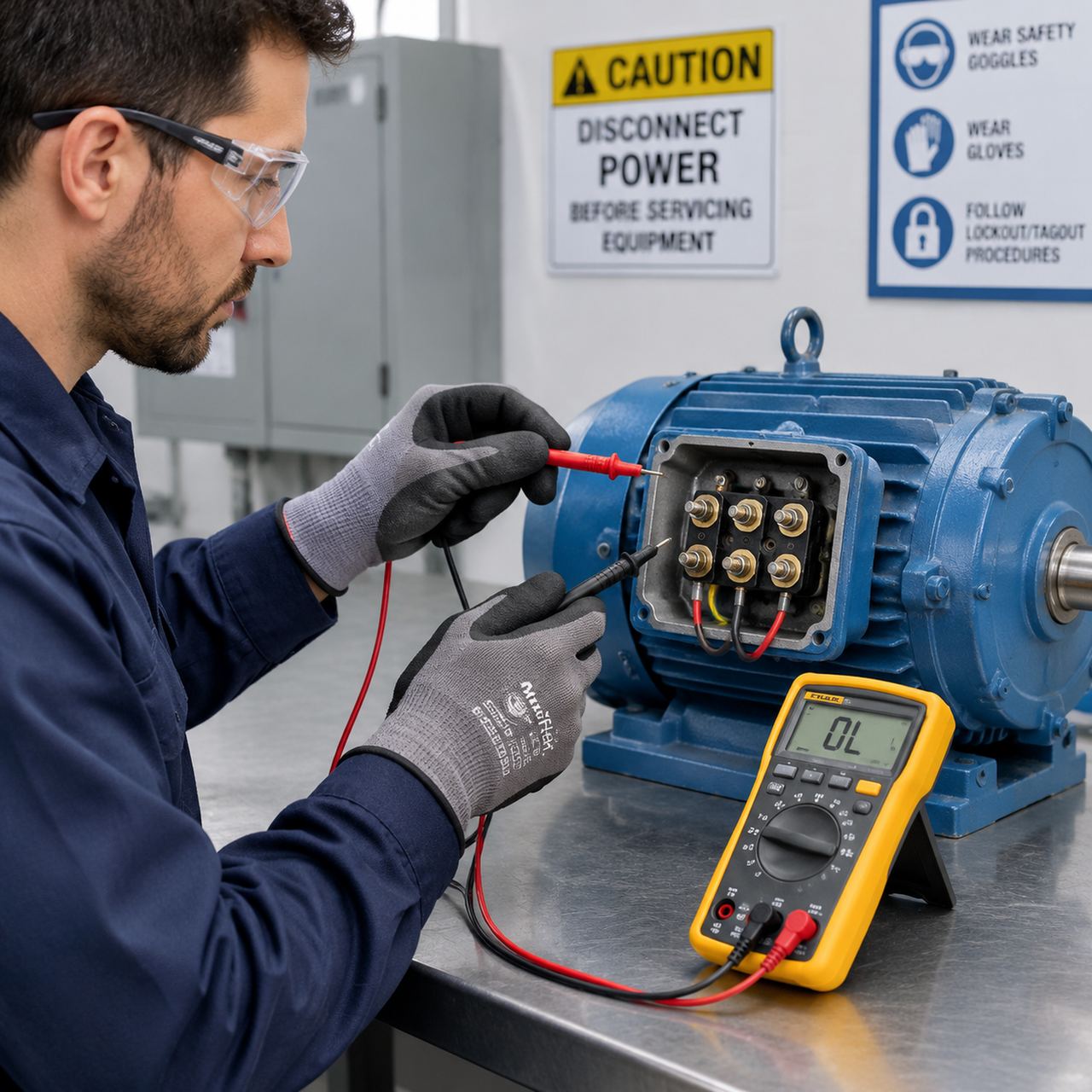
Technician in safety gear testing a motor with a multimeter.
Key Specifications and Features of Multimeters
- True RMS capability: Essential for accurately measuring AC signals, including non-linear waveforms often seen in variable frequency drives (VFDs) used with AC motors.
- Wide measurement ranges: Ensure the multimeter supports adequate voltage, current, and resistance ranges to accommodate the specifications of your AC motor and its application.
- Insulation resistance testing: A built-in high-resistance measurement feature (megohms range) is critical for conducting winding-to-ground tests to detect insulation failures.
- Auto-ranging functionality: Simplifies the operation of the multimeter by automatically selecting the appropriate range for a given measurement.
- Durability and safety certification: Choose a multimeter with a CAT III or CAT IV safety rating to withstand the potentially high electrical transients encountered during motor testing.
Comparison of Multimeters Suitable for AC Motor Testing
Selecting the right multimeter for AC motor testing involves considering key features such as True RMS capability for accurate waveform measurements, appropriate voltage and resistance ranges, and robust safety ratings like CAT III or CAT IV. This comparison highlights three versatile models—Fluke 179, Klein Tools MM450, and UNI-T UT61E. Each offers distinct advantages: the Fluke 179 excels in precision and durability, the Klein Tools MM450 is user-friendly with auto-ranging and data hold features, while the UNI-T UT61E combines affordability with advanced graphing functions. Engineers should match the device to the specific requirements of their motor tests, prioritizing safety and functionality.
| Feature | Option A | Option B | Option C |
|---|---|---|---|
| True RMS Capability | Fluke 179 | Klein Tools MM450 | UNI-T UT61E |
| Voltage Measurement Range | 600V AC/DC | 1000V AC/DC | 750V AC / 1000V DC |
| Resistance Testing Range | Up to 50MΩ | Up to 40MΩ | Up to 20MΩ |
| Safety Rating | CAT IV 600V, CAT III 1000V | CAT III 1000V | CAT IV 600V |
| Special Features | Temperature measurement, backlight display | Auto-ranging, data hold feature | PC connectivity, advanced graphing functions |
| Price Range | $250-$300 | $150-$200 | $100-$150 |





1 thought on “Testing Procedures for AC Motors Using a Multimeter”