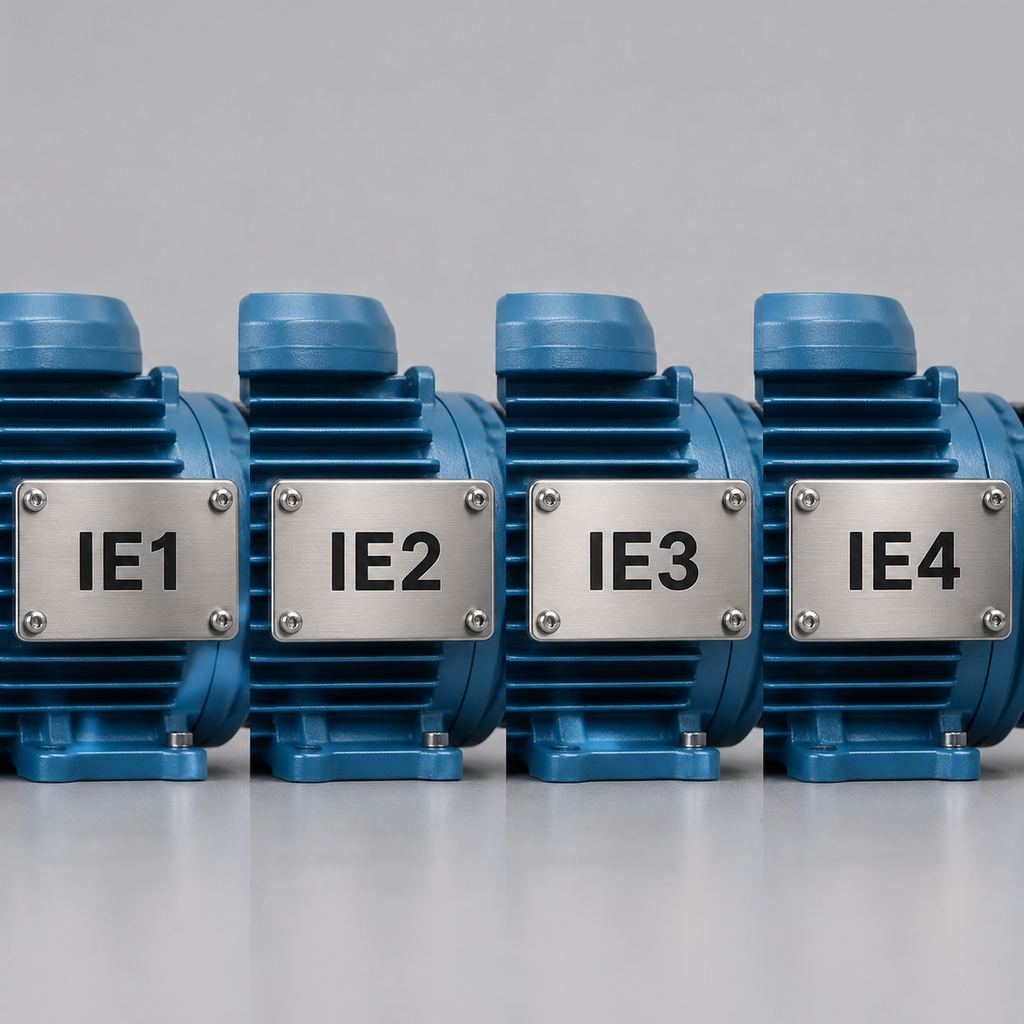
IE1 is the Standard Efficiency class in IEC 60034-30-1, the international scheme that rates line-operated AC motors by efficiency. It is the lowest of the four classes most buyers meet: IE1 Standard, IE2 High, IE3 Premium and IE4 Super Premium. IE1 is not one fixed percentage. Each class sets a minimum efficiency at rated output, voltage and frequency, and that minimum depends on the motor’s kW rating and pole count.
For a buyer, the practical point is that IE1 is no longer a legal choice for new in-scope motors in the major markets, and in the EU and UK most new IE2 motors from 0.75 kW up are now out as well. This article explains what IE1 means, which regulations removed it, what that means for replacements and exports, how to recognise an IE1 motor from its nameplate, and how to estimate the payback of replacing one. The class-by-class product comparison and the efficiency formula are covered in existing articles: IE2 vs IE3 vs IE4 motors, a comparative analysis of IE2, IE3 and IE4, how to determine motor efficiency and IEC motor standards and specifications. They are not repeated here.
Where IE1 Sits on the IE Scale
| Class | IEC name | Position |
|---|---|---|
| IE1 | Standard Efficiency | Lowest common class; no longer a legal new-motor choice for most in-scope ratings in the markets below |
| IE2 | High Efficiency | Still the minimum for some smaller ratings and special cases; no longer the general minimum for 0.75–1000 kW in the EU and UK |
| IE3 | Premium Efficiency | The general minimum for many three-phase industrial motors in the EU, UK and China |
| IE4 | Super Premium Efficiency | Required in the EU and UK for some 75–200 kW motors since July 2023 |
Moving up a class means lower losses at the same output. The size of the step is set by the IEC tables for each kW and pole number; this article does not list or estimate those figures.
Why IE1—and Now IE2—Motors Are Being Phased Out
Governments set minimum energy performance standards (MEPS) by reference to the IE classes. As those minimums rose, IE1 dropped out first. In the EU and UK the general minimum for 0.75 kW and above has now passed IE2 as well.
European Union: Regulation (EU) 2019/1781
Commission Regulation (EU) 2019/1781 has applied since 1 July 2021 and replaced the earlier Regulation (EC) 640/2009. Its main motor requirements are:
- From 1 July 2021: three-phase motors of 0.75 kW to 1000 kW with 2, 4, 6 or 8 poles, other than Ex eb increased-safety motors, must meet at least IE3. Three-phase motors of 0.12 kW to below 0.75 kW (same poles, not Ex eb) must meet at least IE2.
- From 1 July 2023: Ex eb increased-safety motors of 0.12–1000 kW, and single-phase motors of 0.12 kW and above, must meet at least IE2. Three-phase motors of 75 kW to 200 kW with 2, 4 or 6 poles that are not brake motors, Ex eb or other explosion-protected motors must meet at least IE4.
Under the earlier Regulation 640/2009, an IE2 motor in the 0.75–375 kW range could be used if it was operated with a variable speed drive. That alternative was not carried into 2019/1781: for an in-scope 0.75–1000 kW three-phase motor, adding a VFD does not make a new IE2 motor compliant. The regulation also lists exemptions—for example, certain motors fully integrated into a product, motors designed to run wholly immersed in liquid, some extreme-ambient designs, and motors specifically marketed as spare parts within defined conditions. Check the regulation text before relying on an exemption. The European Commission’s product page summarises the same steps.
United Kingdom
Great Britain applies the same dates and levels through Schedule 16 of the Ecodesign for Energy-Related Products and Energy Information Regulations 2021: IE3 for 0.75–1000 kW three-phase motors from 1 July 2021, and IE4 for the 75–200 kW range from 1 July 2023, with similar exclusions.
United States: DOE rules and NEMA Premium
The US Department of Energy sets motor standards in 10 CFR 431.25. For most covered NEMA Design A and B motors (and equivalent IEC Design N motors) rated 1 hp through 500 hp and manufactured on or after 1 June 2016, the nominal full-load efficiencies are at the NEMA Premium level, which is widely compared with IE3. DOE has also adopted amended standards that apply from 1 June 2027 and raise some ratings, including Design A/B motors from 100 hp to 250 hp, to a Super Premium/IE4-equivalent level. US tables are in horsepower at 60 Hz, so check the current CFR rather than converting from an IEC table.
China: GB 18613-2020
GB 18613-2020 has been in force since 1 June 2021 and replaced GB 18613-2012. It uses its own grades (Grade 1 highest, Grade 3 the minimum allowable). For in-scope three-phase asynchronous motors, the Grade 3 minimum is aligned with IE3, which removed IE2 as the minimum for those motors.
Other markets
- Turkey transposed Regulation 2019/1781 through communiqué SGM 2021/16 (Official Gazette, April 2021). Confirm the current text before export.
- Australia regulates three-phase cage induction motors from 0.73 kW to below 185 kW (up to 1100 V, 2, 4, 6 or 8 poles) under the GEMS (Three Phase Cage Induction Motors) Determination 2019. The Determination sets a MEPS level and a separate “high efficiency” level; check its Schedule 1 tables for the exact class required.
- India uses the IE classes through IS 12615. Check the current Bureau of Indian Standards and Bureau of Energy Efficiency requirements for the rating and application; this article does not state a mandatory date.
What This Means for Buyers
Existing motors. These regulations control motors placed on the market or put into service. An IE1 motor that is already installed can generally keep running and be repaired. The question comes up when it fails or the line is rebuilt.
Replacements. A like-for-like IE1 replacement is generally not available as a new in-scope motor in these markets. In the EU and UK the replacement for most 0.75–1000 kW three-phase motors has to be at least IE3, and for 75–200 kW (2, 4 or 6 poles, outside the listed exclusions) at least IE4. A higher-class motor may be slightly longer, so check the IEC frame size, shaft height, mounting dimensions and coupling before ordering.
Exports and machine builders. The motor must meet the rules of the destination market, including when it is built into a pump, fan or machine. Do not ship a stock IE2 motor to an EU or UK customer for a 0.75–1000 kW duty and assume a VFD will make it compliant. Where IE2 is still the minimum—for example for some ratings below 0.75 kW in the EU and UK, or in a market whose MEPS is still IE2—confirm that before quoting.
How to Tell an IE1 Motor From Its Nameplate
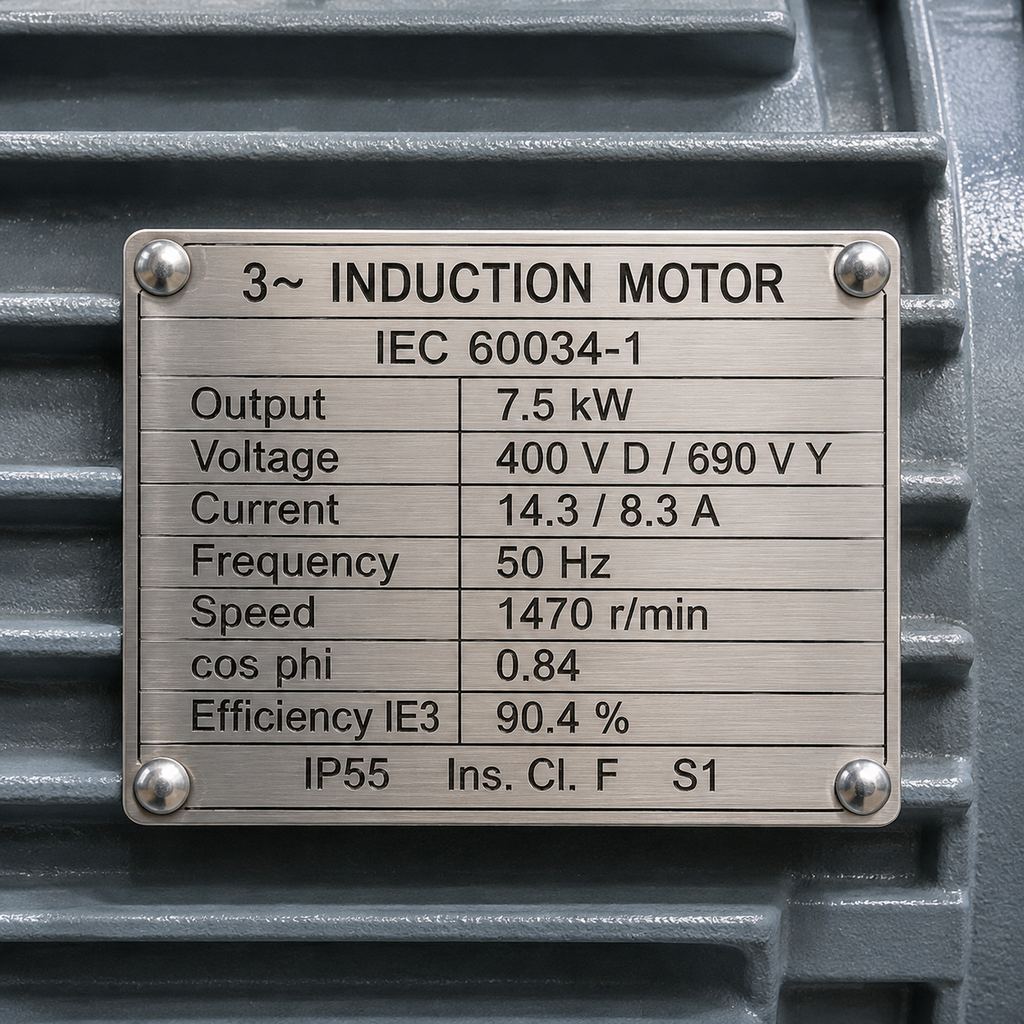
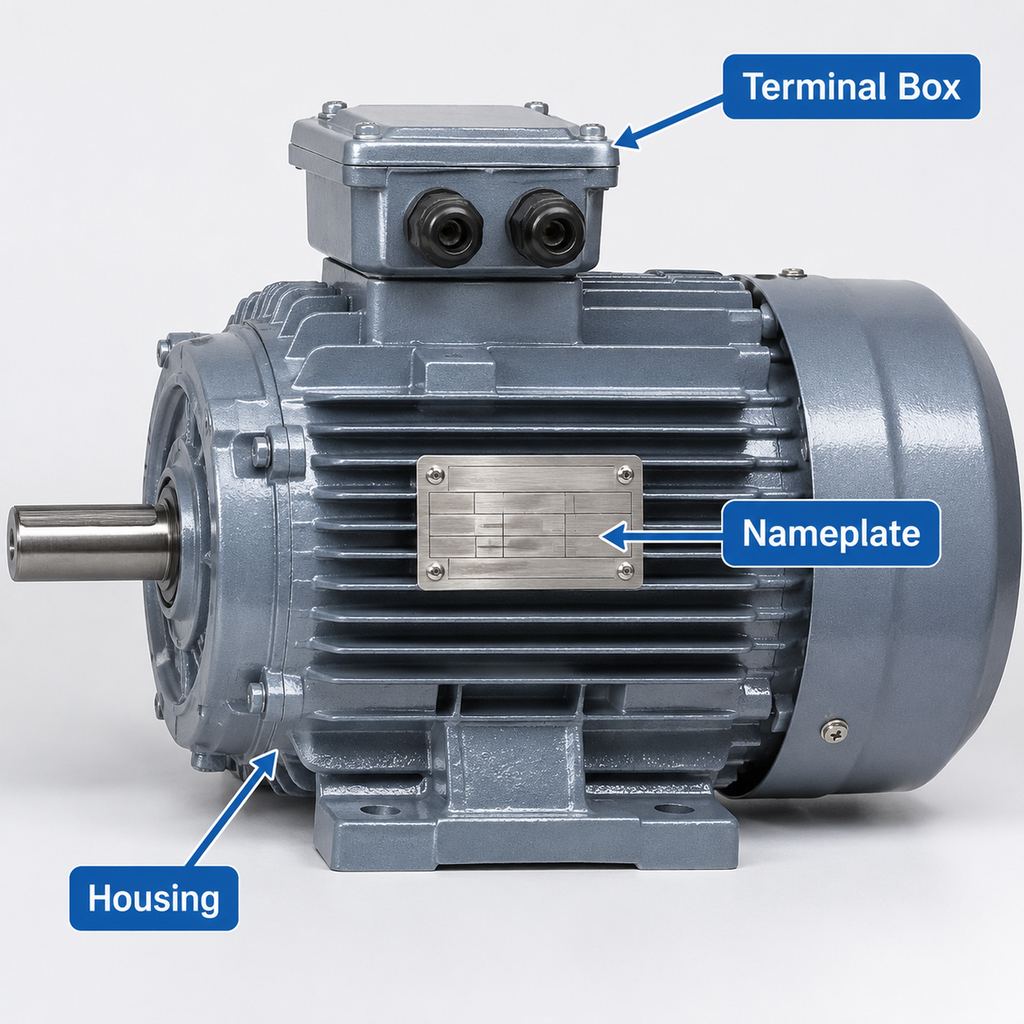
Since the IE codes came into use, the class has been marked on the rating plate.
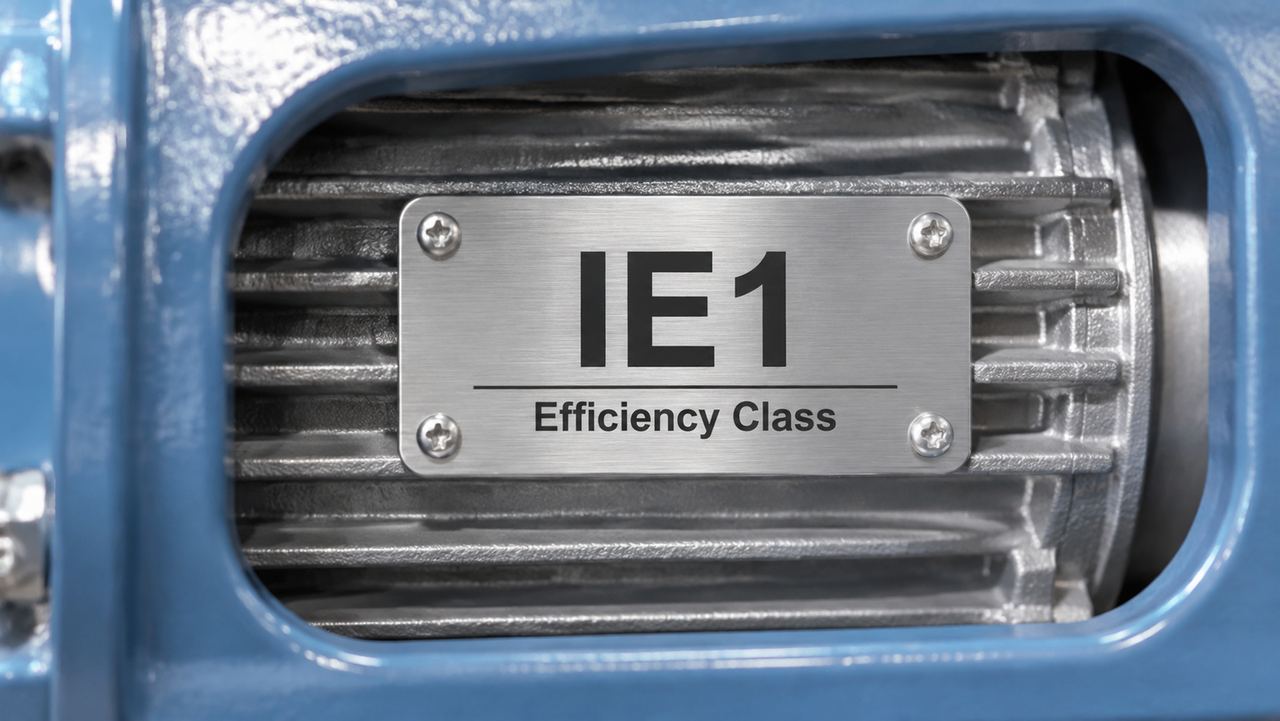
Look for:
- An IE code—“IE1”, “IE2”, “IE3” or “IE4”—on or near the plate
- The rated efficiency (η) at full load, which in the EU and UK must also be shown at 75% and 50% load on the technical documentation, and is often marked on the plate
- The year of manufacture, which the EU and UK rules require on or near the plate
Older European motors may carry the earlier CEMEP marks instead of an IE code; EFF2 is commonly treated as roughly equivalent to IE1. Some old plates show only a percentage. If there is no class mark, compare the rated efficiency with the IEC table for that kW and pole count, or ask the manufacturer. Do not assume a motor is IE1 from its age or colour alone.
Payback From Upgrading an IE1 Motor to YE3 or YE4
The saving comes from lower losses for the same shaft output. A simple estimate is:
Annual energy saved (kWh) ≈ shaft output (kW) × operating hours × (1/ηold − 1/ηnew)
Multiply by your electricity tariff to get the annual cost saving, then divide the extra installed cost of the new motor (including any frame or coupling changes) by that saving to get a simple payback. Use the actual load and hours: a motor running long hours near rated load pays back faster than one that runs briefly or lightly loaded. Field measurement and the effect of part load are covered in how to determine motor efficiency. This article gives no generic payback figure or saving percentage because both depend on the site.
FAQ
What is IE1?
IE1 is the Standard Efficiency class in IEC 60034-30-1, the lowest of the IE1–IE4 classes. The minimum efficiency it represents depends on the motor’s kW rating and number of poles.
Can I still buy a new IE1 motor?
Not for in-scope motors in the EU, UK, US (at the DOE-covered ratings), China or other markets with an IE2 or higher MEPS. Narrow exemptions exist; check the regulation for your market.
Is IE2 still allowed in the EU?
For most three-phase motors from 0.75 kW to 1000 kW, no—the minimum is IE3 and, for 75–200 kW with 2, 4 or 6 poles outside the exclusions, IE4. IE2 remains the minimum for some smaller ratings and listed categories.
Does an IE2 motor become compliant if it runs on a VFD?
That was a route under the earlier EU Regulation 640/2009. It is not part of the current 2019/1781 requirements for 0.75–1000 kW three-phase motors.
Replacing IE1 Motors
For a replacement or new line, the YE3 (IE3) and YE4 (IE4) cast-iron series are the usual starting point, listed under general-purpose motors. Choose YE4 where the rules require IE4 (for example 75–200 kW, 2, 4 or 6 poles in the EU and UK) or where the payback supports it. The Y2 (IE2) series is only relevant where IE2 is still legal for the rating and market. For non-standard frames, voltages or shafts, see customization or all products.