
Motor service factor (SF) is a multiplier on the nameplate rated power. Under the conditions stated for that service factor, the motor may be loaded up to rated power × SF. A 10 hp motor with SF 1.15, for example, is thermally capable of 11.5 hp under those conditions—not a free upgrade to a larger continuous rating.
For pumps, fans and compressors, buyers and plant maintenance often treat SF as “extra horsepower.” That habit shortens insulation and bearing life when the margin is used every day. This guide covers how to read SF and SFA on the nameplate, common values (1.0 / 1.15 / 1.25), when the margin is useful, when to size up instead, and how ambient temperature and altitude eat into the reserve. It is not a deep dive into starting current, induction theory, wiring or megger testing.
For locating SF among other plate data, see how to read an electric motor nameplate. Cast-iron continuous-duty frames such as YE3 / YE4 / Y2 general-purpose motors are typically ordered with SF by frame or project requirement.
What Motor Service Factor Means
Industry practice (NEMA MG 1 style wording) defines service factor as a multiplier which, when applied to rated power, indicates a permissible power loading under the conditions specified for that service factor. Those “normal” conditions usually assume rated voltage and frequency, about 40 °C ambient, and altitude up to roughly 1,000 m (3,300 ft), unless the maker states otherwise.
SF is therefore a thermal capability statement, not a guarantee of unchanged efficiency, power factor, speed or life at the higher load. Running above 1.0 SF raises winding temperature. As a rule of thumb, about every 10 °C of extra hot-spot temperature roughly halves insulation life. Bearing life also suffers from higher heat and load. That is why SF should not be treated as continuous design capacity for a steady process duty.
- Short-time / occasional overload within SF, under nameplate conditions: the intended use of the margin (plus a buffer for mild voltage dip or warm days when the motor is otherwise at rated load).
- Long-term load above nameplate inside the SF band: allowed thermally in the short sense, but life expectancy drops versus continuous rated load.
- Above SF, or SF used when ambient/altitude/voltage are already off-nameplate: do not count on the published margin; derate or choose a larger motor.
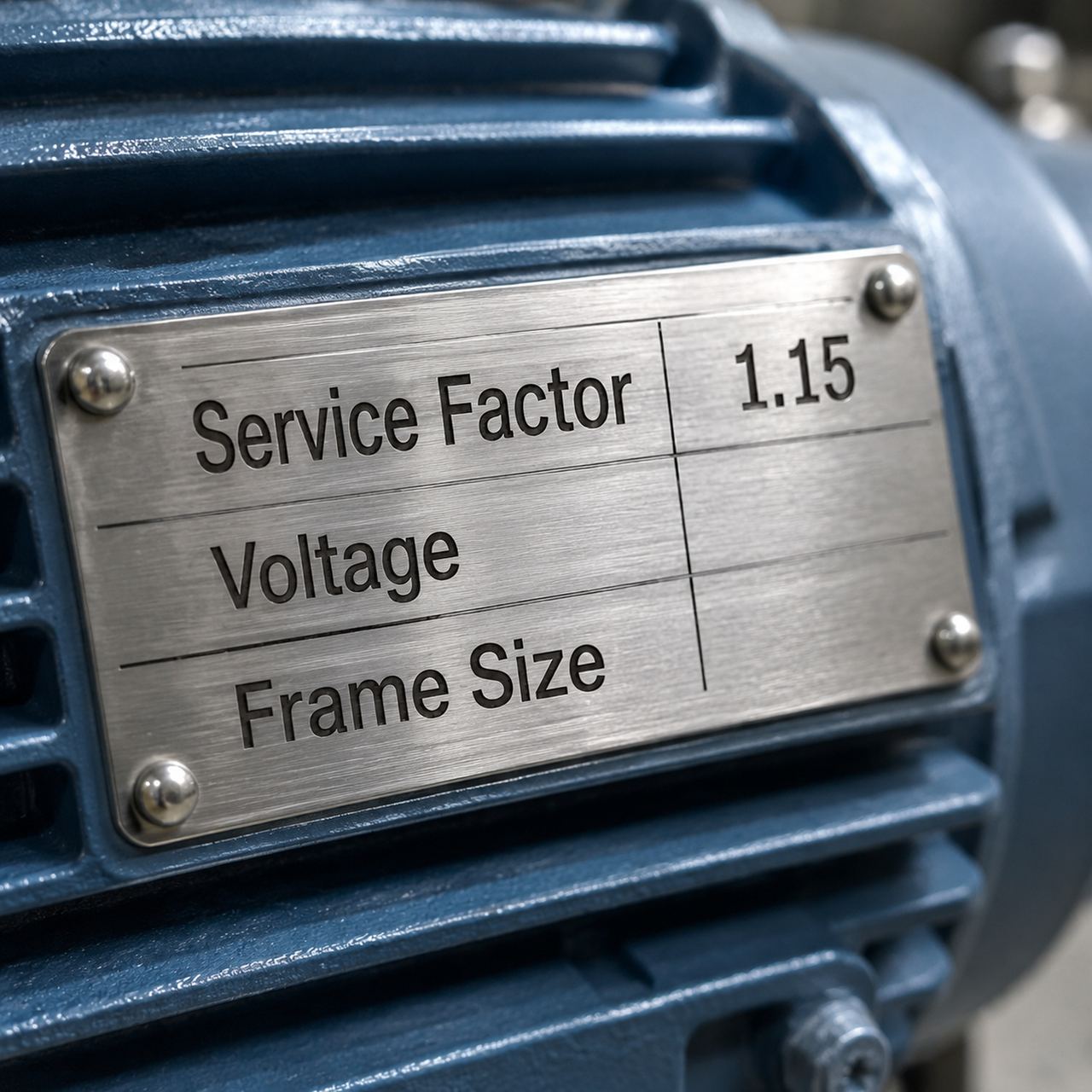
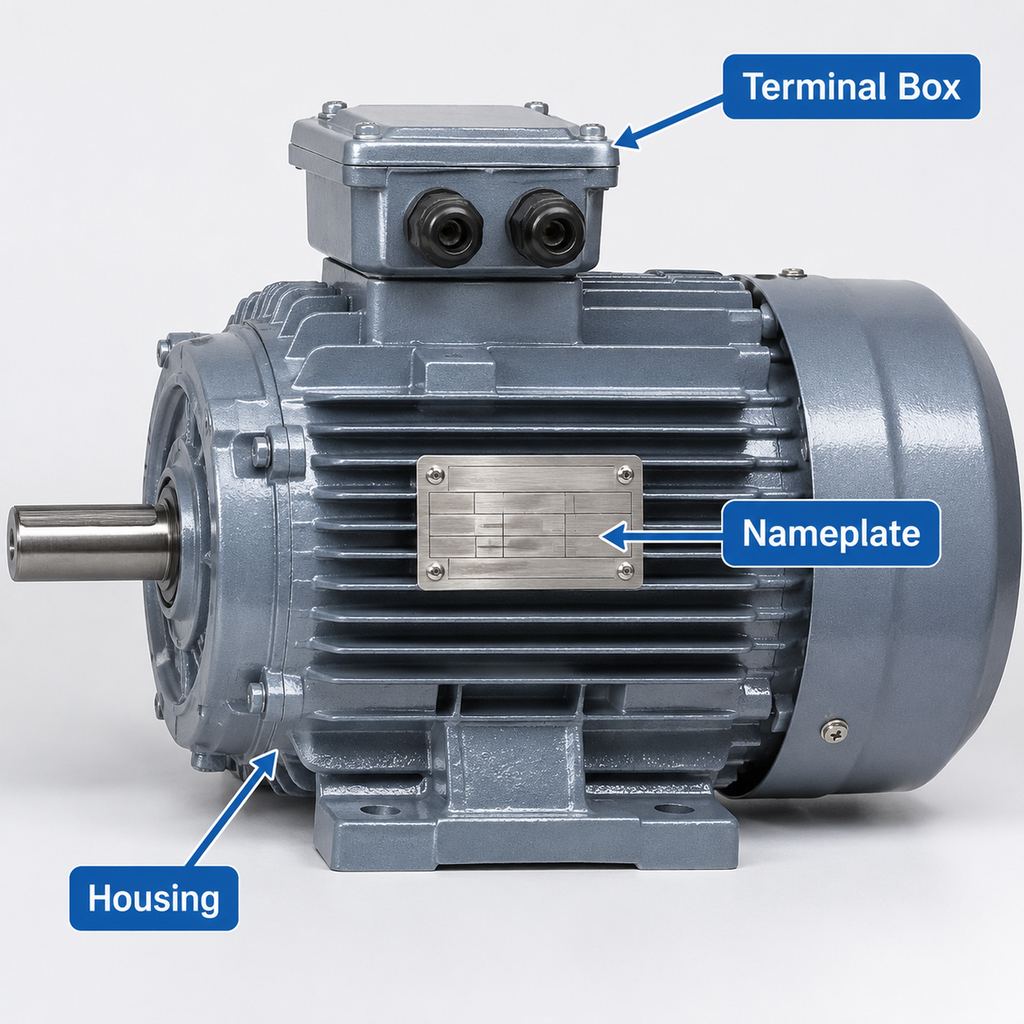
Nameplate detail: Service Factor 1.15—read SF together with ambient, altitude and voltage notes in the motor documentation.
Common SF Values: 1.0, 1.15 and 1.25
| Service factor | What it usually means | Typical fit |
|---|---|---|
| 1.0 | No published overload band above rated power under SF rules; size for the real continuous load (plus any derate). | Steady process loads; many IEC continuous-duty selections; applications where you prefer cooler continuous running at nameplate. |
| 1.15 | Most common industrial margin (~15% above rated power under SF conditions). | Pumps, HVAC fans and similar duties with occasional peaks—provided continuous shaft power still stays at or below nameplate. |
| 1.25 | Larger published margin; still not a substitute for continuous sizing at 125% if that load is the normal duty. | Demanding or poorly characterized peaks where the buyer still plans continuous operation near nameplate, not at 1.25× all day. |
IEC-oriented catalogues often list SF 1.0 as standard for continuous duty and supply higher SF only by agreement or for certain NEMA-style frames. Confirm the value on the actual nameplate of the motor you receive—not only on a family brochure.
Reading SF and SFA on the Nameplate
SF appears as a number such as 1.0 or 1.15. Multiply nameplate kW (or hp) by SF to get the service-factor load under the maker’s stated conditions.
SFA means service factor amps: the approximate line current when the motor is delivering the service-factor load at rated voltage. Use SFA when checking feeder, contactor and overload-relay settings if the machine will briefly enter the SF band. Overload protection is still set for the intended continuous duty—not automatically for SFA as a continuous trip point—unless your protection scheme and maker guidance say otherwise.
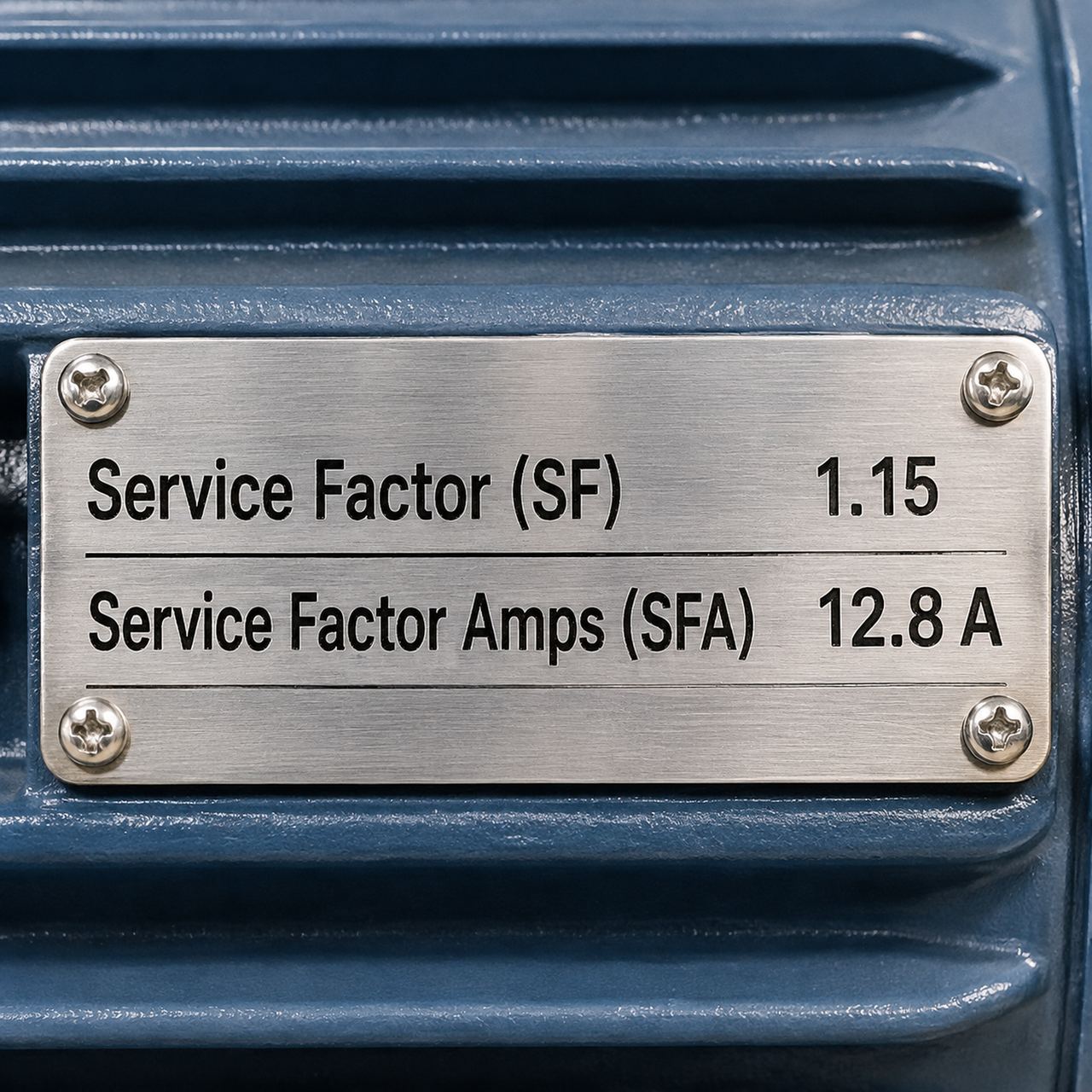
Example plate fields: SF 1.15 and SFA (service factor amps). SFA is the current at service-factor load, not a license for continuous overload.
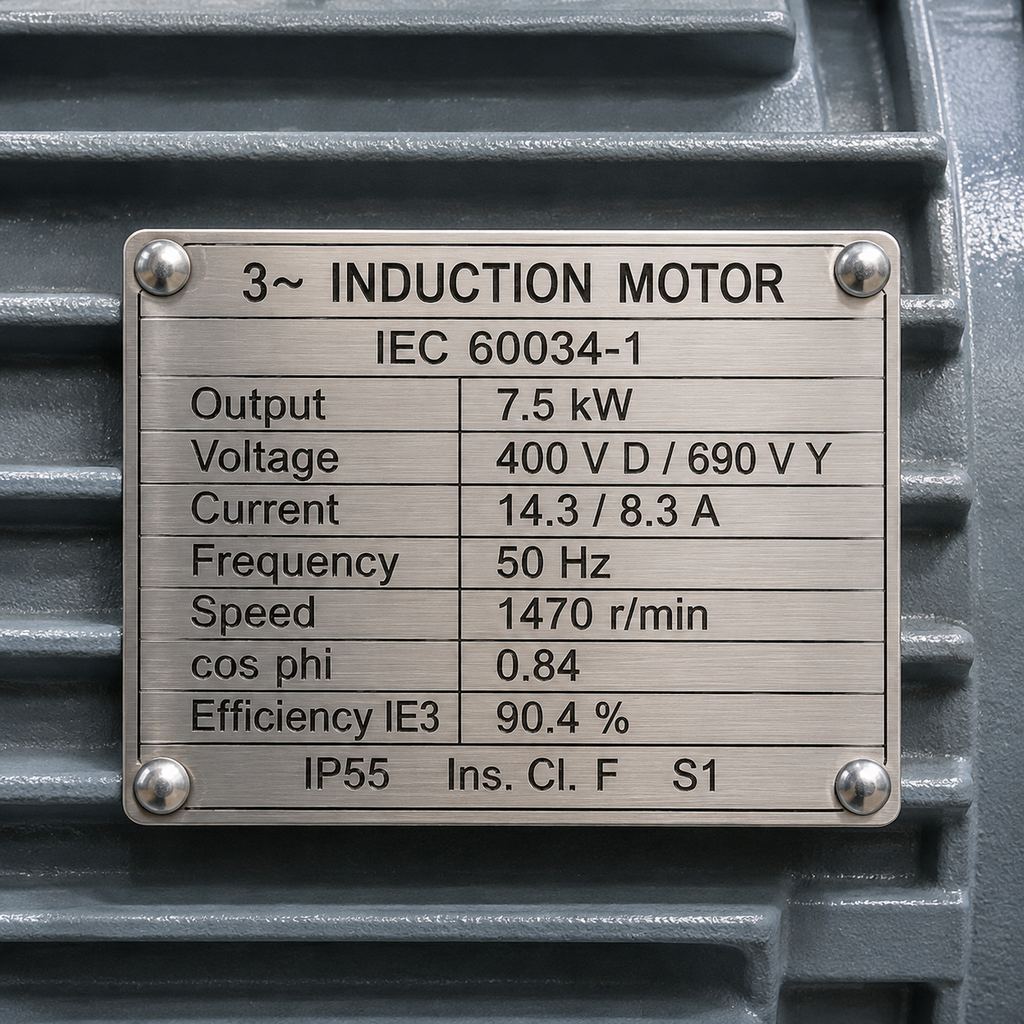
Also read voltage, frequency, rated current (FLA), duty type, insulation class and ambient/altitude notes. A Class F insulation system and an IE3/IE4 efficiency rating improve temperature margin and energy use at rated load; they do not cancel the life penalty of living in the SF band. More on insulation: insulation class.
When You Can Use the SF Margin—and When Not To
Reasonable uses of SF margin
- Occasional process peaks on a pump or fan that otherwise runs at or below nameplate.
- A buffer when supply voltage wanders slightly while shaft load stays near rated (SF is still defined at rated voltage—treat this as risk reduction, not a design formula).
- Warm-up or short abnormal conditions that are rare and monitored.
Do not treat SF as continuous overload capacity
- Designing a water or HVAC duty so the motor’s normal operating point is 1.15× nameplate “because SF says so.”
- Counting on full SF when ambient > ~40 °C, altitude well above ~1,000 m, poor ventilation, or sustained low/unbalanced voltage.
- Ignoring higher current (toward SFA), hotter bearings and shorter insulation life in lifecycle cost.
Read SF next to voltage, power and amps—selection needs the whole plate, not SF alone.
Derating: Ambient Temperature and Altitude
Published SF assumes the maker’s normal service conditions. Higher ambient temperature reduces cooling margin; higher altitude thins the air and reduces cooling. In either case the safe continuous load falls, and the usable SF shrinks or disappears. Typical practice is to derate continuous output (or choose a larger frame) per the manufacturer’s ambient/altitude tables rather than “using up” SF to cover a hot or high site.
Voltage variation also matters: operating far from rated volts while loaded into the SF band can push current and heating beyond what the nameplate SF story assumed.
“Buy the Next Size Up” vs “Use SF Margin”
| Approach | Pros | Cons / cautions |
|---|---|---|
| Size so continuous shaft power ≤ nameplate; keep SF as reserve | Cooler continuous running; better insulation/bearing life; SF available for rare peaks | May need a larger frame or different ratio; slightly higher first cost |
| Rely on SF so normal duty sits above nameplate (e.g. ~1.15×) | Smaller nameplate rating on paper; lower purchase price in some bids | Higher continuous temperature; shorter life; less headroom for bad volts/ambient; often false economy |
For most B2B pump and fan selections, the durable choice is: continuous load at or below nameplate, SF as insurance—not as the everyday operating point. If the calculated continuous load already needs the next rating, buy that rating (or a customized winding/frame via customization) instead of stretching SF.
Selection Examples: Pumps and Fans
Centrifugal pump (water / wastewater) — Size from duty-point shaft power with hydraulic and aging margins so continuous kW ≤ motor nameplate. Prefer SF 1.15 (where offered) as reserve for occasional high-head or viscosity swings, not as the design continuous load. See water & wastewater applications.
HVAC / ventilation fan — Filter loading and damper positions change torque. Design continuous absorbed power to nameplate; use SF only for rare peaks. Continuous “SF loading” on a filter-loaded fan is a common life killer. See HVAC & ventilation.
Agriculture / irrigation — Long seasonal runs favor cooler continuous operation at nameplate. Specify ambient and altitude clearly; do not spend SF covering a hot pump house. See agriculture.
YE3 / YE4 high-efficiency and Y2 cast-iron three-phase lines are selected as continuous-duty machines; request the required SF with the frame when the project specifies 1.15 or similar. Browse all products or the general-purpose motors category for series options.
FAQ
What is a service factor on a motor?
A nameplate multiplier on rated power. Under the stated service-factor conditions, permissible loading may reach rated power × SF. It is a thermal capability limit with life trade-offs, not a continuous “free hp” rating.
What is the service factor of a motor / what is electric motor service factor?
Same idea: SF on AC industrial motors (often 1.0 or 1.15). Always read the value on that motor’s plate and the maker’s ambient/altitude notes.
What does service factor 1.15 mean?
Permissible loading up to 115% of nameplate power under the conditions defined for that SF. Continuous operation at that level reduces expected insulation and bearing life versus rated load.
What is SFA on a motor?
Service factor amps—the approximate current at service-factor load and rated voltage. Useful for checking supply and protection coordination; not an invitation to run there continuously.
Is it safe to run continuously in the service-factor band?
It may be electrically/thermally “permissible” under nameplate conditions, but life expectancy drops. Prefer continuous load ≤ nameplate and keep SF as margin unless the manufacturer explicitly designs for that continuous SF load.


3 thoughts on “What Is Motor Service Factor? SF, SFA, and When Not to Overload Continuously”