Understanding AC Motor Reversal
Reversing the direction of an AC motor is a practical adjustment often required in industrial applications, such as reversing conveyor systems or fine-tuning the operation of pumps and fans. For AC motors, the principle is straightforward: the direction is dictated by the rotation of the magnetic field within the stator, which is controlled by the sequence of phase connections to the motor windings. Altering the motor’s direction involves changes to the electrical connections, either manually or through automated switching mechanisms.
In basic terms, reversing a three-phase AC motor involves swapping any two of the three power supply leads, causing the rotation of the magnetic field to reverse. On single-phase motors, the process may involve modifying capacitor wiring or reversing the start winding connections. These adjustments enable versatility in applications but require compliance with safety procedures and motor-specific wiring diagrams to avoid damage or operational inefficiency. Proper reversal techniques ensure not just operational success but also longevity for the equipment.
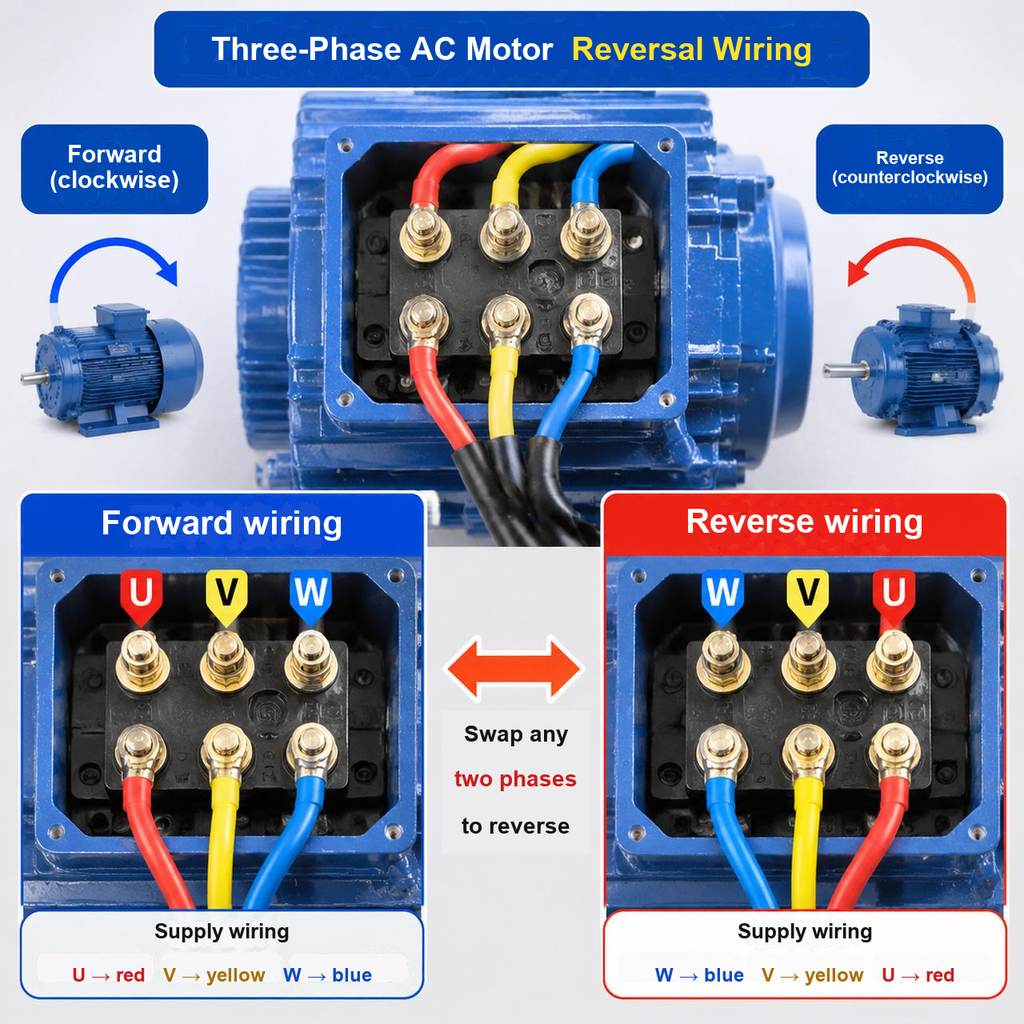
Technical diagram of AC motor wiring for direction reversal.
Step-by-Step Guide to Reversing AC Motor Direction
- Ensure power is disconnected: Safety should always be the first priority. Lockout and tagout the motor’s power source to prevent electrical hazards.
- Identify motor type and wiring diagram: Determine whether the motor is single-phase or three-phase. Consult the manufacturer’s wiring diagram, typically found on the motor housing or datasheet.
- For three-phase motors, swap any two phase leads: To reverse the direction, interchange any two of the three power supply connections (e.g., swap L1 and L2). This will reverse the rotating magnetic field.
- For single-phase motors, change the capacitor or start winding connections: Locate the connection terminals for the start winding and its related capacitor. Reverse the wiring connections as shown in the manufacturer’s diagram. Some motors may require specific switches or relays.
- Reconnect power and perform a test run: After making the necessary adjustments, restore power and briefly run the motor to verify the direction change. Observe carefully for any unusual noise or behavior that might indicate wiring issues.
Key Considerations When Reversing AC Motors
- Verify the motor’s compatibility with reversal before proceeding. Some specialized motors, such as shaded pole motors or those with specific directional design, may not support direction reversal without specialized modifications.
- Understand the control system integrated with the motor. For motors connected to complex control systems or variable frequency drives (VFDs), the reversal process may require special programming or adjustments to avoid operational conflicts.
- Inspect motor terminals and wiring connections in detail. Ensure that terminal blocks and motor leads are clearly labeled to prevent miswiring, which can lead to equipment damage or unsafe conditions.
- Consider the impact of reversal on attached accessories. Coupled devices such as pumps, fans, and gearboxes may have performance limitations or constraints in reverse operation.
- Account for potential mechanical or electrical stresses. Frequent directional changes can increase wear on components such as bearings, winding insulation, or starters. Verify that the motor can handle the anticipated duty cycle without overheating or premature wear.
Frequently Asked Questions
Are all types of AC motors reversible?
Not all AC motors are designed to be reversible. While three-phase motors and most single-phase motors allow direction reversal, some specialized designs, such as shaded pole motors or motors with built-in directional mechanisms, do not support straightforward reversal and may require particular adjustments or are limited to a single directional operation.
How can I reverse the direction of a three-phase AC motor?
Reversing the direction of a three-phase AC motor is straightforward. Swap any two phase leads (such as L1 and L2) at the motor terminals or in the control panel. This changes the phase sequence, altering the rotating magnetic field and, thereby, the motor’s direction. Always ensure power is disconnected during the process.
Can you reverse a single-phase AC motor with a capacitor?
Yes, reversing a single-phase motor with a capacitor is possible but involves altering the connections of the start winding or capacitor circuit. This typically requires consulting the motor’s wiring diagram to ensure correct and safe reconnections. Incorrect adjustments can cause starting issues or potential damage to the motor.
Types of AC Motors and Their Reversal Capabilities
Not all AC motors are created equal when it comes to their ability to reverse direction. While some types make it simple with a quick swap of wiring, others require more specialized steps or are inherently unsuitable for easy direction changes. Understanding the type of AC motor you are working with is key to determining the method and feasibility of reversal.
Three-Phase AC Induction Motors
These are commonly used in industrial applications because of their durability and reliability. reversing the direction of a three-phase AC motor is as simple as swapping any two of the three-phase power leads (L1, L2, or L3). This reverses the phase sequence, which alters the rotation of the electromagnetic field within the stator. This feature allows for easy adaptation in machinery requiring rotation changes, such as conveyor belts or lifts, with minimal additional hardware.
Single-Phase AC Motors
Single-phase motors, such as split-phase motors, operate using both main and auxiliary windings. Reversing their direction requires switching the connections of one of these windings or altering the wiring of the starting capacitor (when applicable). However, this tends to be more complex than reversing three-phase motors. Additionally, certain single-phase motor types, like shaded pole motors, are not inherently reversible and may require mechanical modification to achieve direction change.
Synchronous AC Motors
For synchronous motors, direction reversal is generally achieved by changing the polarity of the rotor excitation or altering how the stator windings are connected to the power supply. These motors need precise synchronization between the stator and rotor magnetic fields for operation, making reversal a more delicate process. Such motors often use additional control systems for flexibility.
- Three-Phase AC Induction Motors: These motors are widely used in industrial applications due to their robustness and simplicity. Reversing the direction of rotation involves swapping any two of the three phase leads (L1, L2, L3). This changes the sequence of the magnetic fields in the stator, effectively reversing the motor’s rotation. The process is straightforward and does not require additional components, making three-phase motors highly versatile for applications needing frequent direction changes.
- Single-Phase Split-Phase Motors: These motors rely on both a start winding and a main winding to operate. To reverse their direction, one must reverse the connections of either the start winding or the capacitor that assists in creating the phase shift. This process is more complex than for three-phase motors and may not be supported by all single-phase motor designs—some may lack terminals or an accessible configuration to facilitate reversal.
- Synchronous AC Motors: Reversing a synchronous motor often involves changing the connection of the stator windings or modifying the rotor excitation polarity. Because of their precise speed and phase requirements, synchronous motors might necessitate specialized controls or external circuitry to ensure proper reversal. This makes reversing their direction less straightforward and generally more challenging compared to induction motors.
| Point |
|---|
| Three-Phase AC Induction Motors: These motors are widely used in industrial applications due to their robustness and simplicity. Reversing the direction of rotation involves swapping any two of the three phase leads (L1, L2, L3). This changes the sequence of the magnetic fields in the stator, effectively reversing the motor’s rotation. The process is straightforward and does not require additional components, making three-phase motors highly versatile for applications needing frequent direction |
| Single-Phase Split-Phase Motors: These motors rely on both a start winding and a main winding to operate. To reverse their direction, one must reverse the connections of either the start winding or the capacitor that assists in creating the phase shift. This process is more complex than for three-phase motors and may not be supported by all single-phase motor designs—some may lack terminals or an accessible configuration to facilitate reversal. |
| Synchronous AC Motors: Reversing a synchronous motor often involves changing the connection of the stator windings or modifying the rotor excitation polarity. Because of their precise speed and phase requirements, synchronous motors might necessitate specialized controls or external circuitry to ensure proper reversal. This makes reversing their direction less straightforward and generally more challenging compared to induction motors. |
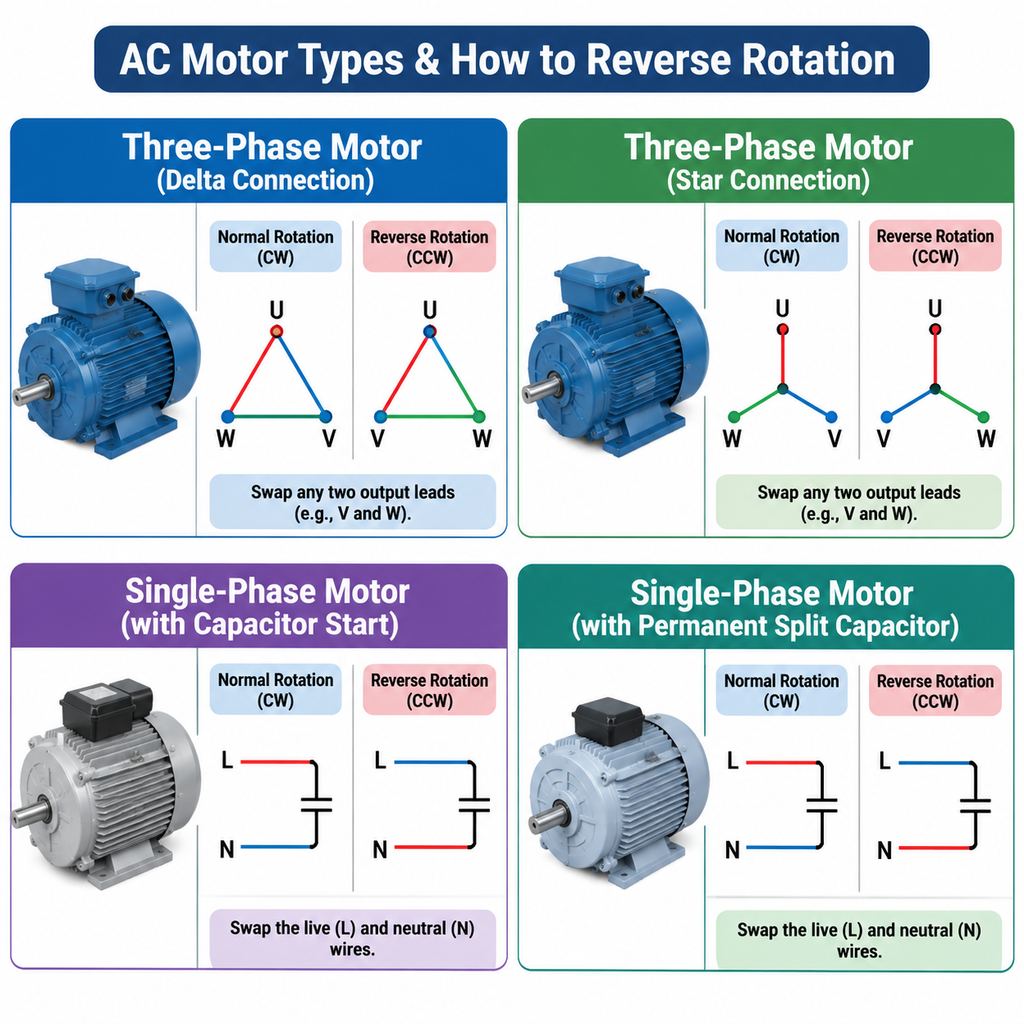
Diagram illustrating various types of AC motors and reversal methods.
Safety Considerations for AC Motor Reversal
Reversing the direction of an AC motor involves changes to its electrical connections, which can present safety risks if not conducted properly. Observing strict safety measures is essential to protect both personnel and equipment. Begin by fully disconnecting the motor from its power supply. Utilize a lockout-tagout (LOTO) system to ensure the motor does not receive power while work is in progress. Even brief accidental energization during rewiring can cause severe injury or damage.
Verify that the motor type and its operating conditions support direction reversal. Certain motors, such as shaded pole or specialized synchronous motors, may not be designed for reversal without additional modifications. In these cases, forcing a reversal could lead to winding damage, reduced efficiency, or permanent operational issues.
Take care to avoid creating hazardous conditions by ensuring all wires are properly identified and connections are secure and insulated. Loose connections can cause arcing, increasing the risk of electrical shocks or fire.
Personal protective equipment (PPE), including insulated gloves and eye protection, should always be used when working with electrical equipment. Furthermore, once the reversal process is complete, inspect the motor for proper rotation before reconnecting it to any mechanical load. This precaution ensures that coupled equipment, such as pumps or conveyors, will not malfunction or suffer damage when put into reverse operation.