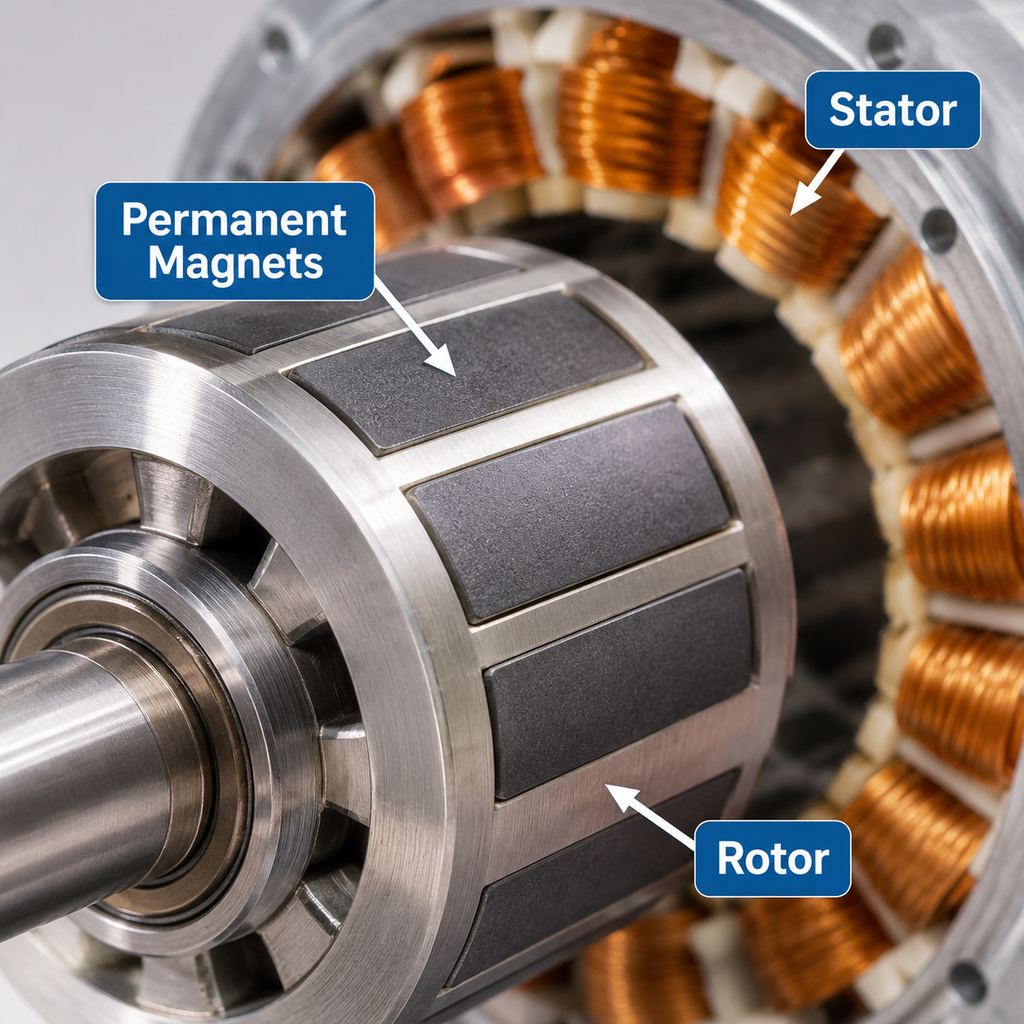
A permanent magnet motor (PM motor) is an electric motor whose magnetic field is produced by permanent magnets, usually mounted on or embedded in the rotor. It does not rely on induced current in a squirrel-cage rotor the way an induction motor does, and it does not need a separate wound field supplied through slip rings.
The industrial types buyers usually mean are the permanent-magnet synchronous motor (PMSM or PMAC) and the brushless DC motor (BLDC). Both use a wound stator and a magnet rotor. This article explains that construction briefly, answers how a PM synchronous motor’s speed is adjusted, and then compares PM motors with cast-iron IE4 induction motors such as YE4—on cost, whether a drive is required, part-load efficiency, duty type, demagnetization risk, and repair. JWMotor does not manufacture PM motors; the YE4 and YVF2 references below are induction machines offered as alternatives where that topology fits.
How a Permanent Magnet Motor Works
The stator windings are energised so they produce a rotating (or stepped) magnetic field. The rotor magnets interact with that field and produce torque. In a PMSM the rotor locks to the stator field and turns at synchronous speed. In a BLDC the drive electronically commutates the stator phases, usually with rotor-position feedback. In both cases the rotor field is already there; there is no need to induce a cage current to create it.
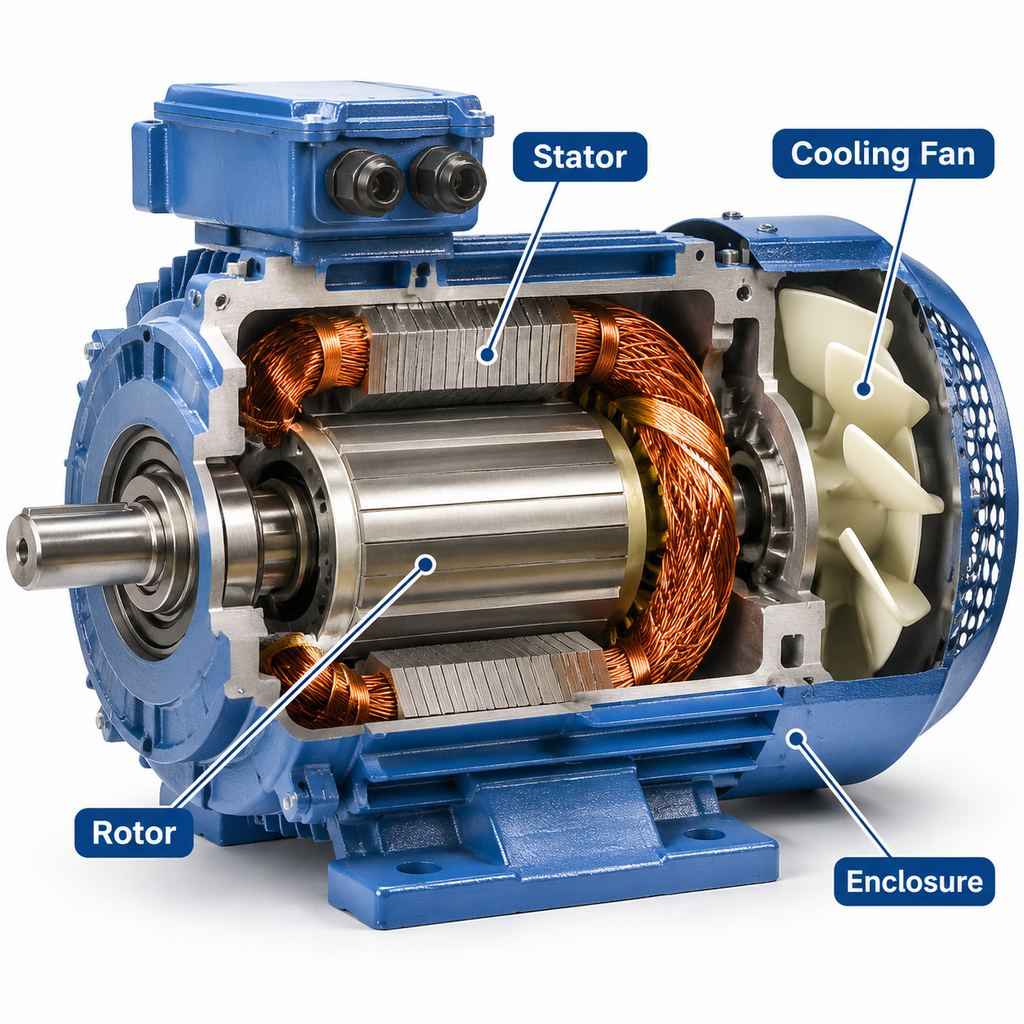
That is the useful difference from a squirrel-cage induction motor, which must develop rotor current and therefore has rotor I²R loss and a small amount of slip in normal motoring. A longer account of induction-motor operation is not repeated here. The practical consequences—drive requirements, part-load behaviour, heat and repair—are in the comparison below.
How a Permanent Magnet Motor’s Speed Is Adjusted
A permanent magnet synchronous motor’s speed is adjusted by changing the supply frequency with a VFD or a servo drive. At steady state the rotor follows the stator field, so speed is set by frequency and pole count, in the same relationship as synchronous speed (n = 120f/p). You do not adjust a PMSM’s running speed by changing slip the way a fixed-frequency induction motor does, and a simple DOL starter does not give you a speed range.
A servo drive is the usual choice when the duty needs tight position or torque control. A general-purpose VFD with a PM-motor mode (and the matching feedback or sensorless algorithm) is used when the job is variable speed rather than axis control. How a VFD changes frequency, and what “inverter duty” means for a motor that will live on a drive, are covered in what is a VFD drive and what is an inverter duty motor; those articles are not repeated here.
Most industrial PMSM and BLDC motors therefore need a drive even to start and run. Line-start permanent magnet (LSPM) motors are a special design that can start across the line; they are not the default industrial PM package.
PM Motors vs Cast-Iron IE4 Induction Motors
IE4 is an efficiency class, not a rotor type. A cast-iron IE4 induction motor such as YE4 still uses a squirrel-cage rotor. It can meet a high full-load efficiency without magnets. The comparison below is about that choice, not about whether IE4 exists only as a PM machine. The class differences themselves are in IE2 vs IE3 vs IE4 motors.
First cost. PM motors, especially those that use rare-earth magnets, usually cost more to buy than a comparable IE4 induction motor. The magnet material, the tighter rotor build and the almost-always-required drive all add to the installed cost. An IE4 induction motor avoids that magnet cost and can often be started with a DOL or star-delta starter when the speed is fixed.
Whether a drive is mandatory. For a typical PMSM or BLDC, yes: a VFD or servo drive is part of the system. A YE4 induction motor can run on a fixed-frequency supply. If the same duty needs a speed range, an induction motor can also be run from a VFD; for wide or continuous inverter service, an inverter-duty design such as YVF2 is the usual induction option.
Efficiency at part load. Because the rotor field does not have to be induced, a PM motor often holds its efficiency better as load falls. An IE4 induction motor is already efficient at its rated point, but magnetizing current and rotor loss still rise as a share of input when the machine is lightly loaded. How much the curves differ depends on the design; this article does not invent percentages or payback figures. Where the load spends a lot of time well below rating, that part-load behaviour is worth asking both suppliers to show on a curve, not only at the nameplate point.
Suitability for different duties. PM motors (with a servo or a capable VFD) suit compact, high-dynamic or high-efficiency variable-speed duties—positioning, some high-performance fans, compressors and spindles—when the budget and the service arrangement can support them. Cast-iron IE4 induction motors suit general-purpose continuous duties such as pumps, fans, conveyors and compressors, especially when a simple starter, a widely understood rewind and a standard IEC frame matter more than the last increment of part-load efficiency.
Demagnetization and heat. Permanent magnets can lose strength if they are overheated, exposed to a severe fault current, or driven with an unsuitable control method. That damage is not always reversible. An induction motor has no rotor magnets to demagnetize; its thermal limits are still real, but they are the familiar winding and bearing limits. On a PM machine, winding temperature, drive setup and short-circuit protection need extra attention.
Maintenance and repair. The stator of a PM motor can still be rewound, but the magnet rotor is harder to handle, balance and replace than a squirrel-cage rotor. Many shops that routinely rewind an IE4 induction motor will not rebuild a PM rotor. If the site depends on local repair, that difference can outweigh a smaller frame or a better part-load curve.
| Point | PM motor (PMSM / BLDC) | Cast-iron IE4 induction motor (e.g. YE4) |
|---|---|---|
| First cost | Usually higher (magnets, tighter build, drive almost always included) | Usually lower installed cost for a given kW on a fixed-speed supply |
| Is a drive mandatory? | Yes for typical PMSM/BLDC; line-start PM is a special exception | No for fixed speed (DOL or star-delta). A VFD is added when speed must vary; YVF2 is the inverter-duty induction option |
| Efficiency at part load | Often holds up better as load falls (ask for curves; no single percentage applies) | High at the rated IE4 point; the share of no-load and rotor loss is usually larger at light load |
| Typical duties | Compact, high-dynamic or tightly controlled variable-speed applications | General-purpose continuous pumps, fans, conveyors and compressors |
| Demagnetization and heat | Magnets can be damaged by overheating or severe faults | No rotor magnets; thermal limits are winding and bearing related |
| Maintenance and repair | Stator can be rewound; magnet rotor is harder to service locally | Squirrel-cage rotors are widely understood; rewind shops are easier to find |
When Each One Makes Sense
Choose a PM motor when the application needs a compact machine, a wide efficient speed range, or servo-like dynamics, and when you can specify a compatible drive and a repair path for the magnet rotor.
Choose a cast-iron IE4 induction motor when you want IE4 efficiency in a standard IEC frame, especially on a fixed-frequency supply, or when local rewind and a conventional starter matter. That is the usual role of YE4. If the same induction topology must run for long periods on a VFD, specify an inverter-duty motor such as YVF2 rather than assuming every general-purpose frame is equally suitable.
Do not treat “IE4” and “permanent magnet” as the same decision. You can reach IE4 with an induction rotor; you choose a PM machine for its field construction and the system that comes with it.
FAQ
What is a permanent magnet motor?
An electric motor that uses permanent magnets, usually on the rotor, to produce the magnetic field. Industrial types are typically PMSM/PMAC or BLDC.
How does a permanent magnet motor work?
The stator windings create a rotating or stepped field. The rotor magnets produce torque as they follow or are commutated with that field. Speed in a PMSM is synchronous with the supply frequency.
A permanent magnet motor’s speed can be adjusted by what?
By changing the supply frequency with a VFD or a servo drive. A DOL starter does not give a PMSM a speed range.
Does every PM motor need a drive?
Most industrial PMSM and BLDC motors do. Line-start PM motors can start across the line, but they are a special design, not the default.
Does JWMotor make permanent magnet motors?
No. JWMotor’s YE4 and YVF2 ranges are induction motors. YE4 is a cast-iron IE4 general-purpose machine; YVF2 is the inverter-duty induction option for VFD service.
If You Need an IE4 or Inverter-Duty Induction Motor
When a PM motor is not the right fit, a cast-iron IE4 induction motor such as the YE4 series is the usual catalogue starting point, listed with other frames under general-purpose motors. For variable-speed induction service, see the YVF2 series. Efficiency-class differences are summarised on the IE2 vs IE3 vs IE4 page. Non-standard shafts, voltages or mountings go through customization or all products.