Overview of Electromagnetic Motors
An electromagnetic motor is a machine that converts electrical energy into mechanical energy through the principles of electromagnetism. At its core, an electromagnetic motor relies on the interaction between a magnetic field and an electric current to produce rotational motion. This process involves two key components: a stator, which generates a stationary magnetic field, and a rotor, which is a moving part that responds to this magnetic field, causing it to spin.
The technology behind electromagnetic motors is the basis for countless applications in manufacturing, transportation, HVAC systems, and robotics. Their ability to efficiently convert energy while providing precise motion control makes them crucial in modern automation, energy solutions, and industrial processes. Understanding how electromagnetic motors function is key for engineers and buyers tasked with choosing the right motor for their specific applications.
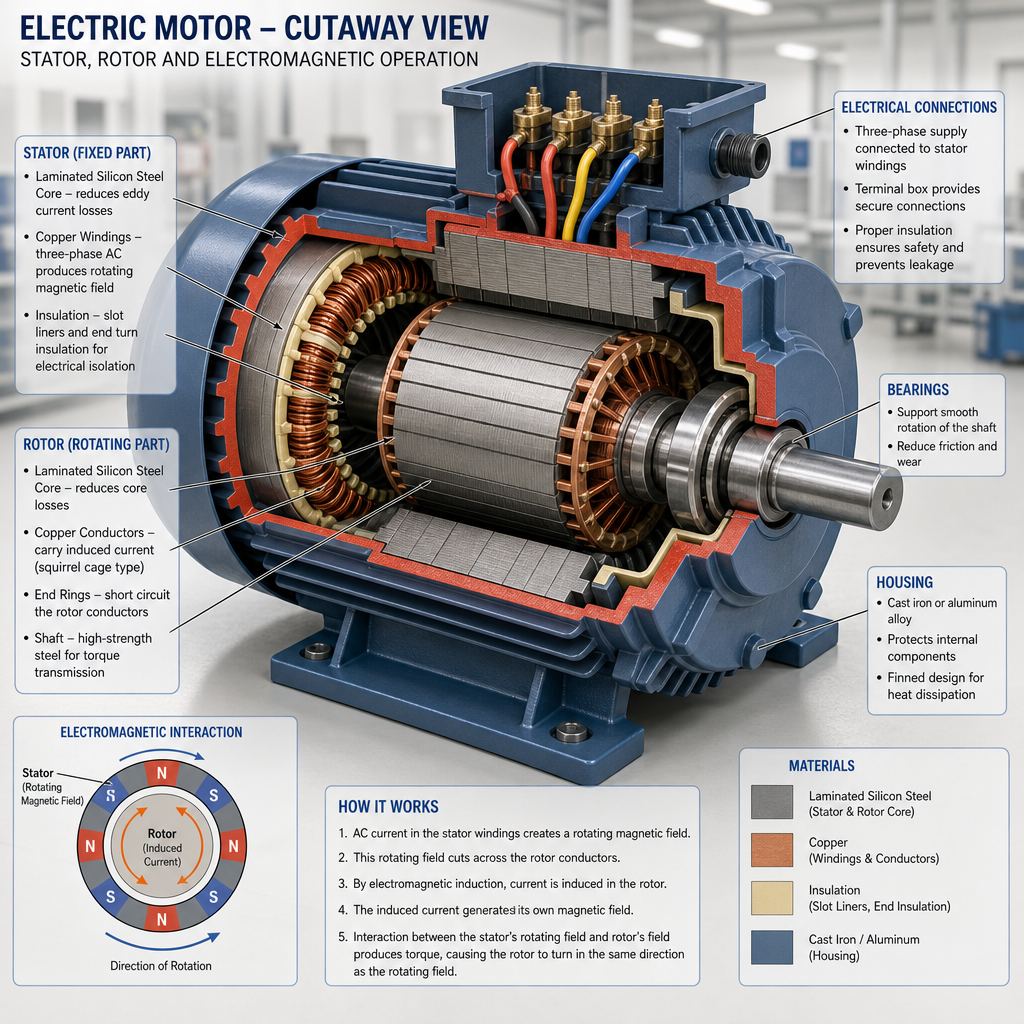
Technical cutaway of an electromagnetic motor showing key components and function.
How Electromagnetic Motors Work: Step-by-Step Process
- Electrical energy is supplied to the motor, initiating the process of current flow through its conductors. Depending on the motor type, this current may be direct current (DC) or alternating current (AC).
- As the current passes through the conductors, it generates a magnetic field. Specifically, the stator—the stationary part of the motor housing the windings—produces a magnetic field.
- The interaction between the stator’s magnetic field and the rotor creates a torque, which causes the rotor to spin. In DC motors, this movement is aided by a mechanical component called the commutator, ensuring a continuous rotational motion.
- In AC motors, the interplay of currents in the stator windings and the electromagnetic induction generated in the rotor yield the rotational motion without needing a commutator.
Key Principles of Electromagnetic Motors
- Electromagnetic motors operate based on the principle of electromagnetism, where an electric current passing through a conductor generates a magnetic field.
- Magnetic fields exert forces on moving electric charges, causing motion due to the principle that opposite magnetic poles attract and like poles repel.
- The stator creates and maintains a magnetic field, either through permanent magnets or electromagnets with coil windings energized by electric current.
- The rotor, the rotating part of the motor, experiences torque when exposed to the interaction between the electro-magnetically induced magnetic field and the magnetic forces of the stator.
- Continuous rotation in electric motors, particularly DC motors, is facilitated by a commutator that maintains the current flow in a way that sustains motion.
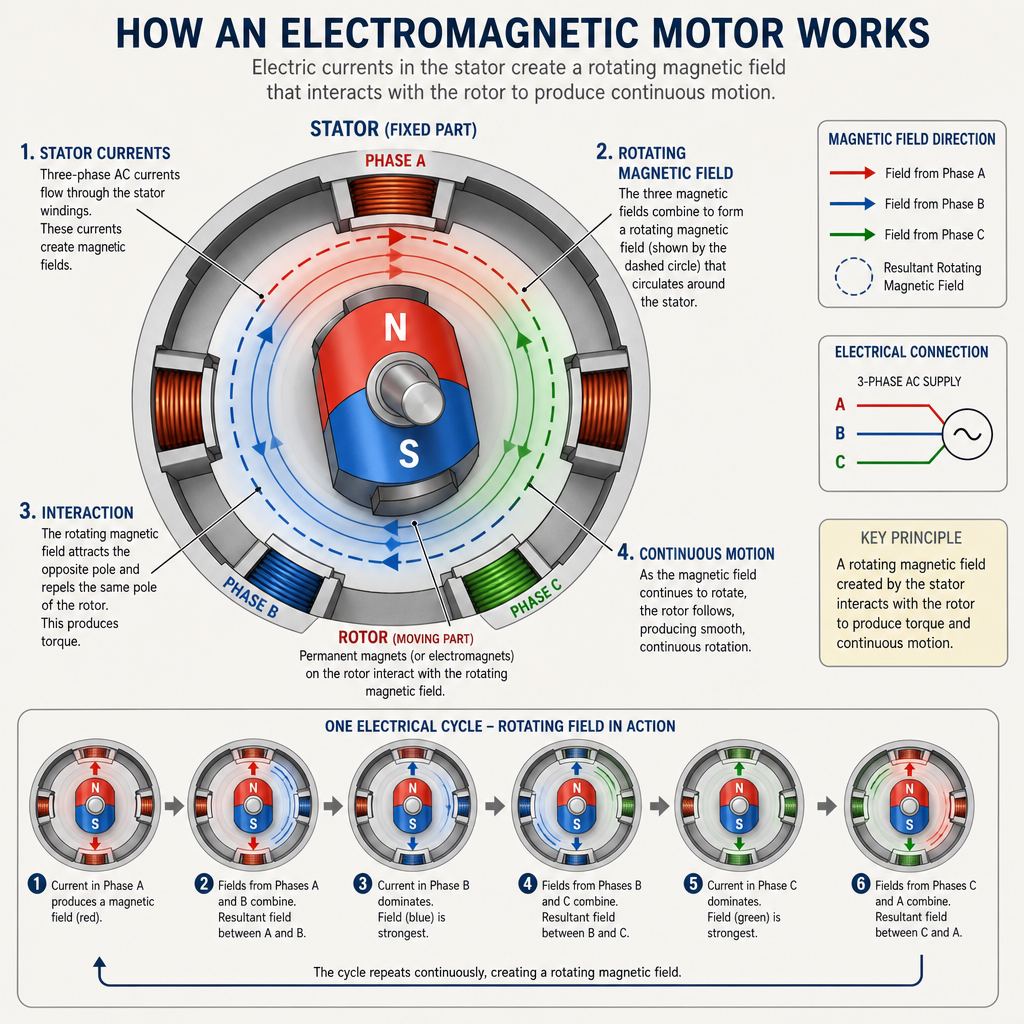
Illustration of magnetic field interaction causing rotation in an electromagnetic motor.
Types of Electromagnetic Motors
Electromagnetic motors can be broadly classified into two main types: AC motors and DC motors. Both operate on the principles of electromagnetism, but their features, applications, and advantages vary widely depending on the use case. AC motors are highly efficient for large-scale and continuous operations, such as pumps and industrial fans, due to their ability to handle high power loads with lower maintenance. On the other hand, DC motors excel in applications requiring precision, such as robotics or automotive systems, offering unparalleled speed and torque control.
The choice between AC and DC motors often depends on your operational priorities. For instance, AC motors are generally simpler, cost-effective, and more reliable for industrial settings, while DC motors’ design allows them to shine in small-scale environments where precise movement control matters. Industrial buyers should carefully assess the power source, efficiency, application, maintenance needs, and budget constraints to select the motor type that best suits their needs.
| Feature | AC Motors | DC Motors |
|---|---|---|
| Power Source | Uses alternating current (AC), which periodically reverses direction. | Uses direct current (DC), which flows continuously in one direction. |
| Efficiency | Typically higher efficiency, particularly for larger loads and continuous operation. | Highest efficiency in variable-speed and torque applications. |
| Applications | Widely used in industrial pumps, fans, conveyor systems, HVAC systems. | Commonly used in robotics, automotive applications, and precision tools requiring speed control. |
| Maintenance Requirements | Lower maintenance due to absence of commutator and brushes. | Higher maintenance due to the wear and tear on brushes and the commutator. |
| Cost and Complexity | More cost-effective for large-scale industrial setups; simpler in design. | Can be more costly due to complex speed regulation components; typically simpler for small-scale setups. |
| Key Advantage | Better suited for high-power systems and long-term reliability. | Offers precise control over speed and torque adjustments. |
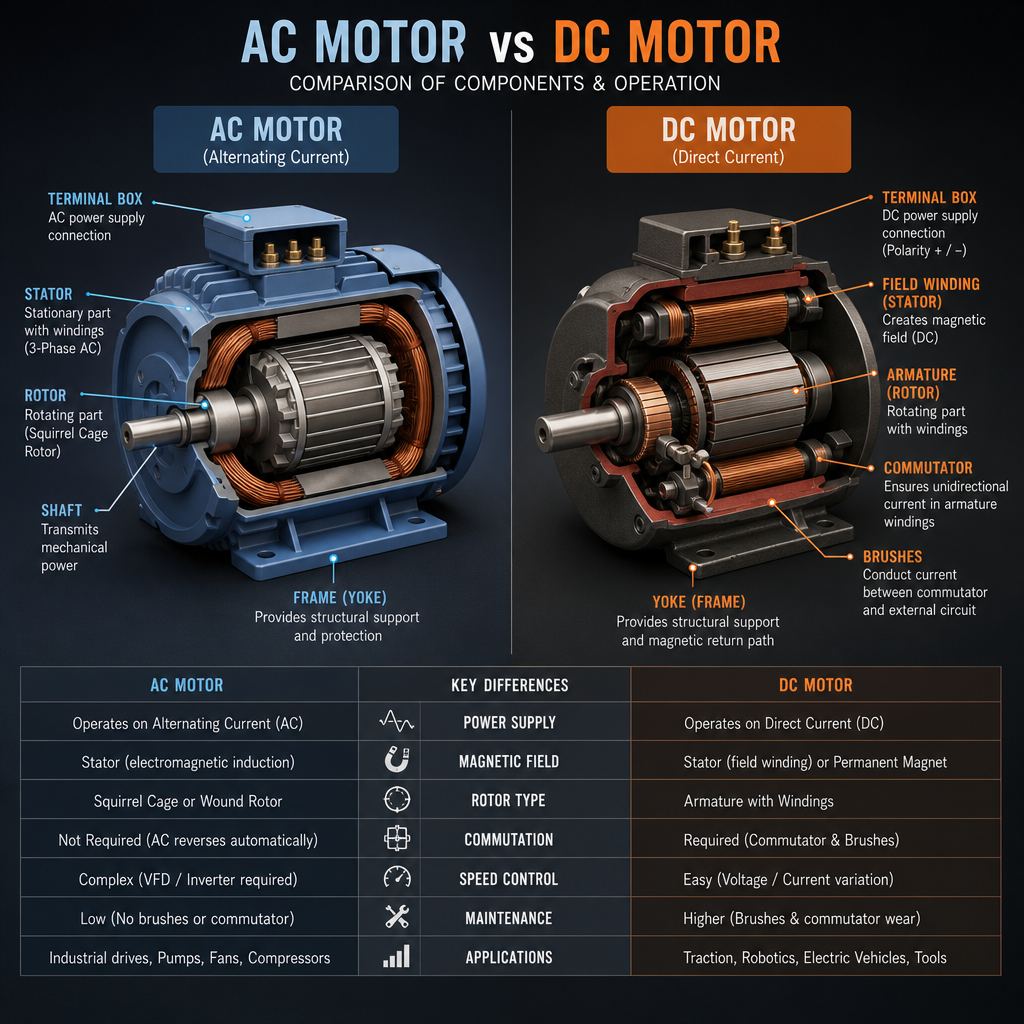
Comparison of AC and DC electromagnetic motors in labeled diagram.
Frequently Asked Questions about Electromagnetic Motors
What are the main components of an electromagnetic motor?
Electromagnetic motors primarily consist of two key components: the stator and the rotor. The stator is the stationary part of the motor that generates the magnetic field, either through permanent magnets or electromagnets. The rotor is the moving part that rotates due to the interaction with the magnetic field generated by the stator.
How does an electromagnetic motor produce motion?
An electromagnetic motor produces motion through the interaction of magnetic fields. When an electric current flows through the motor’s windings, it generates a magnetic field in the stator. The rotor interacts with this magnetic field, resulting in torque that causes it to rotate.
What is the role of a commutator in a DC motor?
In DC motors, a commutator helps maintain continuous rotation by reversing the direction of current in the rotor windings at the appropriate time. This ensures the magnetic forces acting on the rotor continue to generate torque in the same direction, sustaining motion.
Why are AC motors widely used in industrial applications?
AC motors are widely used in industrial applications because they are more efficient for handling large power loads, require less maintenance due to the absence of components like commutators, and are generally simpler to operate. Their robust design makes them ideal for continuous operations, such as running pumps and industrial fans.
How do electromagnetic motors differ from other types of electric motors?
Electromagnetic motors specifically rely on the principles of electromagnetism to generate rotational motion. This distinguishes them from other types, such as piezoelectric motors, which use mechanical vibrations for motion, or hydraulic motors, which depend on fluid dynamics for power transmission.