
To determine motor efficiency, divide the mechanical power the motor delivers at the shaft by the electrical power it draws: η = Pout / Pin × 100%. The formula is simple. Getting reliable numbers for it is the hard part. This guide is for buyers and maintenance teams working with three-phase industrial motors. It covers the efficiency formula, how to measure input power, how nameplate efficiency differs from a field estimate, where the losses go, why oversized motors waste energy, and how to work out payback when you upgrade.
The Motor Efficiency Formula
Efficiency (η) = Output power / Input power
- Output (mechanical) power: Pout = T × ω, where T is shaft torque in N·m and ω = 2π × n / 60 is angular speed in rad/s (n in rpm). As a shortcut, Pout (kW) = T × n / 9550.
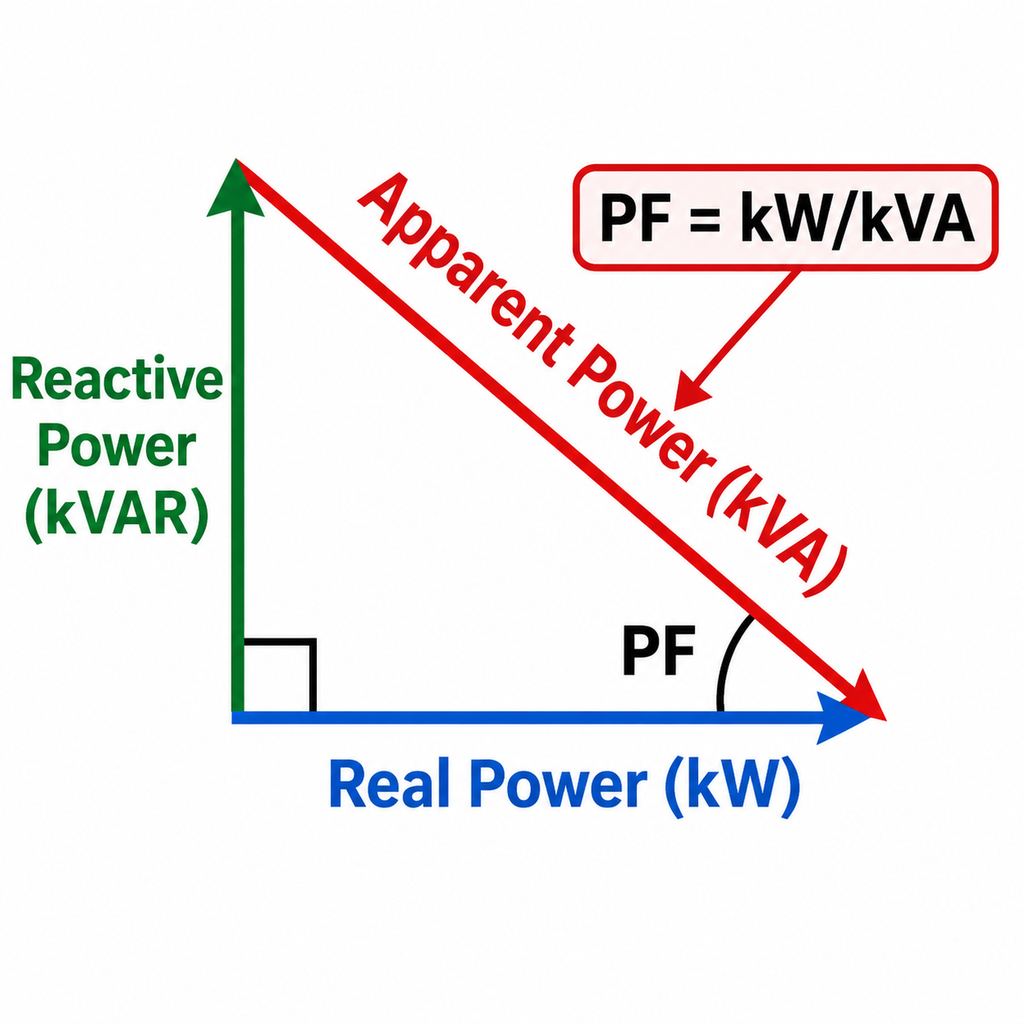
- Input (electrical) power, three-phase: Pin = √3 × VL × IL × PF, using line-to-line voltage, line current and power factor. Divide by 1000 to get kW.
- Losses: Ploss = Pin − Pout. You can also write η = 1 − Ploss / Pin.
Worked example (illustrative numbers): a motor delivers 7.5 kW at the shaft and draws 8.1 kW from the supply. η = 7.5 / 8.1 ≈ 92.6%. The other ≈0.6 kW becomes heat.
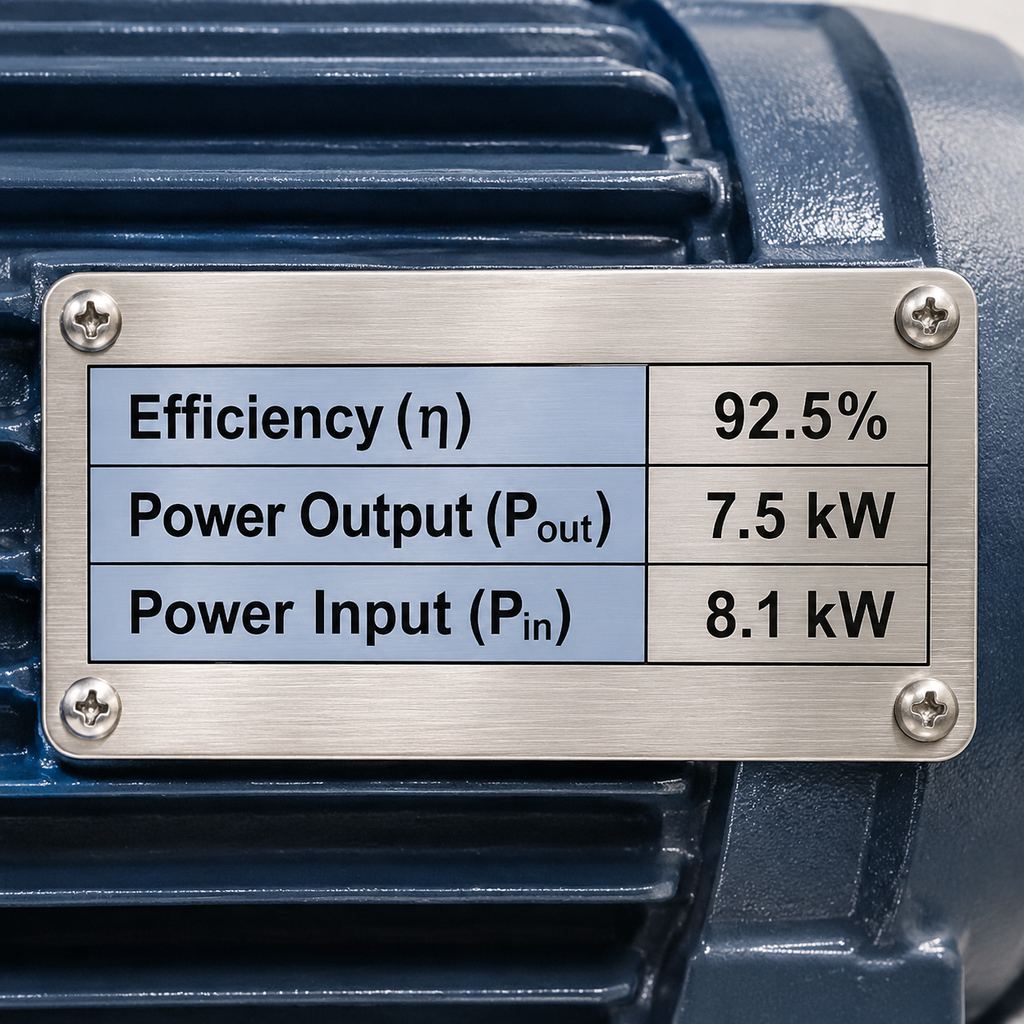
Illustration of the output/input relationship. Real nameplates show rated output and efficiency, not input power.
How to Find Motor Efficiency in Practice
1. Read the nameplate or datasheet
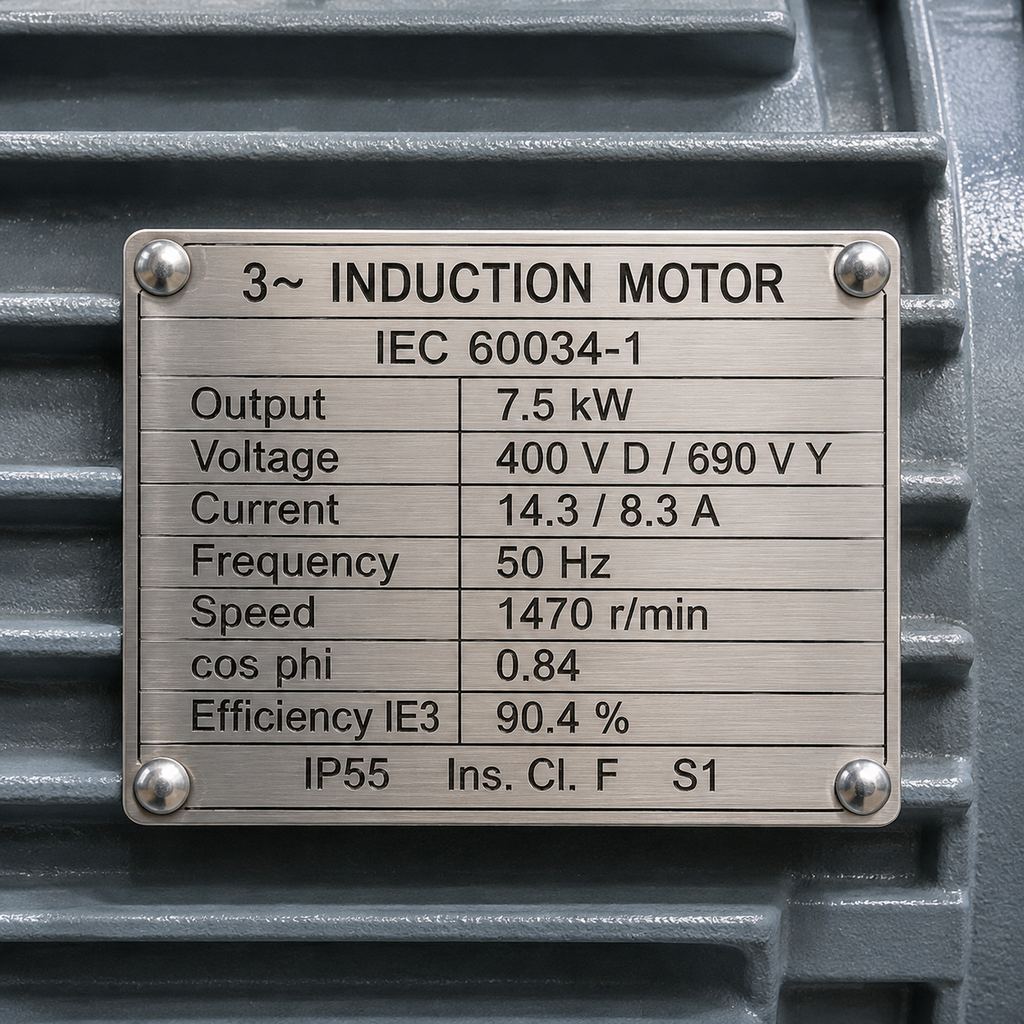
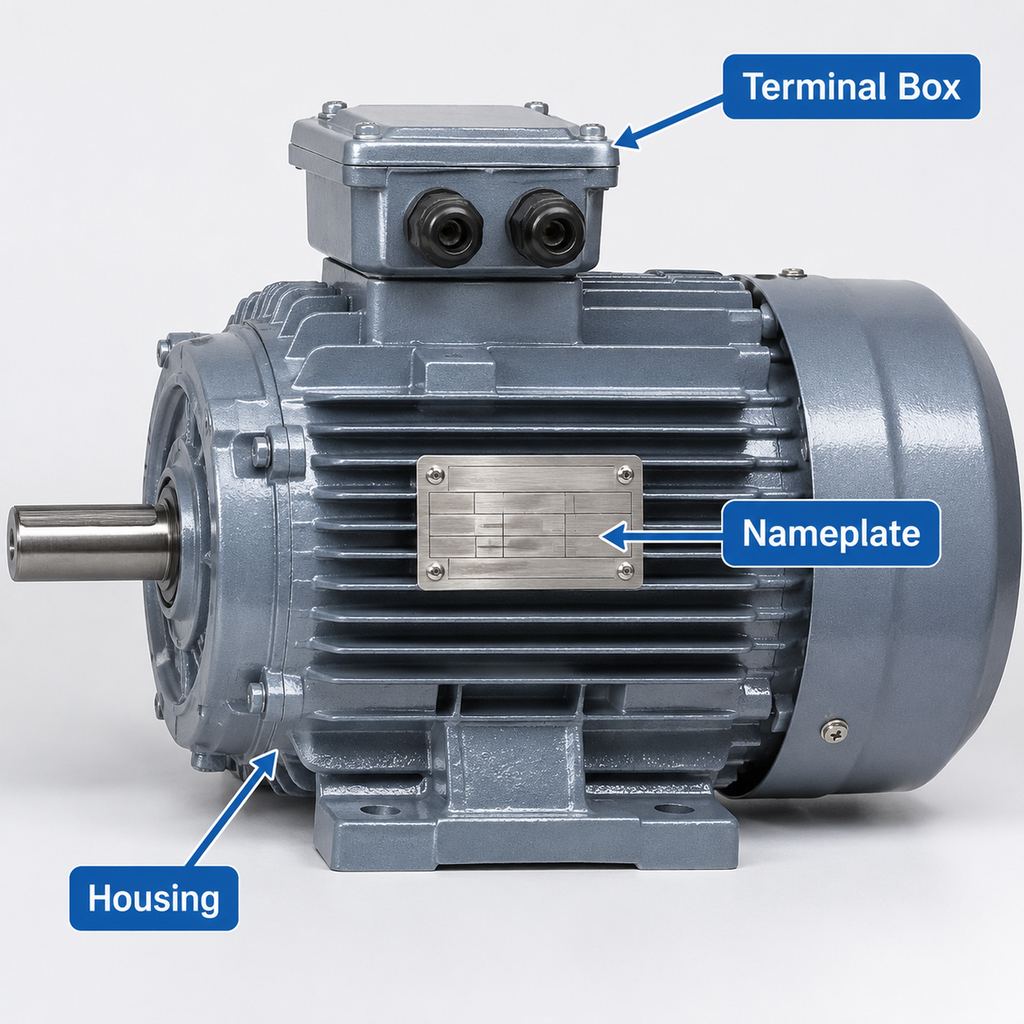
The nameplate efficiency is the rated full-load value, determined under IEC 60034-2-1 (or an equivalent standard) on a test bench at rated voltage, frequency and load. Datasheets often list efficiency at 100%, 75% and 50% load. For buyers this is the right basis for comparison. Values from different makers are only directly comparable when they were measured by the same method.
2. Measure input power on site
Use a three-phase power analyzer that measures true kW directly, including power factor and voltage unbalance. A multimeter and clamp meter alone give V and I. They don’t give power factor, so √3·V·I·PF ends up relying on an assumed PF. Only qualified staff should take live measurements, following site electrical safety rules.
3. Estimate output power
Torque transducers are rare in the field, so output is usually estimated by one of these methods:
- Slip method: load ≈ (nsync − nmeasured) / (nsync − nrated) × rated kW. It is quick but sensitive to voltage and to how accurate the nameplate rpm is.
- Current method: scale load from measured current versus nameplate current. It is less reliable at light load, where magnetizing current dominates.
- Input power × datasheet efficiency at that load: often the most practical estimate.
4. Calculate and sanity-check
Divide estimated output by measured input. Field results usually carry an uncertainty of a few percentage points, so treat them as indicative. They are useful for spotting oversized or degraded motors, but they don’t overturn a certified nameplate value.
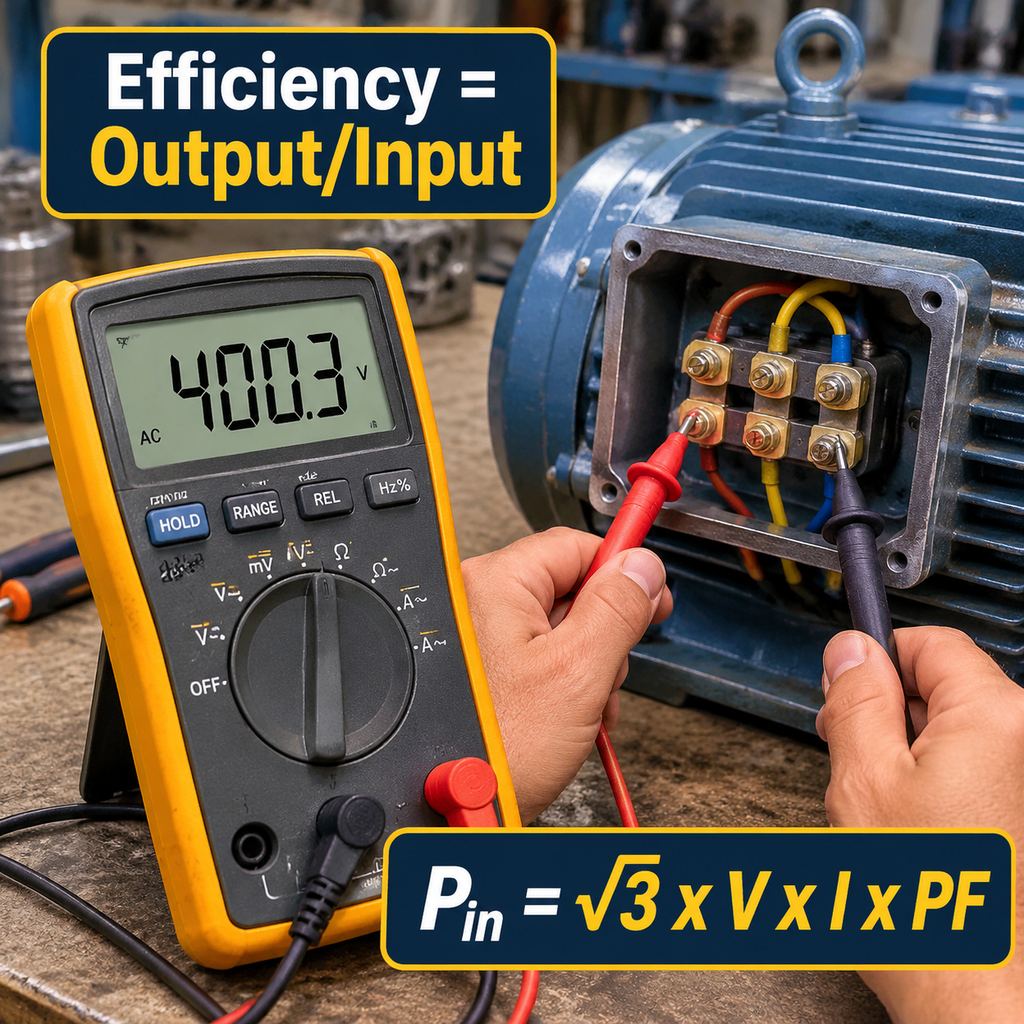
Voltage and current readings feed Pin = √3 × V × I × PF. For accurate kW and PF, use a power analyzer.
Where the Losses Go
| Loss | Cause | Varies with load? |
|---|---|---|
| Stator copper loss (I²R) | Current through winding resistance | Yes, roughly with current² |
| Rotor loss (I²R) | Rotor bar current; proportional to slip | Yes |
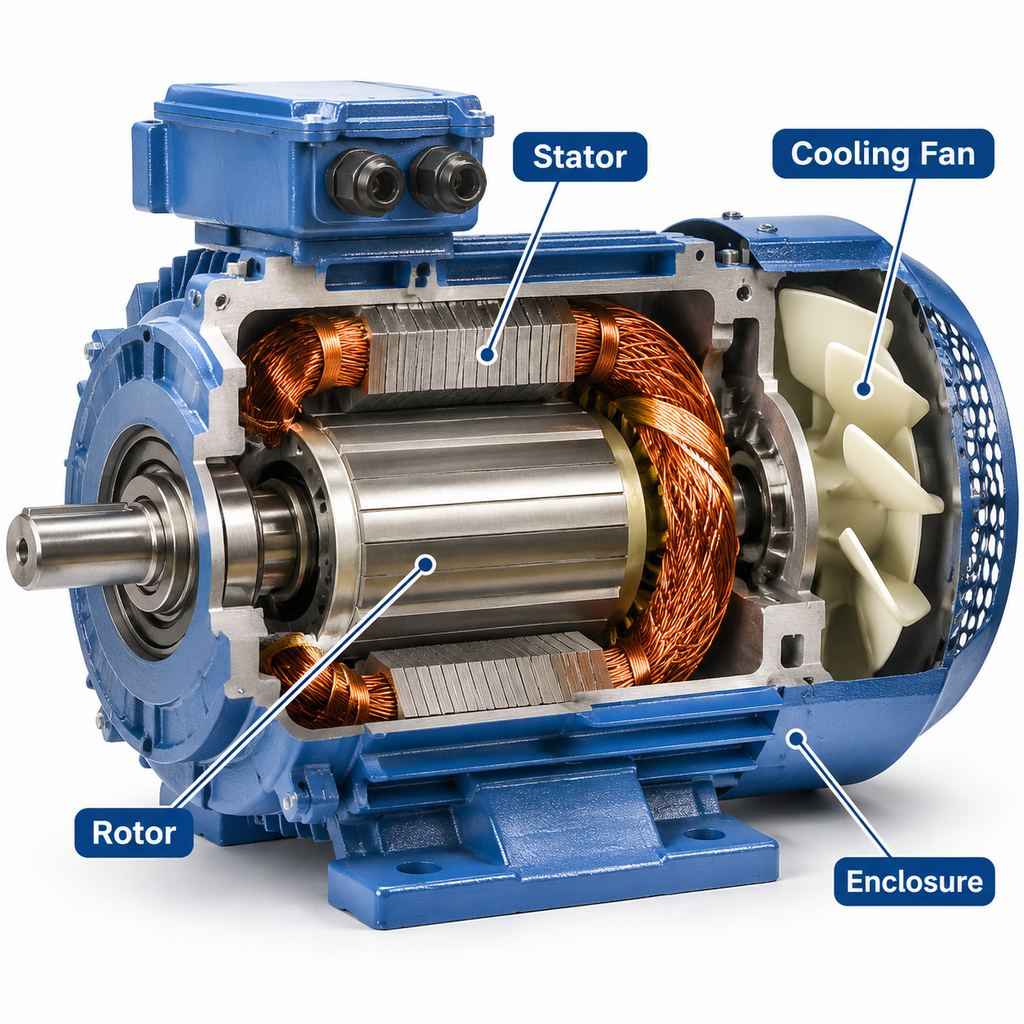
| Iron (core) loss | Hysteresis and eddy currents in the laminations | Nearly constant at fixed V and f |
| Friction and windage | Bearings and the cooling fan | Nearly constant at fixed speed |
| Stray (additional) load loss | Leakage flux, harmonics and surface losses | Yes |
Material and design choices drive these losses. More and better copper in the slots reduces I²R loss. Thinner, lower-loss silicon steel laminations cut core loss. Correctly specified, well-lubricated bearings and an appropriately sized fan keep friction and windage down.
Part-Load Efficiency and Oversizing
Most three-phase motors reach peak efficiency at roughly 75–100% load and stay fairly flat down to about 50%. Below that, the fixed losses (core, friction and windage) make up a growing share of the input, so efficiency falls, often steeply under about 40% load. Power factor drops at light load as well, which raises current and cable losses.
A common cause is oversizing (“one size bigger to be safe”). A 30 kW motor driving a 12 kW pump runs at 40% load and below its best efficiency for its whole life. Size the motor so normal duty sits near 75–100% of rated output. Keep the margin as a reserve; don’t make it the operating point. For how overload margin works, see what is motor service factor.
Energy Cost and Payback: IE3 to IE4 (Formula Method)
For the same shaft load Pout, annual energy for each motor is E = Pout / η × hours. The annual saving from the higher-efficiency motor is:
Saving (kWh/yr) = Pout × hours × (1/ηIE3 − 1/ηIE4)
Saving (cost/yr) = kWh saved × tariff
Simple payback (years) = price difference / annual cost saving
Take ηIE3 and ηIE4 from the datasheets of the specific YE3 and YE4 models at your actual operating load, not from a generic chart. Use your own running hours, tariff and quoted price difference. Payback is usually shortest for motors that run long hours near full load, such as continuously running pumps and fans. It is weakest for low-hour or lightly loaded machines. For class definitions and side-by-side figures, see IE2 vs IE3 vs IE4 motors (Y2, YE3, YE4). In short, Y2 meets IE2, YE3 meets IE3 and YE4 meets IE4.
Ways to Improve Motor System Efficiency
- Right-size replacements to the measured load rather than copying an oversized original.
- Choose higher-efficiency motors (IE3/IE4) for long-running duties, and check the efficiency at your actual load point.
- Use a VFD on variable-torque loads. Centrifugal pumps and fans that are throttled by valves or dampers can often save more energy by running slower than by any change in motor class.
- Maintain supply quality: keep voltage close to rated and phases balanced, since unbalance raises losses sharply.
- Look after the mechanics: alignment, lubrication, clean cooling fins and correct belt tension.
- Weigh rewinding against replacement. A poor-quality rewind can raise losses, so for older low-efficiency motors replacement often pays back.
Application Notes
Water and wastewater pumps often run 6,000–8,000 h/yr or more, so a small efficiency gain adds up and the IE3→IE4 payback calculation is usually worth doing. HVAC and ventilation fans tend to gain most from correct sizing plus speed control. Cast-iron Y2, YE3 and YE4 three-phase motors are listed under general-purpose motors and all products. For non-standard voltage, frame or mounting, see customization.
FAQ
What is the motor efficiency formula?
η = Pout / Pin × 100%. For three-phase motors, Pin = √3 × V × I × PF and Pout = T × 2πn/60.
How do I calculate motor efficiency without a torque meter?
Measure input kW with a power analyzer, estimate load by the slip or current method, then divide the estimated output by input. Expect an uncertainty of a few percentage points.
Why is my measured efficiency lower than the nameplate?
Common reasons are light load, voltage unbalance or deviation, harmonics, a previous rewind, mechanical wear and measurement error. The nameplate value applies at rated conditions.
Does a higher IE class always save money?
Only when running hours and load are high enough for the energy saving to pay back the price difference. Run the payback formula above with your own figures.


2 thoughts on “How to Determine Motor Efficiency: Formula, Field Measurement, Losses and Payback”