
In industrial practice, a motor controller is the equipment that starts, stops, protects and—when needed—varies the speed of an electric motor. For three-phase induction motors the usual choices are a DOL contactor starter, a star-delta starter, a soft starter or a variable frequency drive (VFD). This guide explains what the term covers and how factories and OEMs choose among those options for pumps, fans and conveyors.
It does not rework induction-motor theory. For inverter-ready motors see what is an inverter-duty motor. Starting-current behaviour is summarised in one table row and covered in full in what happens to current when an induction motor starts.
What “Motor Controller” Means
A motor controller sits between the supply and the motor. Depending on the design it may:
- Connect and disconnect the motor (start / stop)
- Limit how hard the motor starts
- Set direction (forward / reverse) where required
- Regulate speed and, on some drives, torque
- Provide overload, phase-loss, short-circuit and thermal protection
- Exchange signals with a PLC or building/process control system
In plant language the phrase often means the whole motor control package: contactor or drive, overload or electronic protection, control power, and the enclosure. It is broader than a single “motor driver IC,” and a VFD is one type of motor controller—not the only type.
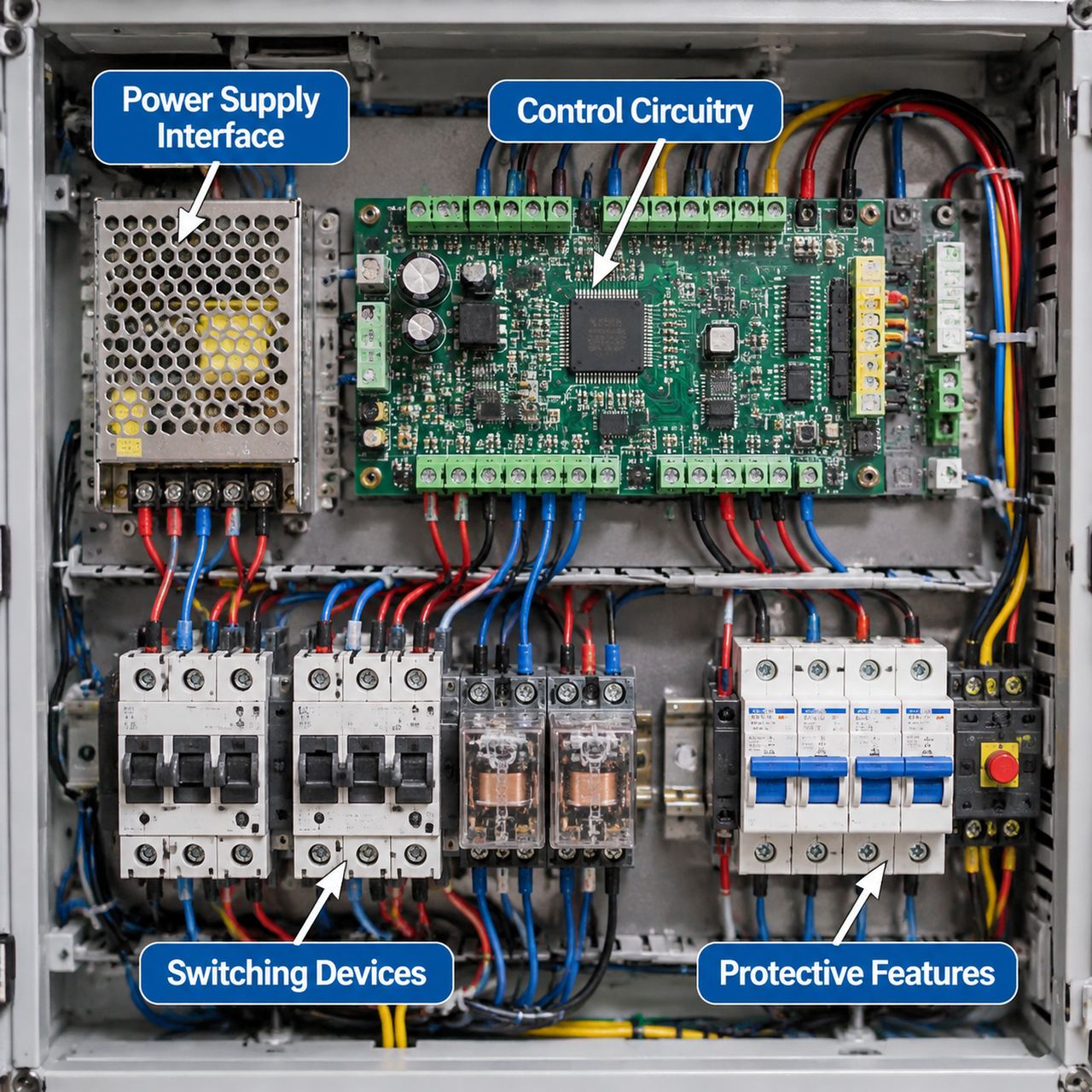
Typical industrial control panel: power interface, control logic, switching devices and protective devices.
The Four Common Options for 3-Phase Motors
Direct-on-line (DOL) contactor
A contactor applies full line voltage to the motor. An overload relay (or motor protection circuit breaker) provides running protection. DOL is simple, compact and usually the lowest hardware cost. It is common on smaller fixed-speed motors when the supply and driven machine can accept a hard start.
Star-delta (wye-delta) starter
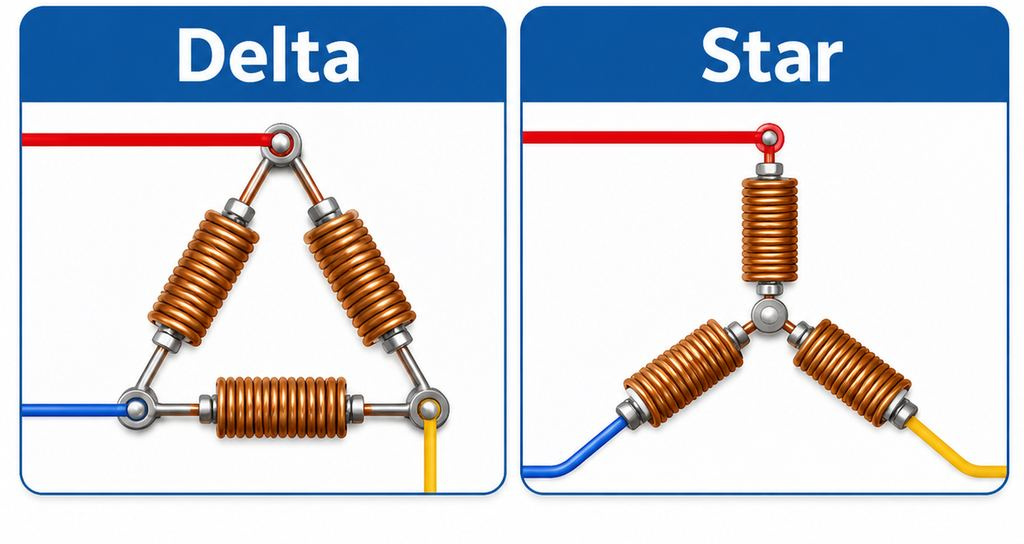
The motor starts in star (reduced voltage and current), then switches to delta for run. It needs a six-terminal motor and several contactors plus a timer. Starting torque and current are lower than DOL, but there is a torque dip at the changeover, so it suits some centrifugal loads better than hard constant-torque starts.
Soft starter
A soft starter ramps voltage with thyristors so the motor accelerates smoothly, then typically bypasses to a contactor for running. It reduces mechanical shock and voltage dip compared with DOL, but once at full speed it does not vary speed. Good for fixed-speed pumps, fans and conveyors that need a gentle start.
Variable frequency drive (VFD)
A VFD converts AC to DC and back to variable-frequency, variable-voltage AC. It controls acceleration, deceleration and running speed, and can cut energy use on variable-torque fans and pumps. It is the most capable option and usually the highest installed cost; the motor should be suitable for inverter supply (see the inverter-duty article linked above).
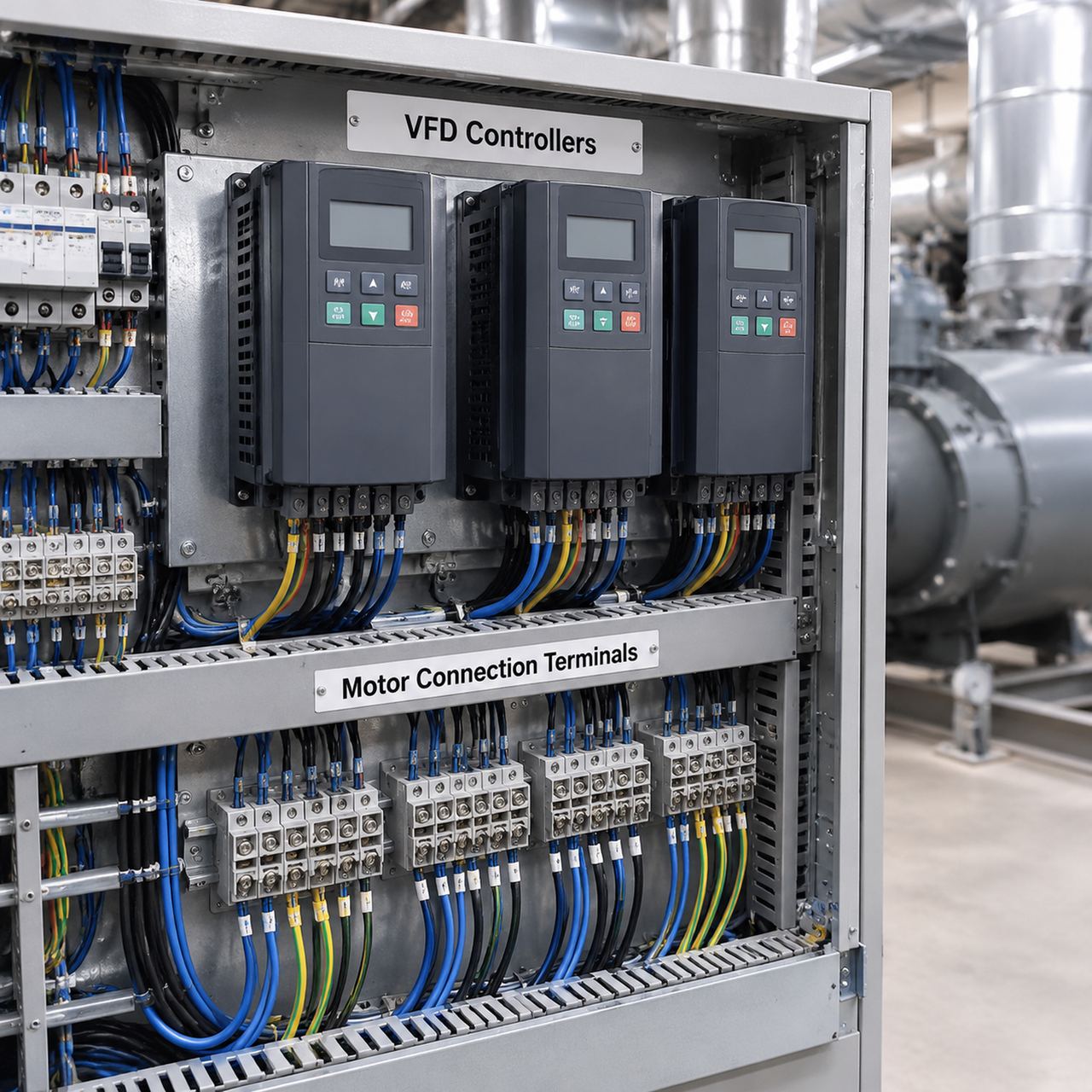
VFDs and motor terminals in a plant control cabinet—one common form of motor controller.
Comparison: DOL vs Star-Delta vs Soft Starter vs VFD
| Factor | DOL contactor | Star-delta | Soft starter | VFD |
|---|---|---|---|---|
| Typical role | Fixed-speed start/stop | Reduced-voltage start, fixed run | Soft start/stop, fixed run | Soft start + continuous speed control |
| Starting current | Highest (see starting-current article) | Lower than DOL | Lower, adjustable ramp | Controlled by acceleration ramp |
| Speed control | No | No | No | Yes |
| Relative hardware cost | Lowest | Low–medium | Medium | Highest |
| Typical power (guideline) | Often small to mid-size LV motors | Mid to larger LV motors | Mid to larger LV motors | Wide range; justified when speed or process control is needed |
| Best fit | Simple pumps, fans, conveyors on a stiff supply | Some large centrifugal loads | Fixed-speed machines needing smooth start | Variable flow/speed, energy saving, process control |
Cost bands are qualitative and site-specific (panel, cabling, harmonics filters and labour matter as much as the device price).
Pump (Variable Torque) vs Conveyor (Constant Torque)
Matching the controller to the load type matters as much as matching it to the motor:
Centrifugal pumps and fans (variable torque)
Torque demand rises roughly with the square of speed, and power with the cube. A VFD that slows the machine in low-demand periods often saves more energy than a fixed-speed motor with a valve or damper. Soft starters or DOL/star-delta remain fine when the machine always runs at one speed. See water and wastewater and HVAC and ventilation.
Conveyors and many material-handling drives (constant torque)
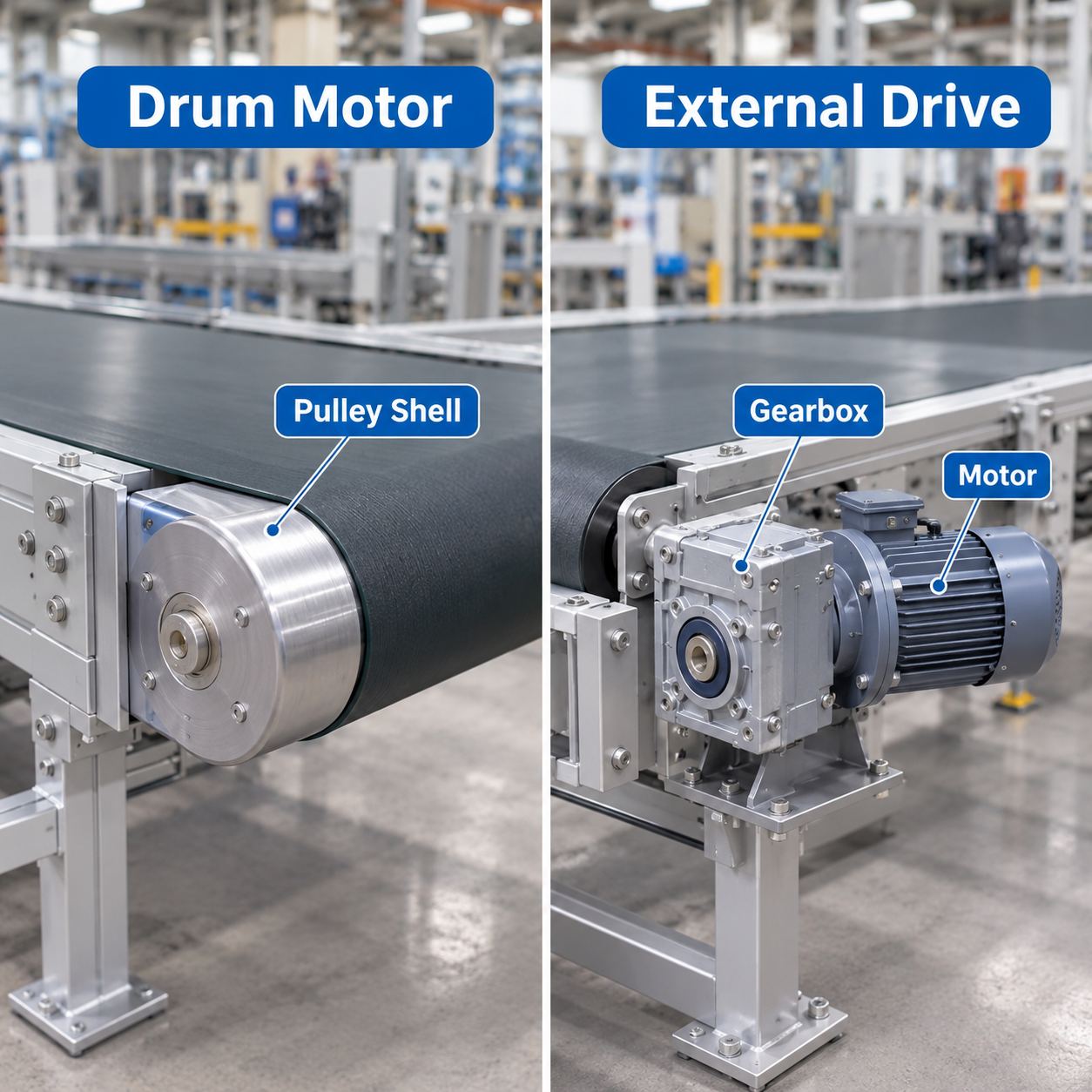
They need roughly the same torque at low and high speed. A VFD must be sized for constant-torque duty and for starting against a loaded belt. Many conveyors still use DOL or a soft starter plus a gearbox when only one speed is required. See material handling.
Rule of thumb: need only start/stop at line frequency → contactor, star-delta or soft starter. Need adjustable speed, soft process ramps or pump/fan energy saving → VFD.
Motor Choice: YE3 / YE4 / Y2 vs YVF2
- Fixed-speed with contactor or soft starter: YE3, YE4 and Y2 general-purpose three-phase motors are the usual match. Select frame, poles, IE class, IP rating and mounting for the machine.
- VFD duty: Prefer an inverter-capable design such as YVF2 when the motor will run for long periods at low speed, over a wide speed range, or on a PWM supply. Details are in the inverter-duty motor article.
- VFD installation notes (brief): keep motor cables reasonably short or use the drive maker’s guidance on dV/dt or sine filters; bond the motor and drive to a low-impedance PE; set carrier frequency as a compromise between audible noise and heating/EMC. Follow the VFD manufacturer’s manual for grounding and EMC.
Non-standard voltages, flanges or accessories can be requested under customization. Full catalogue: all products.
What to Put on the Purchase / Spec Sheet
List at least:
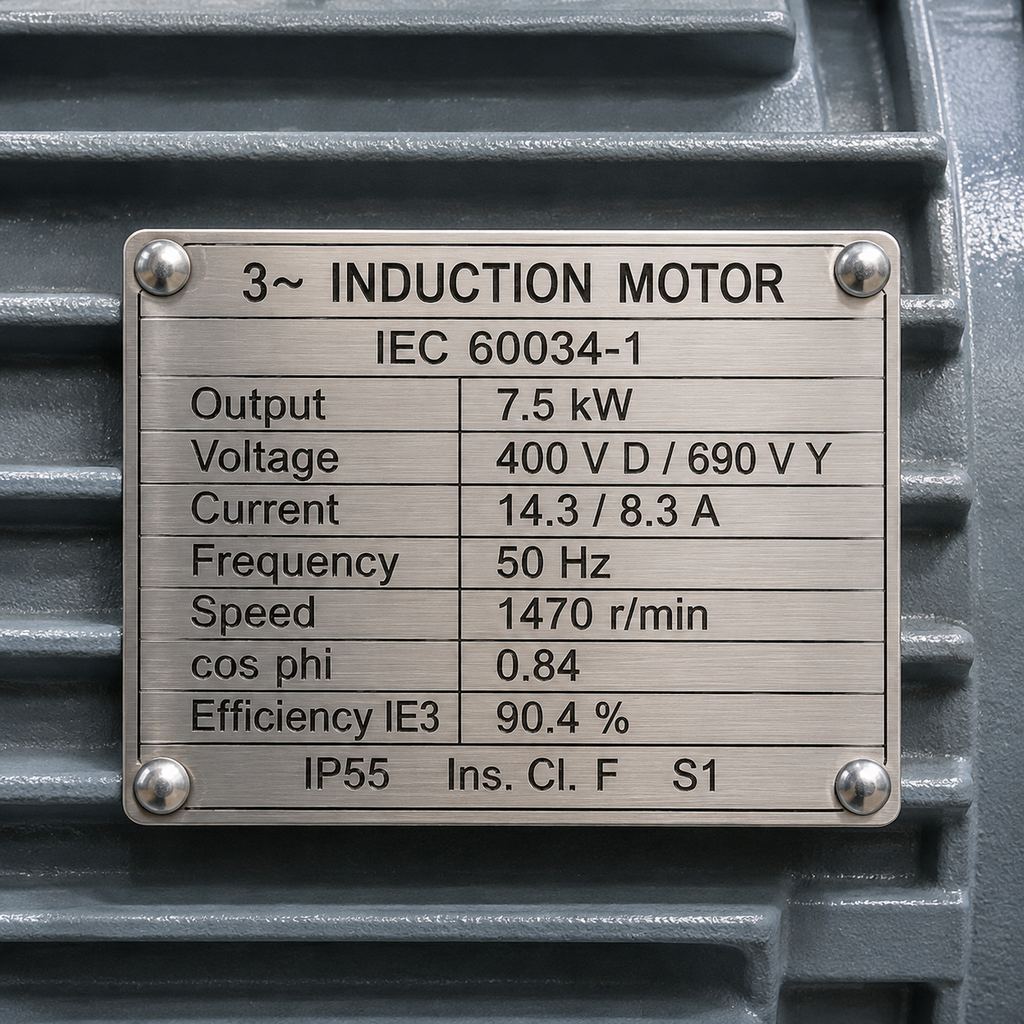
- Motor: kW (or HP), poles/RPM, voltage, frequency, IE class, frame, IP, mounting, duty.
- Load: pump / fan / conveyor (or other); variable-torque or constant-torque; inertia and starting against load or unloaded.
- Control type: DOL, star-delta, soft starter or VFD—and why (fixed speed vs speed range).
- Supply: available short-circuit level and any limit on starting current or voltage dip.
- Environment: ambient, altitude, enclosure, washdown or dusty area.
- Interfaces: start/stop, speed reference (0–10 V, 4–20 mA, fieldbus), feedback, brake or bypass contactor if any.
- Protection: overload class, phase-loss, thermistor/PTC inputs, earth-fault policy.
- Standards: IEC motor and starter/drive standards required by the project.
Clear load and control type on the enquiry prevent under-sizing soft starters and VFDs or over-specifying a drive when a contactor would do.
Frequently Asked Questions
What is a motor controller?
Equipment that controls how an electric motor is started, stopped, protected and, if required, speed-regulated. In plants that usually means a contactor starter, star-delta starter, soft starter or VFD.
What is the difference between a motor starter and a VFD?
A starter (DOL, star-delta or soft starter) gets the motor to line frequency and leaves it there. A VFD is a motor controller that also varies frequency and voltage for continuous speed control.
How does a motor controller work?
Electromechanical starters switch the supply with contactors. Soft starters and VFDs use power electronics to shape voltage (and, for VFDs, frequency) under the command of a control circuit or PLC.
When should I choose a soft starter instead of a VFD?
When the machine runs at one speed and you only need a smoother start/stop than DOL, at lower cost than a drive.
Can I use a YE3 motor on a VFD?
Often yes for moderate speed ranges; check the motor and drive makers’ guidance. For wide or low-speed continuous duty, specify an inverter-duty motor such as YVF2.


1 thought on “What Is a Motor Controller? DOL, Soft Starter and VFD Compared for 3-Phase Motors”