Frequency converter duty · YVF2 · 5–100 Hz
VFD motors
A motor for a frequency converter has to stay cool at low speed and hold up to the converter’s pulse voltage. JWMotor builds that motor as the YVF2 series: a separately powered IC416 fan, constant torque from 5 Hz to 50 Hz, constant power above 50 Hz, 0.18–375 kW in IEC frames 80–355.
Start from the speed band
Below the 50 Hz base frequency the converter holds torque, so power falls with speed. Above it, the motor holds power and torque falls. Write down the lowest and highest frequency the machine needs, then check the table. The top of the constant-power band is not the same on every model.
| Poles | Frames | Power in the catalog | Constant torque | Constant power up to |
|---|---|---|---|---|
| 2 | 80–160 | 0.75–15 kW | 5–50 Hz | 100 Hz |
| 2 | 315–355 | 132–375 kW | 5–50 Hz | 60 Hz |
| 4 | 80–225 | 0.55–45 kW | 5–50 Hz | 100 Hz |
| 4 | 250–280 | 55–90 kW | 5–50 Hz | 70 Hz |
| 4 | 315–355 | 110–375 kW | 5–50 Hz | 60 Hz |
| 6 | 80–355 | 0.37–315 kW | 5–50 Hz | 100 Hz |
| 8 | 80–355 | 0.18–250 kW | 5–50 Hz | 100 Hz |
| 10 | 315–355 | 45–132 kW | 5–50 Hz | 100 Hz |
Catalog performance is at 380 V, 50 Hz, IP55. Rated voltage on the series page is 220–690 V. Rated torque is listed for every model. A YVF2-225M-4 is 45 kW at 1480 r/min with 291 N·m, and that torque is the figure the constant-torque band holds from 5 Hz to 50 Hz.
What a standard motor gets wrong
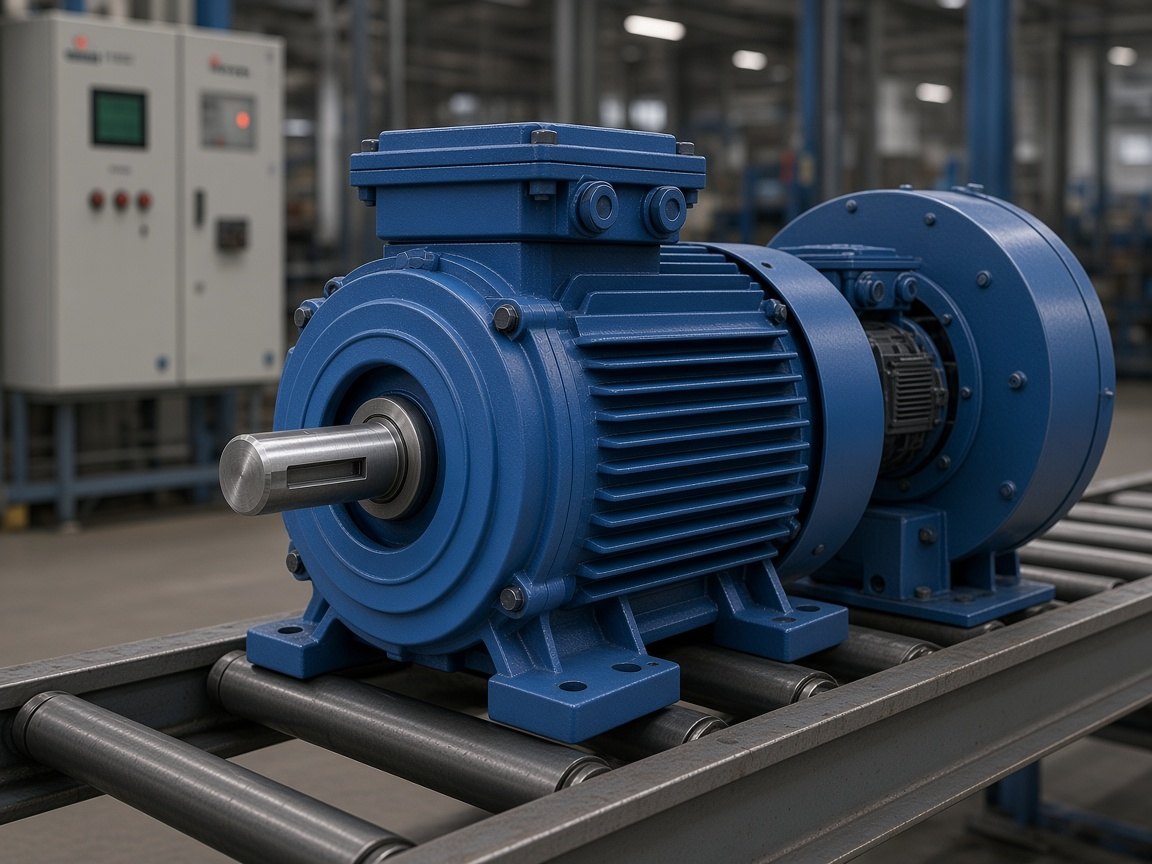
A standard motor on a converter has two weak points: its fan and its insulation. YVF2 is built around both.
01
The fan slows with the shaft
A shaft-mounted fan moves less air at low frequency, just when a constant-torque load keeps the current up. YVF2 has an independent axial fan, IC416, on its own supply. Airflow stays at full capacity from a crawl to top speed.
02
Pulse voltage on the winding
A converter feeds the winding with fast voltage pulses and harmonics. YVF2 uses reinforced insulation and vacuum pressure impregnation, in line with NEMA MG1 Part 31 practice.
03
Slow all day
Reinforced insulation and the separate fan are specified for S1 continuous duty at low speed. Conveyors, extruders and automated lines are the duties named.
04
Closing the loop
The non-drive end has a mounting face for a rotary encoder, for closed-loop speed or position control with a vector converter.
05
Above 50 Hz
Constant power above base frequency suits cutting and winding, where speed goes up and torque can come down. Check the top frequency for your frame in the table.
06
Site conditions
Ambient −15 °C to +40 °C. Altitude up to 1,000 m, with a power derating above that. Voltage tolerance ±5%. Catalog rows list Class F insulation and IP55. Class H is available for hot sites.
When the motor needs to be a VFD motor
Not every converter needs a special motor. These are the duties where it does.
Long hours at low speed
Conveyors, extruders and tension control running well below 50 Hz, where a shaft fan cannot keep up.
Constant torque down low
Hoisting and loaded conveyors that need full torque at a crawl.
Above base speed
Cutting and winding that run past 50 Hz at constant power.
A closed loop
Speed or position control with an encoder and a vector converter.
If the machine only needs two or three fixed speeds, a pole-changing motor on contactors may be simpler. See multi speed motors. For fans and pumps stepped by contactor, see YDT.
The YVF2 series
The model code reads left to right. In YVF2-225M-4, YVF2 is the series, 225 the frame height in millimetres, M the core length, and 4 the pole count.
Variable frequency · three-phase
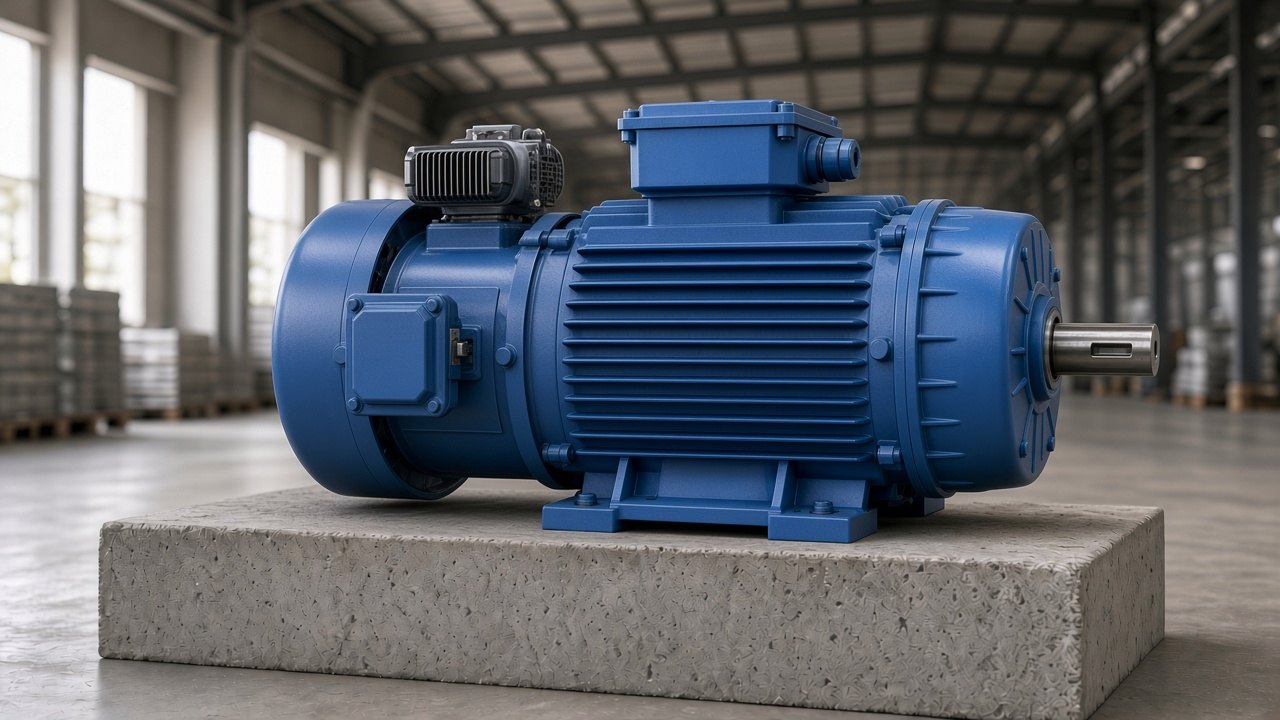
YVF2 Series VFD Motors
Three-phase induction motor for frequency converter duty. Independent IC416 axial fan, reinforced insulation with vacuum pressure impregnation, encoder mounting face at the non-drive end. Constant torque 5–50 Hz, constant power above 50 Hz.
0.18–375 kW · 2 · 4 · 6 · 8 · 10 poles · Frames 80–355 · IP55
Where YVF2 goes
Conveying and hoisting
Constant torque below base frequency for conveyors, lines and lifting.
Process lines
Extruders, textiles, metallurgy and food lines that run at many speeds.
Cutting and winding
Constant power above base frequency, and CNC duty with closed-loop control.
Industry pages: Material handling · Food and beverage · Mining and aggregates
Send the converter duty
The base frequency splits the two bands. Tell us where the machine runs on each side of it.
- Kilowatts and pole count, or the old nameplate
- Supply voltage and base frequency
- Lowest and highest frequency, and hours at each
- Load type: constant torque, constant power or fan
- Encoder, if the loop is closed
- Mounting: B3, B5, B35 or V1. The factory also builds B14, B34, V3 and V5.
Jiangxi Jiawang Special Motor · +86 199 0684 4761 · [email protected]
Before the quote
What is a VFD motor?
A three-phase motor built to run from a variable frequency drive. It keeps its cooling at low speed and its insulation is made for the converter’s pulse voltage. On JWMotor this is the YVF2 series.
Why does YVF2 have a separate fan?
Because it often runs slowly. A fan on the motor shaft then moves too little air. The IC416 fan has its own supply and keeps full airflow at any speed, which protects the winding and the insulation.
What frequency range can it run?
Constant torque from 5 Hz to 50 Hz on every model. Constant power above 50 Hz up to 100 Hz on most models. The catalog limits 4-pole frames 250–280 to 70 Hz, and 2-pole and 4-pole frames 315–355 to 60 Hz.
Can it run at low speed continuously?
Yes. Reinforced insulation and the separate cooling are specified for S1 continuous duty at low speed, for conveyors, extruders and automated lines.
Can I fit an encoder?
Yes. The non-drive end shaft and end shield have an encoder mounting interface, for closed-loop speed or position control with a vector converter. Tell us the encoder at the quote stage.
Do I need a VFD motor, or will a standard motor do?
If the motor runs near 50 Hz most of the time on a light or fan load, a standard motor may be enough. If it runs long hours at low speed, needs full torque at a crawl, or runs above 50 Hz, choose a VFD motor. Send the duty and we will advise.