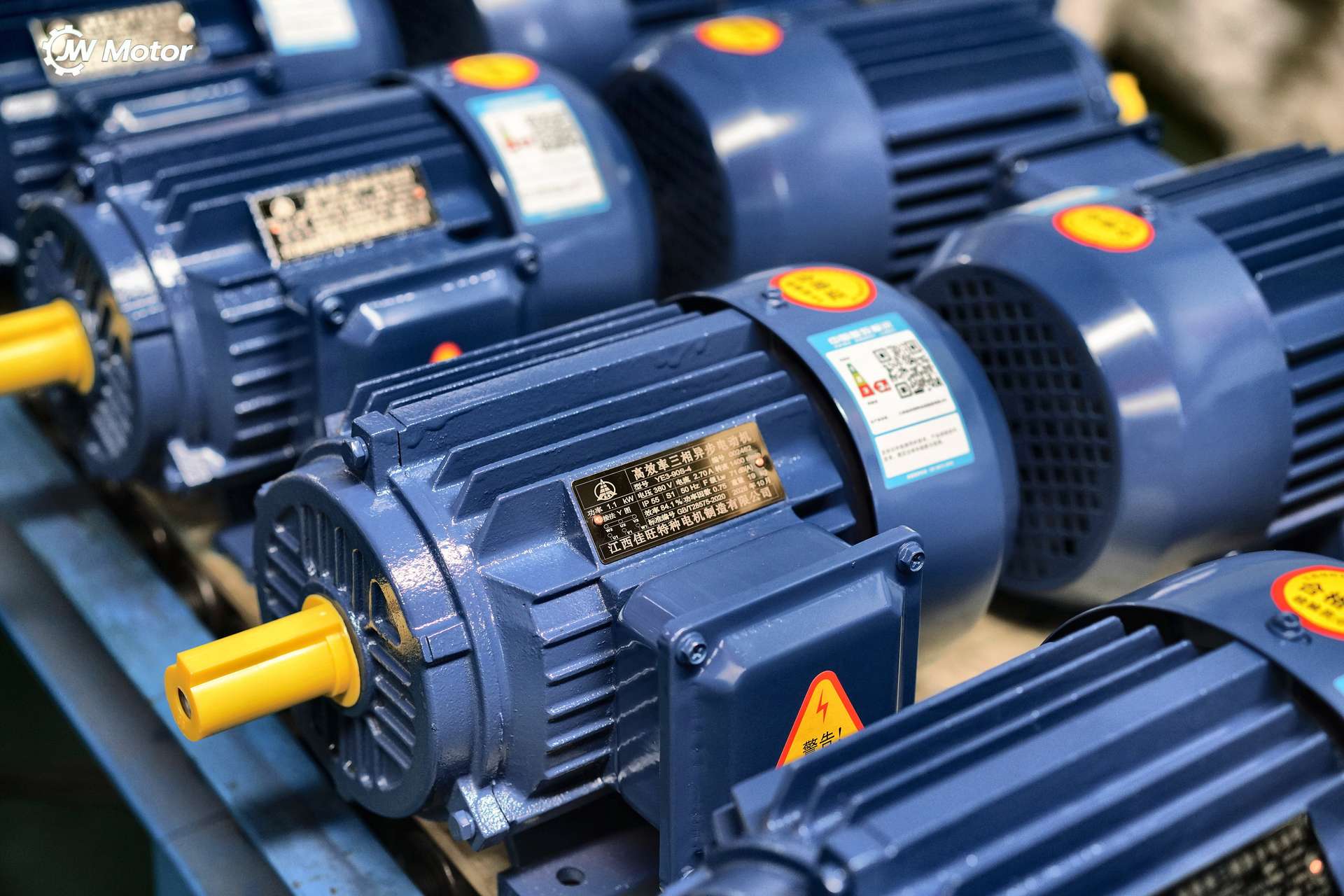
YVF2 model data · 5–100 Hz · IEC 80–355
Variable frequency motors
On a variable frequency motor the converter sets the speed. What matters is how far the model can go. Every YVF2 holds constant torque from 5 Hz to 50 Hz. Above 50 Hz it holds constant power, up to 100 Hz on most models and to 70 Hz or 60 Hz on the largest. Here is the catalog data by pole count and frame.
Model data by pole and frame
Rated figures are at 50 Hz, the base frequency. Find the row for your pole count and power, then read the top frequency on the right.
| Poles | Frames | Power | Rated speed at 50 Hz | Rated torque | Constant power up to |
|---|---|---|---|---|---|
| 2 | 80–160 | 0.75–15 kW | 2840–2930 r/min | 2.52–48.9 N·m | 100 Hz |
| 2 | 315–355 | 132–375 kW | 2975–2980 r/min | 424–1202 N·m | 60 Hz |
| 4 | 80–225 | 0.55–45 kW | 1390–1480 r/min | 3.78–291 N·m | 100 Hz |
| 4 | 250–280 | 55–90 kW | 1480 r/min | 355–571 N·m | 70 Hz |
| 4 | 315–355 | 110–375 kW | 1480–1490 r/min | 710–2404 N·m | 60 Hz |
| 6 | 80–355 | 0.37–315 kW | 885–990 r/min | 3.99–3039 N·m | 100 Hz |
| 8 | 80–355 | 0.18–250 kW | 645–740 r/min | 2.67–3226 N·m | 100 Hz |
| 10 | 315–355 | 45–132 kW | 590 r/min | 728–2137 N·m | 100 Hz |
Catalog performance is at 380 V, 50 Hz, IP55, Class F. Rated voltage on the series page is 220–690 V. The catalog has no 2-pole YVF2 between frames 160 and 315. Constant torque starts at 5 Hz on every row.
Reading the two bands
Speed follows frequency. At 50 Hz the motor runs at its rated speed. At 5 Hz it runs at about one tenth of that, and at 100 Hz about twice.
01
5 to 50 Hz: torque held
The rated torque in the table is available across the band, so shaft power falls in step with speed. A YVF2-225M-4 holds 291 N·m. At 25 Hz that is roughly half of its 45 kW.
02
Above 50 Hz: power held
Power stays at the rated kilowatts and torque falls as speed rises. The same 225M-4 can run to 100 Hz, where torque is about half of 291 N·m.
Three models from the catalog
The top frequency comes down as the frame gets bigger. Check it before you plan a speed above 60 Hz on a large motor.
03
YVF2-132M-4
7.5 kW at 1440 r/min, 49.7 N·m, 87.0% efficiency. Constant torque 5–50 Hz, constant power to 100 Hz.
04
YVF2-280M-4
90 kW at 1480 r/min, 571 N·m, 93.9% efficiency. Constant power is limited to 70 Hz on 4-pole frames 250 and 280.
05
YVF2-355L3-2
375 kW at 2980 r/min, 1202 N·m, 95.0% efficiency. 2-pole and 4-pole frames 315–355 stop at 60 Hz.
06
Reading the code
In YVF2-280M-4, YVF2 is the series, 280 the frame height in millimetres, M the core length, and 4 the pole count.
The YVF2 series
Every model in the table has the same build: an independent IC416 axial fan, reinforced insulation with vacuum pressure impregnation, and an encoder mounting face at the non-drive end.
Variable frequency · three-phase
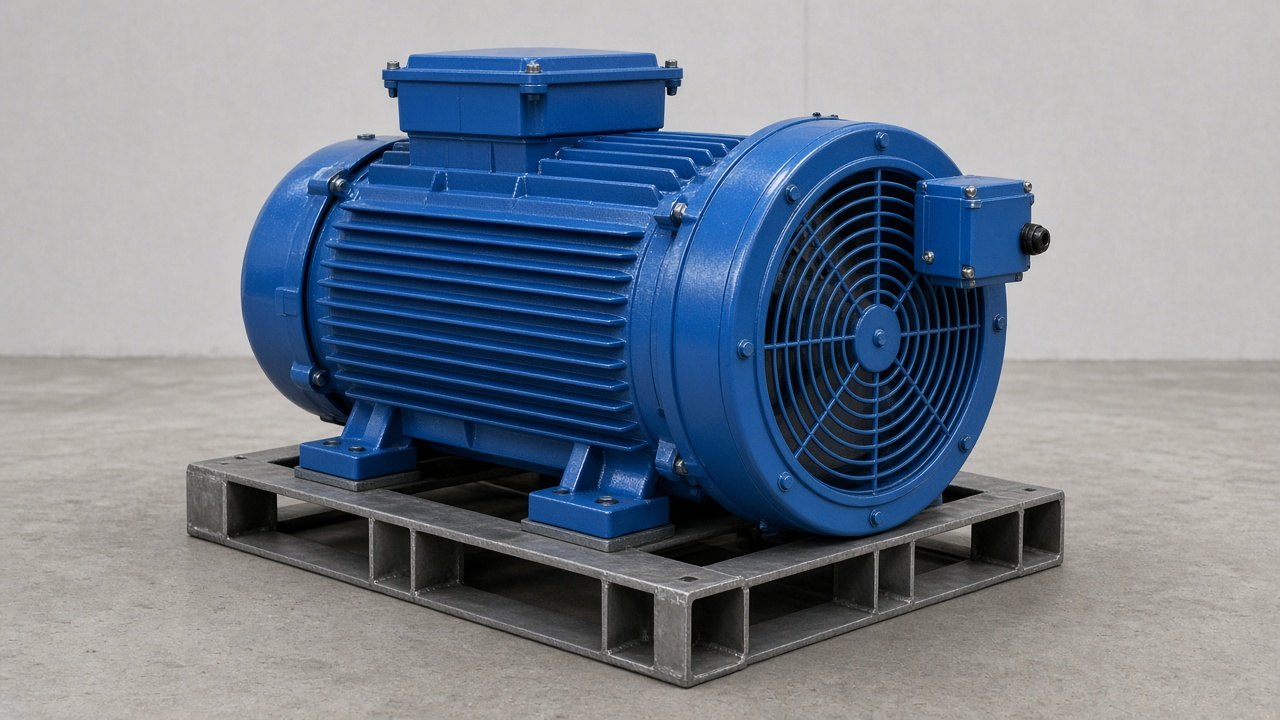
YVF2 Series Variable Frequency Motors
Three-phase induction motor for variable frequency drive systems. The separate fan keeps cooling up at low and even zero speed. The catalog notes smooth starting, low noise and vibration, and strong overload capability.
0.18–375 kW · 2 · 4 · 6 · 8 · 10 poles · Frames 80–355 · 5–100 Hz
Matching the band to the machine
Below base speed
Conveyors and hoisting, which need torque at low speed. They sit in the 5–50 Hz band.
Above base speed
Cutting and winding, where speed goes up and torque can come down. Check the top frequency for the frame.
Across the range
Textiles, metallurgy and CNC, the precision-speed duties the catalog names.
Choosing between a converter and fixed speeds? See variable speed electric motors. For the insulation and cooling build, see inverter duty motors.
Send the frequency range
The lowest and highest frequency decide the model as much as the kilowatts do.
- Kilowatts and pole count, or the old nameplate
- Supply voltage and base frequency
- Lowest and highest frequency, and hours at each
- Torque needed at the lowest speed
- Encoder, if the loop is closed
- Mounting: B3, B5, B35 or V1. The factory also builds B14, B34, V3 and V5.
Jiangxi Jiawang Special Motor · +86 199 0684 4761 · [email protected]
Before the quote
What is a variable frequency motor?
A three-phase induction motor designed to run from a frequency converter across a wide speed range. JWMotor’s is the YVF2 series, with constant torque from 5 Hz to 50 Hz and constant power above 50 Hz.
What is the highest frequency?
100 Hz on most models. The catalog limits 4-pole frames 250–280 to 70 Hz, and 2-pole and 4-pole frames 315–355 to 60 Hz. 6-, 8- and 10-pole models run to 100 Hz at every frame.
What is the lowest frequency?
The constant-torque band starts at 5 Hz on every catalog model. The separate fan keeps cooling up at that speed.
How much torque does it give at low speed?
Its rated torque, held from 5 Hz to 50 Hz. Rated torque is listed for every model, from 2.52 N·m on the YVF2-80M1-2 to 3226 N·m on the YVF2-355L3-8.
Which power range is in the catalog?
0.18 kW (YVF2-80M1-8) to 375 kW (YVF2-355L3-2 and 355L3-4), in IEC frames 80–355, with 2, 4, 6, 8 and 10 poles.
Can I get 60 Hz ratings?
The catalog data on this page is at 50 Hz. Send your base frequency and supply voltage, and we will confirm the rating for your grid.