
How to Calculate Motor Torque
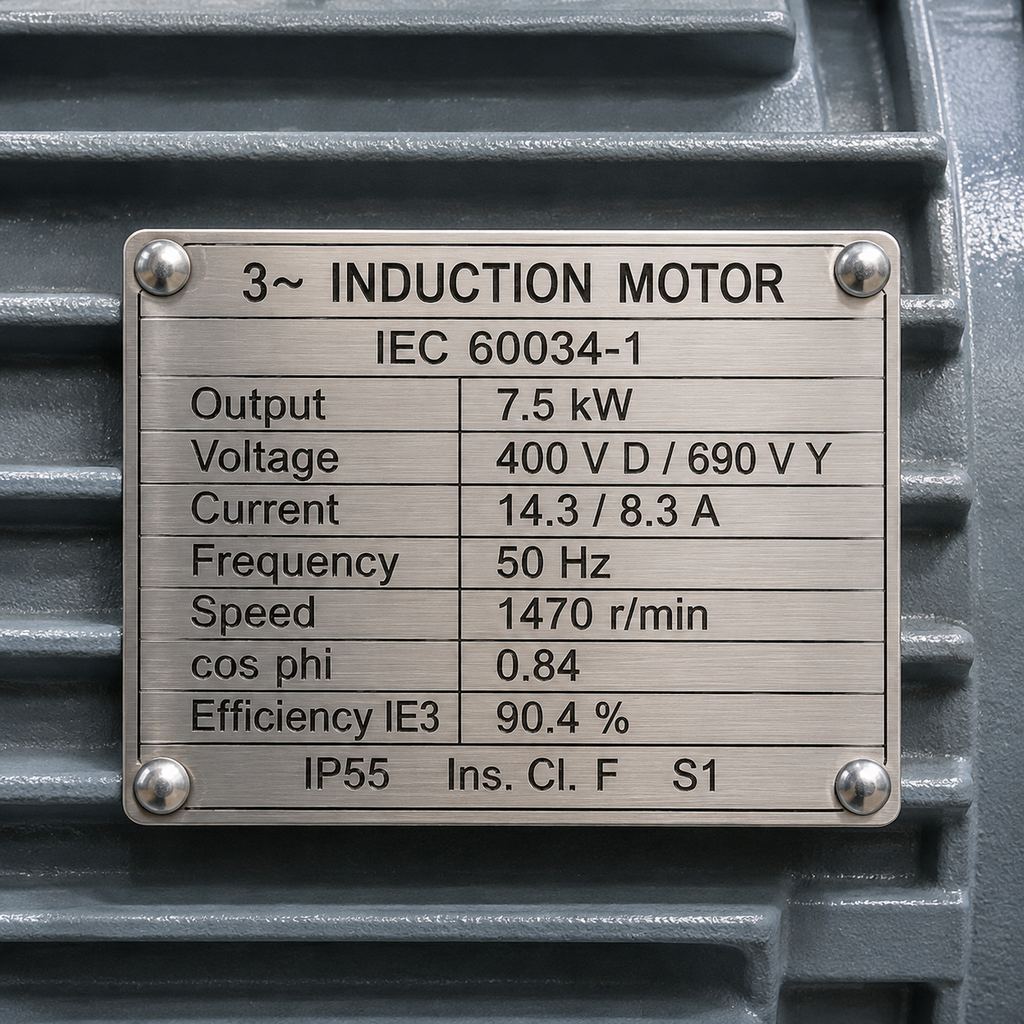
Motor torque is calculated using the formula: T (N·m) = 9550 × P (kW) ÷ n (rpm). Here, T represents torque, P is the rated output power in kilowatts, and n is motor speed in revolutions per minute. In imperial units the same relationship is T (lb·ft) = 5252 × P (hp) ÷ n (rpm). This formula translates shaft power and speed into rotational force, which is crucial for motor sizing and application matching. Use the nameplate full-load speed, not the synchronous speed, and remember that starting and breakdown torque are separate ratings listed on the datasheet.
Understanding Motor Torque
Motor torque is, at its core, the rotational force generated by an electric motor’s shaft to perform mechanical work. In engineering terms, torque is defined as the product of force and the perpendicular distance from the pivot point—essentially describing how strongly a motor drives rotation.
The unit of torque is Newton-meter (N·m) in the SI system, a combination of the physical quantities of force (in Newtons) and distance (in meters). In the Imperial system, torque is measured in pound-foot (lb·ft). This unit is often critical when specifying motors for machinery in regions where Imperial measurements are standard, such as the United States.
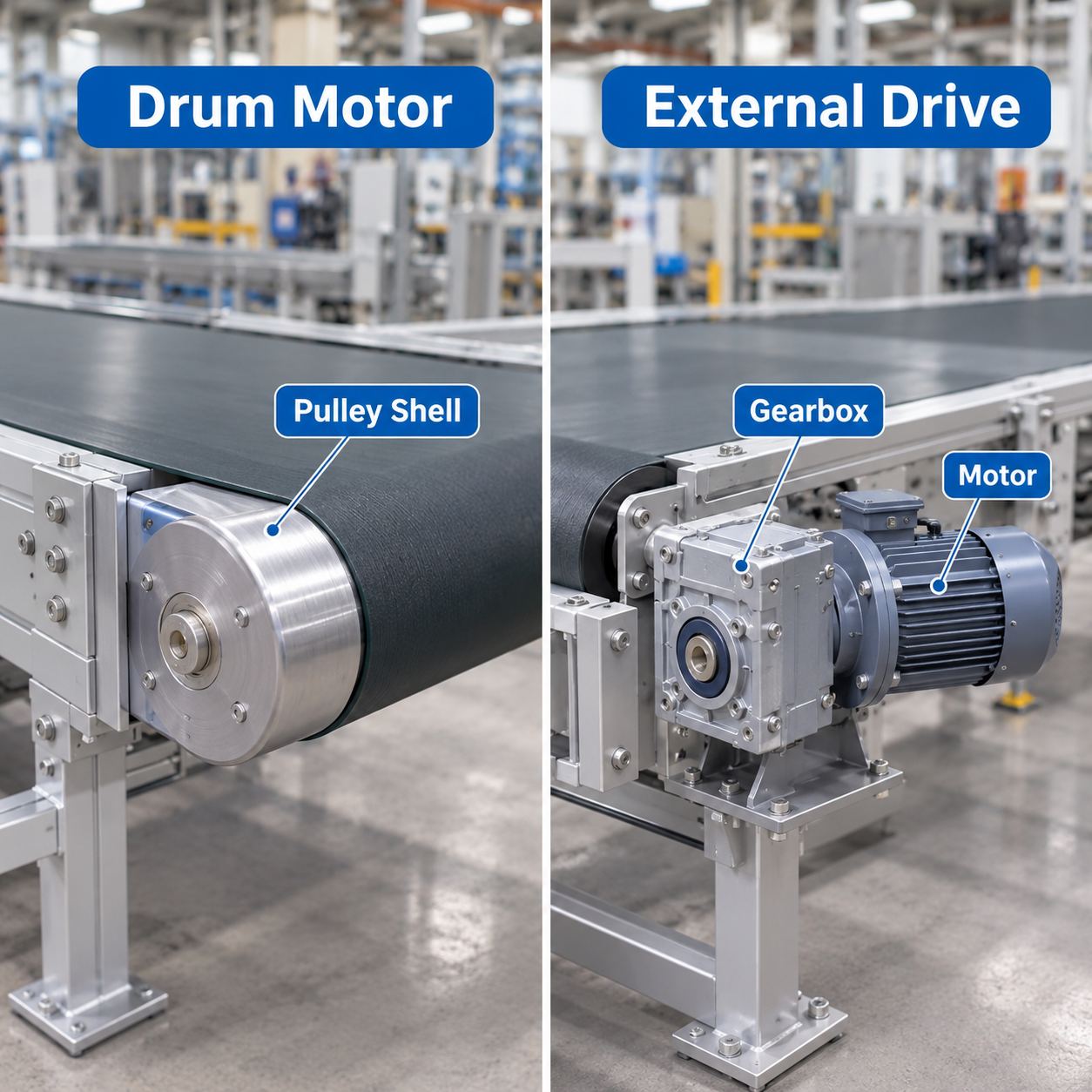
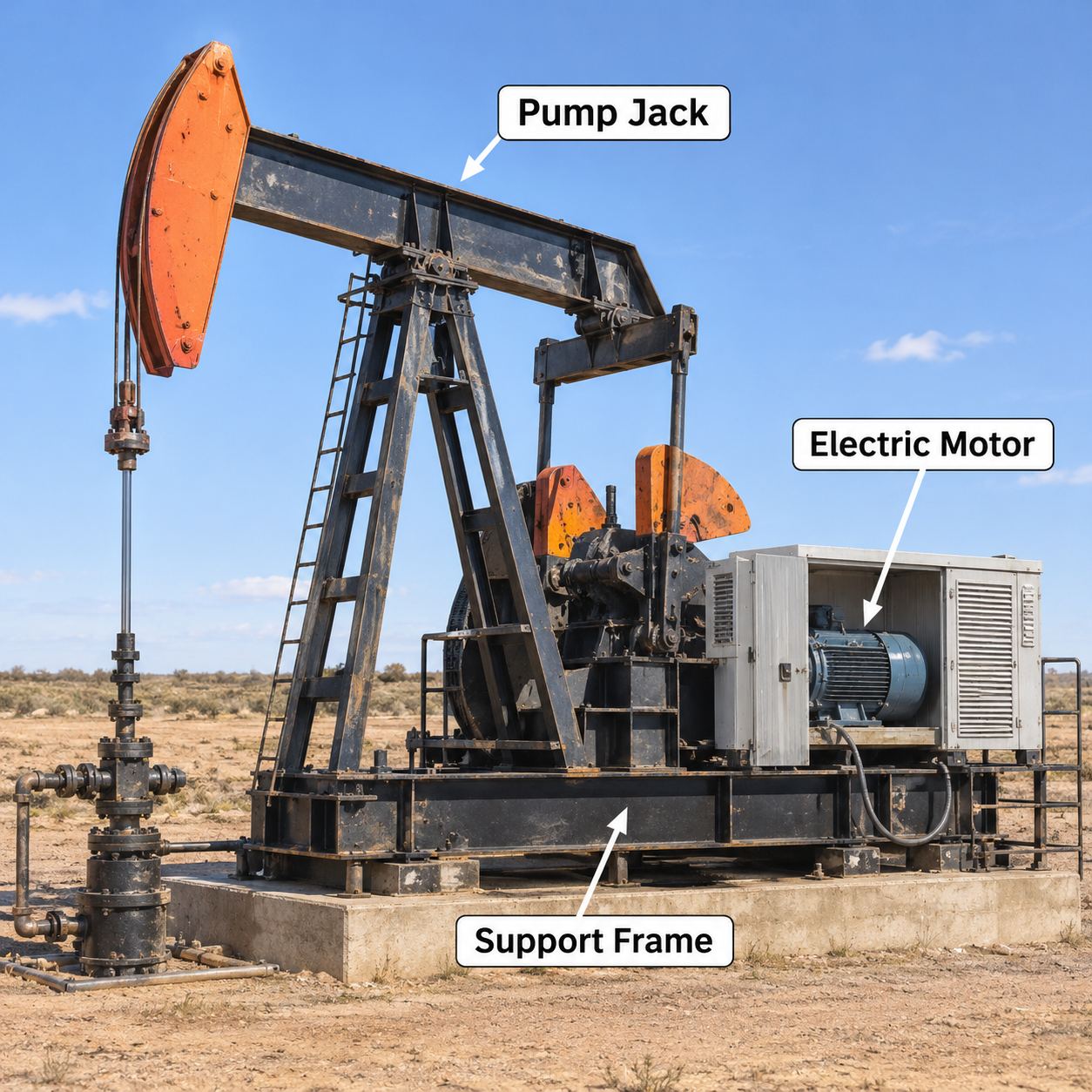
Torque is the direct output acting on a mechanical load, influencing the motor’s suitability for applications ranging from turning heavy conveyor belts to precision machinery. In a three-phase induction motor, the torque the motor can deliver changes as it accelerates from standstill to full-load speed, which is why datasheets list more than one torque value.
Understanding motor torque is essential because it links an electric motor’s power and rotational speed. For the same output power, a slower motor delivers more torque: a 6-pole motor produces roughly three times the torque of a 2-pole motor of the same kW rating. If you also need the current a motor draws at full load, see our guide on how to calculate full load current of a 3-phase motor.
Motor Torque Calculation Formulas
- The general SI formula is T (N·m) = P (W) ÷ ω (rad/s), where ω = 2π × n ÷ 60. With P in kilowatts this becomes T = P (kW) × 1000 × 60 ÷ (2π × n) = 9549.3 × P ÷ n, which is rounded to 9550 in everyday use. The Engineering ToolBox gives the same rated torque formula, T = 9550 P / n, with power in kW and rated speed in rpm.
- In imperial units, torque is calculated using the formula T (lb·ft) = 5252 × P (hp) ÷ n (rpm). In this case, P is power in horsepower, and n is motor speed in revolutions per minute. Note that 1 horsepower equals 0.7457 kW when converting between systems. A NEMA nameplate guide from ABB/Baldor writes the same relationship the other way round, horsepower = speed (rpm) × torque (lb·ft) ÷ 5,250; 5250 and 5252 are both rounded forms of 33,000 ÷ 2π.
- The power in these formulas is the mechanical output at the shaft—the rated kW or hp on the nameplate. Do not use electrical input power, and do not “correct” the result for efficiency; efficiency only matters when you start from measured input power (see how motor efficiency is determined).
Practical Torque Calculations
To understand motor torque calculation in practical terms, let’s go through a worked example step by step. This example assumes an electric motor with known power and speed values.
Example: Calculate Torque for a 1.5 kW, 4-pole Motor at Full Load
Given:
- Output power, P = 1.5 kW (kilowatts)
- Speed, n = 1430 rpm (an example full-load speed for a small 4-pole motor at 50 Hz; synchronous speed is 1500 rpm, so slip is about 4.7%)
In SI units, torque can be calculated using the formula:
T (N·m) = (9550 × P) ÷ n
Where:
- T is the torque in Newton-meters,
- P is the output power in kilowatts,
- n is the rotational speed in rpm,
- The constant 9550 comes from (60000 ÷ 2π) to handle unit conversions accurately.
Step 1: Substitute the known values
T = (9550 × 1.5) ÷ 1430
Step 2: Compute the numerator
9550 × 1.5 = 14,325
Step 3: Divide by the rotational speed
14,325 ÷ 1430 ≈ 10.0 N·m
Conclusion:
This motor provides a rated torque of about 10.0 Newton-meters at full load. Small motors have more slip than large ones, so always take n from the nameplate rather than assuming 1500 rpm—using 1500 rpm here would understate the torque by almost 5%.
Worked Examples at 380 V / 50 Hz: 2-, 4- and 6-Pole Motors
The supply voltage does not appear in the torque formula; it fixes the current, not the torque. What changes torque at a given power is the speed, which on a 50 Hz supply is set by the number of poles (synchronous speed = 120 × f ÷ poles) minus the slip. The table below uses an 11 kW three-phase induction motor on a 380 V / 50 Hz supply with example full-load speeds; your motor’s nameplate speed will differ slightly.
| Poles | Synchronous speed | Example full-load speed | Slip | Rated torque T = 9550 × 11 ÷ n |
|---|---|---|---|---|
| 2 | 3000 rpm | 2930 rpm | 2.3% | 35.9 N·m |
| 4 | 1500 rpm | 1460 rpm | 2.7% | 72.0 N·m |
| 6 | 1000 rpm | 970 rpm | 3.0% | 108.3 N·m |
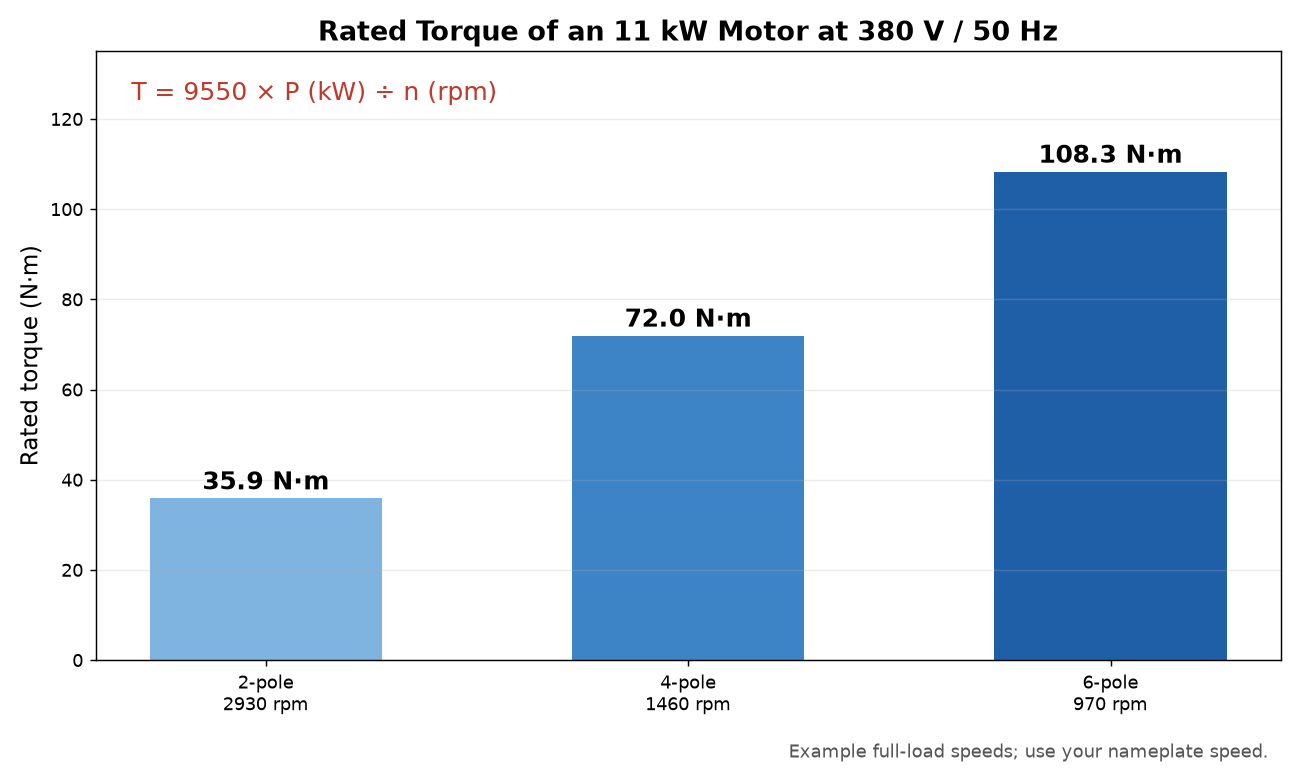
The same 11 kW produces three times the shaft torque at 6 poles as at 2 poles, which is why low-speed, high-torque loads are often served by a higher pole count or a gear reducer rather than a bigger motor.
Insight for Buyers and Engineers:
- Ensure that the calculated torque aligns with the load requirements of your application, such as pumps, fans, or conveyors. If the motor’s torque is lower than the load needs at any point during acceleration, the motor will not reach speed or may stall.
- Compare your calculated value with the rated torque listed in the catalog or datasheet. Small differences come from rounding the nameplate speed; no efficiency correction is needed because the rating is already shaft output.
For those working with motors in imperial units, the process uses a similar formula but adjusted with a constant for horsepower:
T (lb·ft) = (5252 × P) ÷ n
For example, a 15 hp, 4-pole motor running at 1760 rpm on 60 Hz delivers T = 5252 × 15 ÷ 1760 ≈ 44.8 lb·ft, which is about 60.7 N·m (1 lb·ft = 1.356 N·m). This is ideal for users in the United States who work with motors rated in horsepower.
Rated vs Starting vs Breakdown Torque
The formula above gives the rated (full-load) torque. An induction motor’s datasheet lists other torque points too, and these decide whether the motor can actually start and accelerate the load:
- Rated (full-load) torque, T_N: the torque at rated power and full-load speed, calculated with T = 9550 × P ÷ n.
- Locked-rotor (starting) torque, T_st: the torque the motor develops at zero speed. A high starting torque matters for machines that are hard to start, like positive displacement pumps and cranes, while centrifugal fans and pumps can accept a lower one.
- Pull-up torque: the lowest torque on the curve between standstill and the breakdown point.
- Breakdown (maximum) torque, T_max: the highest torque the motor can produce before it stalls; a short overload above T_N is tolerated as long as it stays below this value.
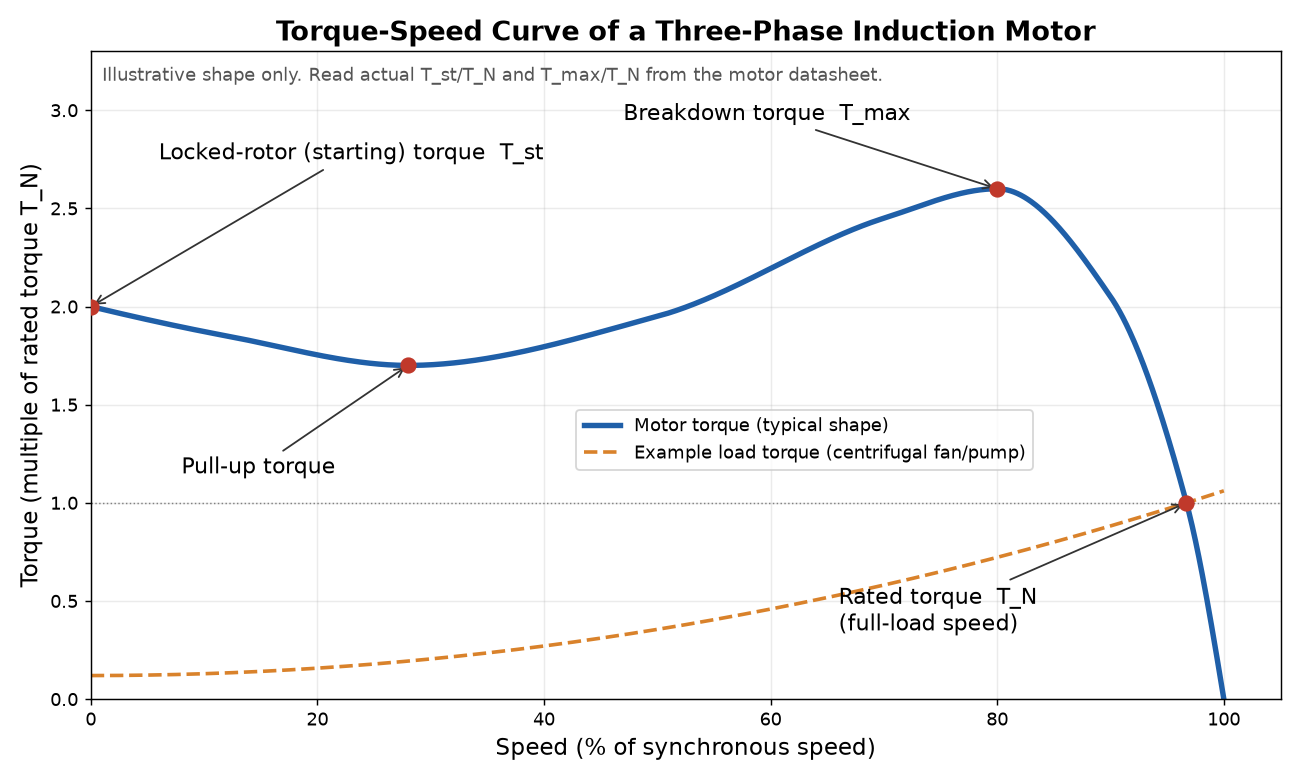
Starting and breakdown torque are usually given as multiples of rated torque. For general-purpose induction motors, T_st/T_N commonly falls around 1.5 to 2.5 and T_max/T_N around 2 to 3, but the exact values depend on the design, size and pole count, so always read them from the datasheet. ABB’s low voltage motor guide shows a 4-pole, 160 kW, 1475 r/min motor with T_N = 1040 N·m, a starting torque of 1.7 × 1040 = 1768 N·m and a maximum torque of 2.8 × 1040 = 2912 N·m. Checking the first number with the formula: 9550 × 160 ÷ 1475 = 1036 N·m, which rounds to the published 1040 N·m.
For the 11 kW, 4-pole example above (T_N = 72.0 N·m), a datasheet ratio of 2.0 for starting torque and 2.3 for breakdown torque would mean about 144 N·m at standstill and about 165 N·m maximum. These are illustrative ratios, not guaranteed values for any particular motor. Test results also carry a tolerance: under IEC 60034-1, the measured locked-rotor torque may deviate from the declared value by −15% to +25%.
Torque classes are standardised. NEMA Design B is the general-purpose design with normal starting torque, while Design C has high starting torque for loaded starts such as conveyors and positive displacement pumps. On the IEC side, torques of IEC Design N motors are close to NEMA Design B, and IEC Design H is nearly identical to NEMA Design C. JWMotor’s catalog lists rated torque for every model, and the high-torque motor options also list starting and breakdown torque.
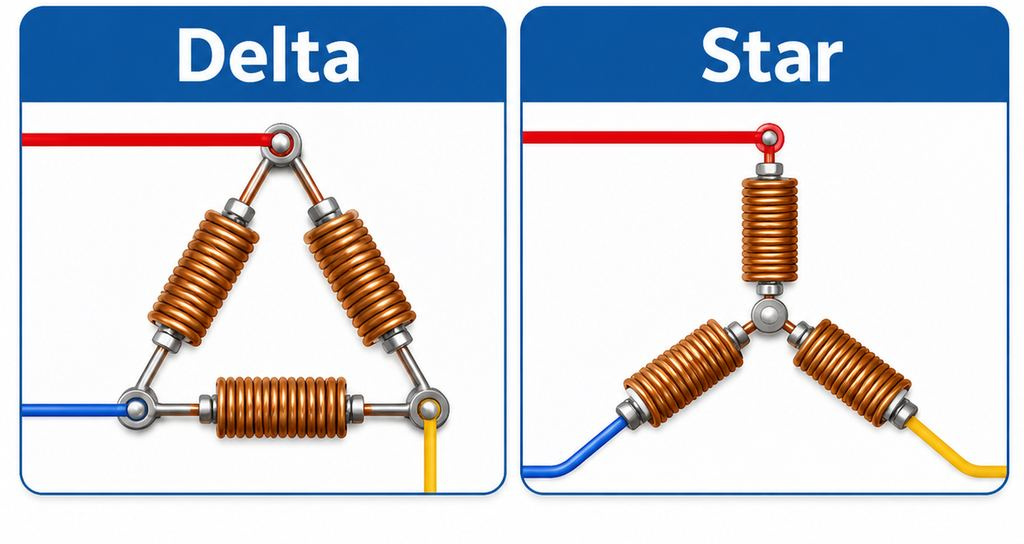
The starting method matters as well. With star-delta starting, the same ABB guide notes that the starting current falls to about 30% of the direct-on-line (DOL) value and the starting torque to about 25% of its DOL value, so check that the reduced torque still exceeds the load torque across the speed range.
Tools and Tips for Accurate Torque Measurement
- Use a calibrated torque meter to ensure accurate measurements. When selecting a tool, ensure it is suited to the motor’s torque range and follows the manufacturer’s guidelines for calibration frequency and method.
- Position the torque sensor correctly for accurate readings. Ensure the alignment between the motor shaft and the torque sensor is precise to prevent inaccuracies caused by misalignment or uneven force distribution.
- Account for external factors like load inertia and friction. These can introduce errors in torque measurement. Use stable test conditions and consistently replicate load scenarios for reliable results.
- Perform multiple measurements and average the values. This practice helps identify any unusual spikes or drops, offering a more consistent and reliable reading of motor torque. Measure at the operating point you care about: a reading at full-load speed checks rated torque, while locked-rotor and breakdown torque need a dedicated test across the speed range.
FAQs on Motor Torque Calculation
How does one calculate motor torque?
Motor torque can be calculated using the formula T (N·m) = 9550 × P (kW) ÷ n (rpm). Here, T is the torque in Newton-meters, P represents output power in kilowatts, and n is the motor speed in revolutions per minute. For imperial units, the formula becomes T (lb·ft) = 5252 × P (hp) ÷ n (rpm). Ensure you know both power and speed to apply it correctly.
How do I convert kW to torque?
To convert kW to torque, use the formula T (N·m) = 9550 × P ÷ n, where P is motor power in kilowatts and n is the speed in revolutions per minute. This equation directly links mechanical power to torque. For industries using imperial units, convert kW to horsepower (1 kW = 1.34102 hp) and use the corresponding formula T (lb·ft) = 5252 × P ÷ n.
What is motor torque measured in?
Motor torque is measured in Newton-meters (N·m) in the metric (SI) system, which combines force (Newtons) and distance (meters). In the imperial system commonly used in the US, it is measured in pound-foot (lb·ft). These units correspond to rotational force applied at a radius around the motor’s axis.
What factors influence calculated motor torque?
Calculated rated torque depends on two inputs: the rated mechanical output power and the full-load speed. Speed is set by the supply frequency, the number of poles and the slip, so a motor with more poles or a lower frequency produces more torque for the same power. Efficiency does not enter the calculation when you start from the nameplate output rating.
Can motor torque vary during operation?
Yes, motor torque can vary during operation due to changes in loading, speed fluctuations, and electrical performance factors like voltage deviations. For induction motors, slip plays a role in determining how torque shifts at different speeds, especially during starting or under variable load.
Is torque calculation different for AC and DC motors?
The fundamental approach to torque calculation—using power and speed—is the same for AC and DC motors. However, DC motors allow additional calculation methods using electrical parameters like armature current. For AC induction motors, the torque at a given speed also depends on slip, which is why the torque-speed curve shows separate starting, pull-up and breakdown values.
Conclusion
Accurate torque calculation is a cornerstone for both motor selection and efficient machinery operation. Start with T = 9550 × P ÷ n using the nameplate kW and full-load speed, then check the starting and breakdown torque ratios on the datasheet against the load’s starting demand. For buyers and engineers, consider every variable—power, speed, load dynamics, starting method and operating environment—when evaluating motors. If you are choosing a motor for a new application, our three-phase induction motor range covers the IE2, IE3 and IE4 lines in IEC frames 63–355.

2 thoughts on “How to Calculate Motor Torque: Formula, Worked Examples and Starting vs Breakdown Torque”