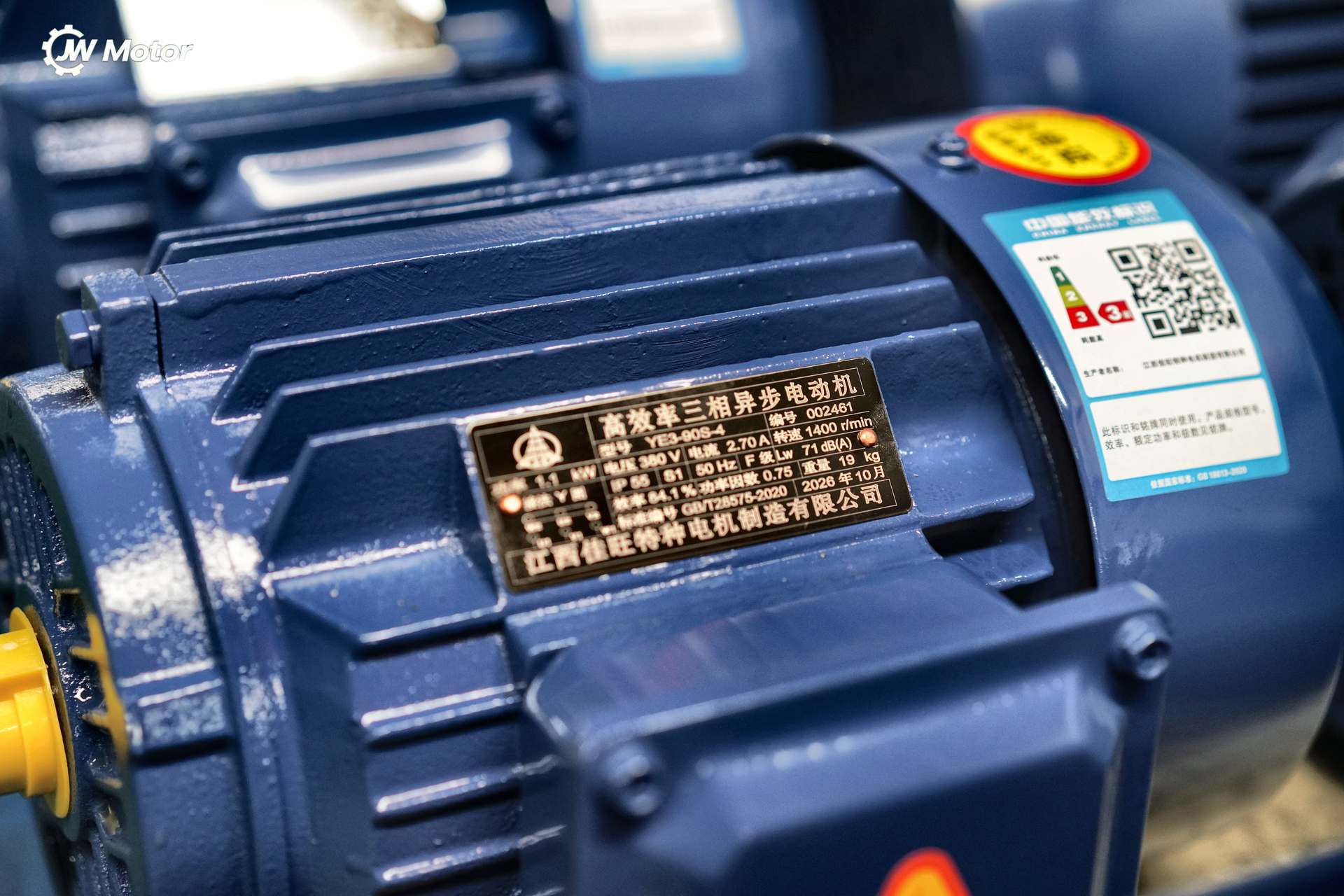
Converter duty · YVF2 · VPI insulation
Inverter duty motors
A converter stresses a motor in ways the mains never does: fast voltage pulses on the winding, and long hours at low speed with too little air. JWMotor’s inverter duty motor is the YVF2 series. It has reinforced insulation with vacuum pressure impregnation, inverter-duty magnet wire and a separately powered IC416 fan. The catalog runs 0.18–375 kW in IEC frames 80–355.
What a converter does to a motor
An inverter duty motor is judged on three things: the winding insulation, the cooling, and the bearings. This page covers how YVF2 is built for each. For choosing a motor by speed band, see VFD motors.
Pulse voltage on the winding
The converter switches fast. Each edge puts a voltage spike and harmonic stress on the winding. Air pockets in the insulation are where corona and partial discharge start.
Heat at low speed
A shaft-mounted fan slows with the shaft. At low frequency it moves too little air while a constant-torque load keeps the current up.
Bearings run longer hours
Converter duty often means slow, continuous running. Bearing grade, clearance and grease life matter as much as on the mains.
Proof, not a claim
Insulation quality has to be measured. Every motor is tested before it ships, and each one ships with its own data sheet.
The insulation system
The YVF2 product page describes reinforced insulation and vacuum pressure impregnation for the high-frequency pulse voltage and harmonic stress of a VFD, in line with NEMA MG1 Part 31 inverter-duty practice. This is how the materials and process pages break that down.
| Layer | What JWMotor uses | Why it matters on a converter |
|---|---|---|
| Magnet wire | Inverter-duty enamelled copper wire from Grandwall and HUAON, UL certified, Class H thermal rating | The enamel is made to withstand voltage spikes and fast switching (dV/dt) and to resist corona discharge |
| Impregnation | Vacuum pressure impregnation (VPI), not a simple dip and bake | Removes air voids, which gives a solid barrier against corona and partial discharge |
| Thermal class | Class F (155 °C) in the catalog, designed to a Class B (130 °C) temperature rise. Class H available | A 25 °C thermal reserve, useful when the converter adds harmonic heating |
| Testing | Insulation resistance and polarization index after VPI, a high-voltage pulse scan of every winding, and a withstand test at 2 × rated voltage + 1000 V | Finds enamel damage and weak spots before the motor reaches your converter |
The YVF2 catalog intro and every catalog row list Class F insulation. Class H insulation is available for high-temperature sites. See insulation class, copper wire and quality for the source pages.
Cooling that does not depend on speed
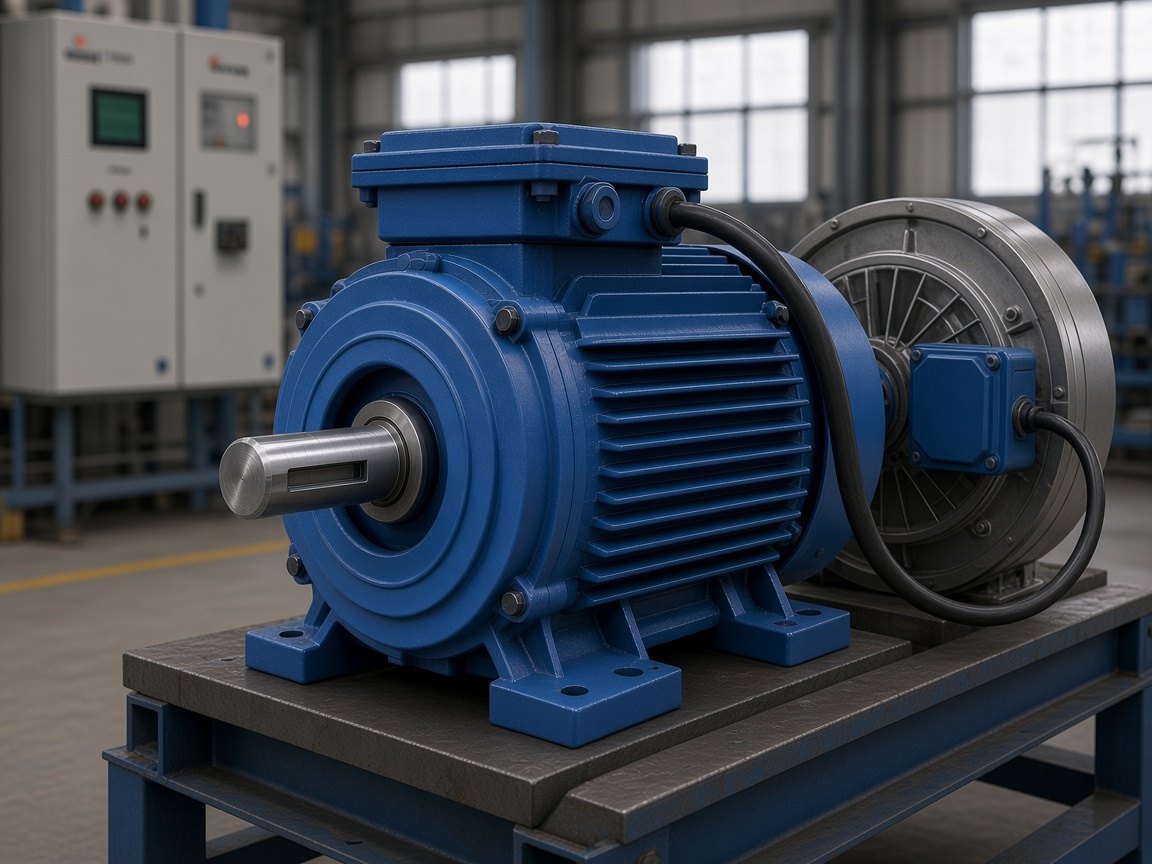
YVF2 carries an independent axial fan, IC416, on its own supply. The catalog says it keeps heat dissipation effective at low or even zero speed.
01
Full airflow at a crawl
The fan runs at full capacity whether the motor crawls or runs at top speed. That removes the burnout risk of a self-cooled motor at low frequency, and protects the insulation.
02
Sensors in the winding
PTC thermistors, PT100 sensors or bimetallic switches can be built into the winding. Tell us which one your converter or relay reads.
Bearings
JWMotor fits deep groove ball bearings from SKF, NSK and C&U, with C3 clearance for the thermal growth of a hot shaft.
03
Design life
The catalog gives a bearing design life for frames H80–H400 of 20,000 hours on 2-pole motors and 30,000 hours on 4-, 6-, 8- and 10-pole motors. That figure is for 50 Hz running under normal conditions with regular grease changes.
04
Clearance and grease
C3 clearance gives the bearing room to expand as the rotor heats up. The bearing page gives a grease and seal range of −40 °C to +150 °C.
05
Insulated bearings
Insulated bearings and shaft grounding are not part of the published YVF2 specification. If your site standard calls for them, put it in the request and we will answer before we quote.
06
Encoder end
The non-drive end shaft and end shield have an encoder mounting interface, for closed-loop speed or position control with a vector converter.
The YVF2 series
One series for converter duty, 2 to 10 poles. Constant torque from 5 Hz to 50 Hz, constant power above 50 Hz.
Inverter duty · three-phase
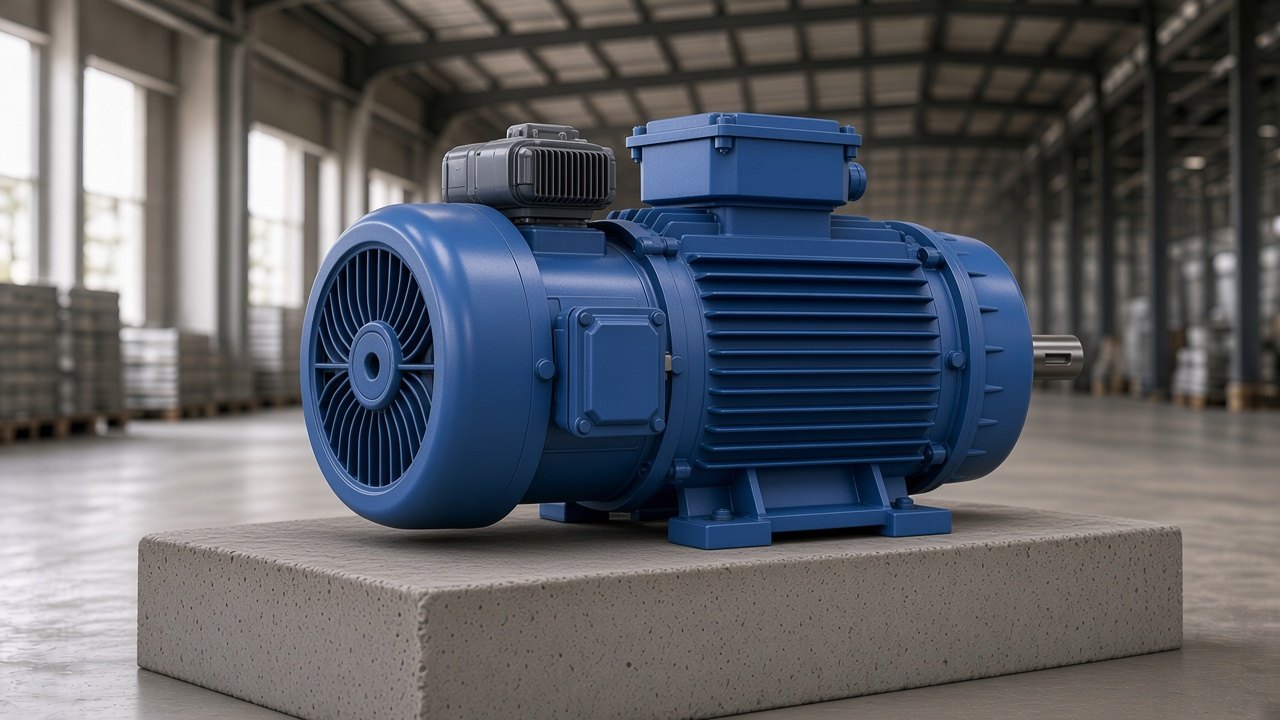
YVF2 Series Inverter Duty Motors
Three-phase induction motor for frequency converter duty. Reinforced insulation with VPI, independent IC416 axial fan, encoder mounting face at the non-drive end. Built to IEC frame dimensions for use with the main converter brands.
0.18–375 kW · 2 · 4 · 6 · 8 · 10 poles · Frames 80–355 · IP55 · Class F
Catalog performance is at 380 V, 50 Hz. Rated voltage on the series page is 220–690 V. Ambient −15 °C to +40 °C, altitude up to 1,000 m with a power derating above that, voltage tolerance ±5%. For frequency limits per pole and frame, see variable frequency motors.
Where inverter duty matters
Slow and continuous
Conveyors, extruders and automated lines running S1 at low speed, where cooling and insulation both work hardest.
Precision speed
Textiles, metallurgy and CNC, the duties the catalog names for YVF2.
Closed loop
Speed or position control with an encoder on the non-drive end and a vector converter.
Industry pages: Material handling · Manufacturing · Mining and aggregates
Send the converter and the site
Insulation and bearing choices depend on the converter and the installation, not only on kilowatts.
- Kilowatts and pole count, or the old nameplate
- Supply voltage and base frequency
- Converter make and model, and the cable length to the motor
- Lowest and highest frequency, and hours at each
- Thermal sensor wanted: PTC, PT100 or bimetallic switch
- Any site standard for insulation class, insulated bearings or shaft grounding
- Mounting: B3, B5, B35 or V1. The factory also builds B14, B34, V3 and V5.
Jiangxi Jiawang Special Motor · +86 199 0684 4761 · [email protected]
Before the quote
What makes a motor inverter duty?
Insulation that withstands the converter’s pulse voltage, and cooling that does not fall away at low speed. On YVF2 that means reinforced insulation with vacuum pressure impregnation, inverter-duty magnet wire, and a separately powered IC416 fan.
Is YVF2 insulation Class F or Class H?
The catalog lists Class F (155 °C) on every YVF2 model, designed to a Class B temperature rise. Class H insulation is available for high-temperature environments. The magnet wire itself carries a Class H thermal rating.
Why does VPI matter on a converter?
Vacuum pressure impregnation fills the winding and removes air voids. Voids are where corona and partial discharge begin under fast voltage pulses. A simple dip and bake can leave them behind.
Does it meet NEMA MG1 Part 31?
The product page describes the insulation system as in line with NEMA MG1 Part 31 inverter-duty practice. If your project needs a formal certificate against a standard, ask before you order.
Do you fit insulated bearings?
They are not part of the published YVF2 specification. Standard bearings are SKF, NSK or C&U deep groove ball bearings with C3 clearance. Put any insulated-bearing or shaft-grounding requirement in the request.
How is the insulation tested?
Insulation resistance and polarization index are measured to verify the VPI. Windings get a high-voltage pulse scan for enamel damage, and a withstand test at twice rated voltage plus 1000 V. Each motor ships with its own data sheet of resistance, hipot and vibration results.
Is this the same page as VFD motors?
Same product, different question. VFD motors helps you choose by speed band. This page explains the insulation, cooling and bearings that make YVF2 suitable for a converter.