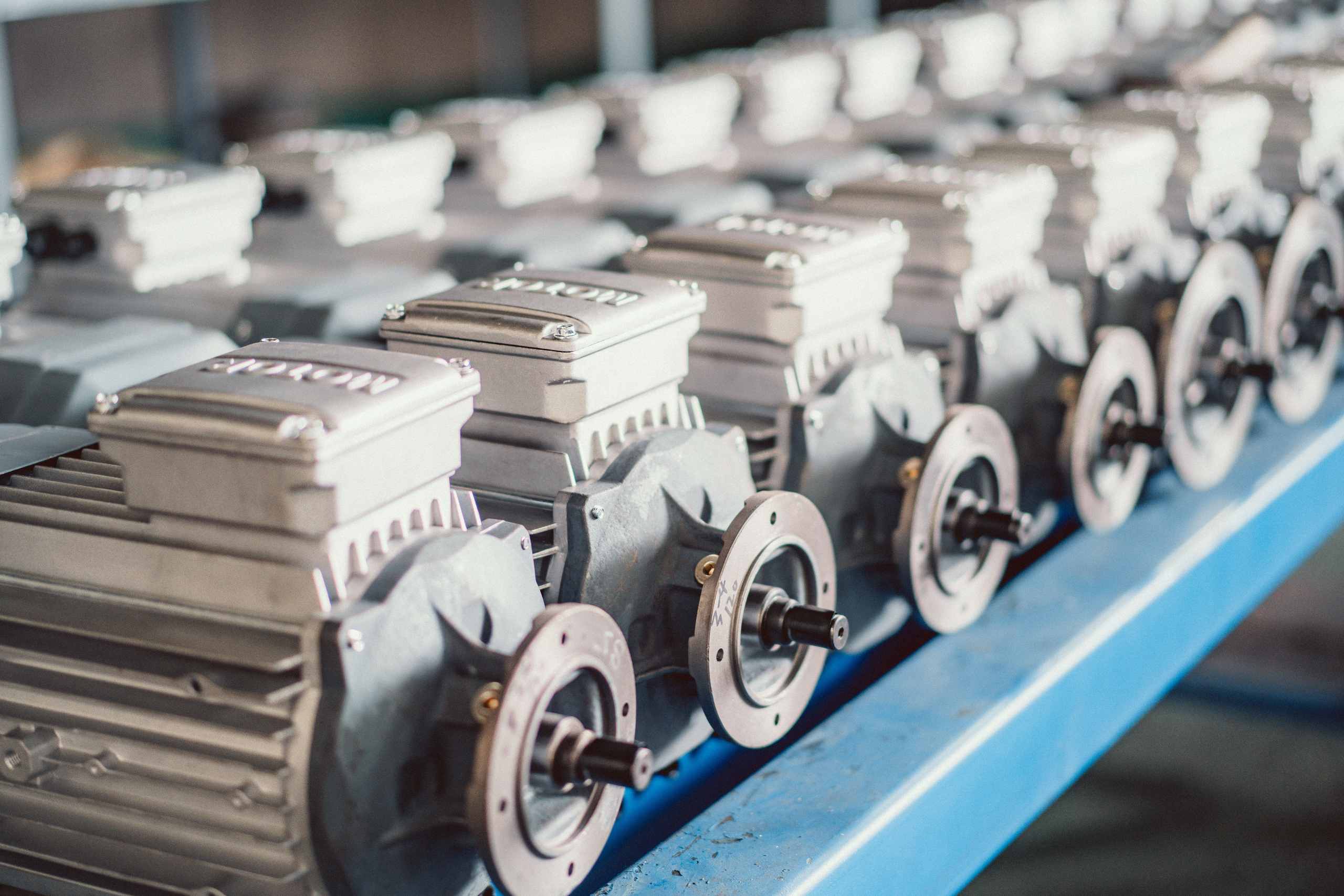
Power-off brake · YEJ · 0.75–45 kW
Brake motors
Three-phase motors with a DC electromagnetic brake built on. The brake is released while the motor runs. When power drops, springs lock the rotor, so a lifted load stays where it is and a machine stops instead of coasting. JWMotor builds them as the YEJ series: 0.75–45 kW, poles 2, 4, 6 and 8, IEC frames 80–225, 220–690 V.
Pick the frame, then the stop
A brake motor is chosen on two things: the power and speed of the motor, and how fast the shaft has to stop. The YEJ catalog lists 50 models. Braking time grows with frame size, because the rotor and the load behind it carry more inertia.
| IEC frame | Power in the catalog | Poles | Braking time, not more than |
|---|---|---|---|
| 80 | 0.75–1.1 kW | 2, 4 | 0.20 s |
| 90 | 0.75–2.2 kW | 2, 4, 6 | 0.20–0.25 s |
| 100 | 1.5–3 kW | 2, 4, 6 | 0.25 s |
| 112 | 2.2–4 kW | 2, 4, 6 | 0.25 s |
| 132 | 0.75–7.5 kW | 2, 4, 6, 8 | 0.25 s |
| 160 | 2.2–18.5 kW | 2, 4, 6, 8 | 0.35 s |
| 180 | 7.5–22 kW | 2, 4, 6, 8 | 0.35–0.45 s |
| 200 | 11–37 kW | 2, 4, 6, 8 | 0.45 s |
| 225 | 18.5–45 kW | 2, 4, 6, 8 | 0.45 s |
Braking times are the catalog maximums under the catalog test condition. The stop on your machine depends on the load inertia and the brake torque setting. By pole count, 2-pole and 4-pole models run 0.75–45 kW, 6-pole 0.75–30 kW, and 8-pole 0.75–18.5 kW. Every model, with speed, current, efficiency and power factor, is on the YEJ model list.
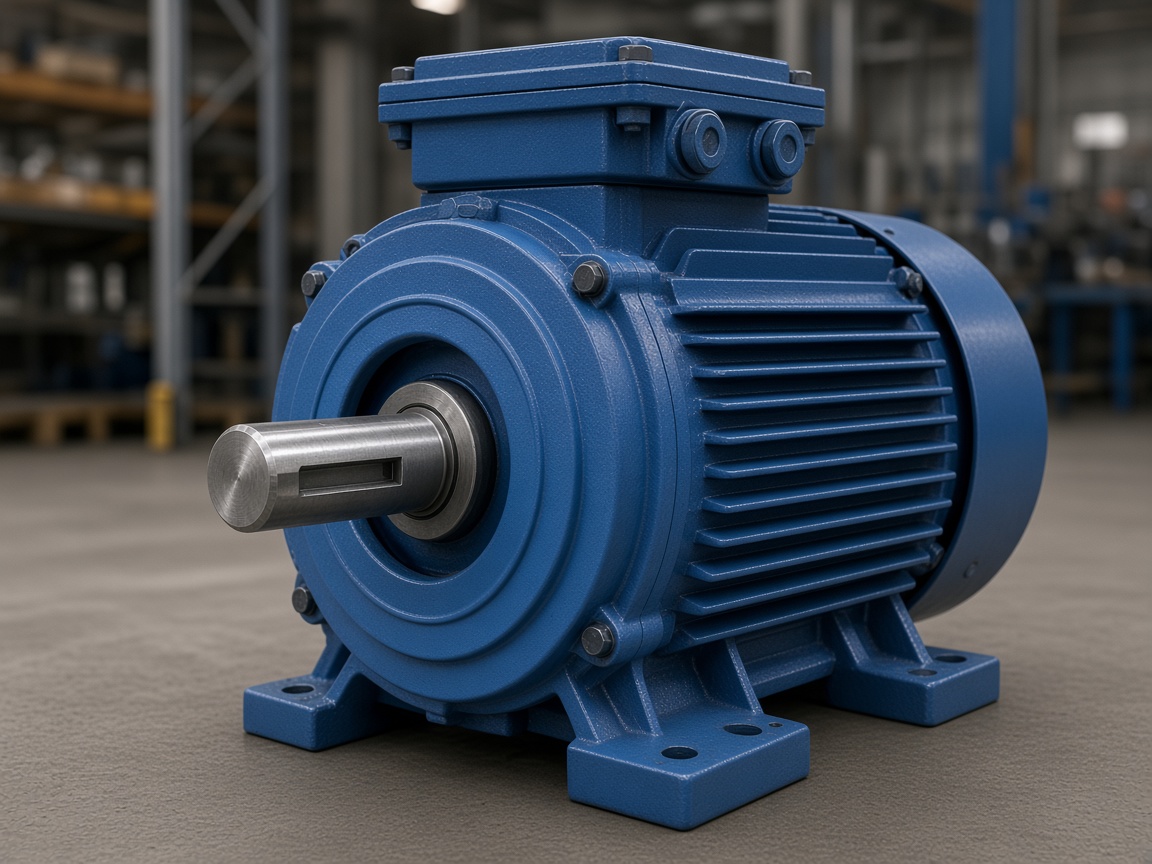
How the brake works
On a brake motor the brake is usually mounted at the non-drive end. Because the springs do the braking, a supply failure applies the brake rather than releasing it.
01
Springs apply, the coil releases
With the motor energized, the DC coil pulls the armature disc clear and the shaft turns freely. Cut the power and the springs press the disc onto the friction lining. The rotor stops and is held.
02
Rectifier in the box
The AC/DC rectifier for the brake coil sits in the terminal box. A standard AC supply is enough. No separate DC cabinet.
03
Stopping and holding
A brake motor does two jobs. It stops a moving load, and it holds a load at rest. On a horizontal conveyor the brake mostly stops. On a hoist or any vertical axis it also has to hold against gravity for as long as the power is off. Tell us which one your machine needs.
04
Brake torque is set on the springs
Brake torque on YEJ is adjusted with the pressure springs in the brake. The series page asks for an air gap of 0.2 mm to 0.5 mm so the friction stays consistent. Too little torque lengthens the stop. Too much gives a hard stop on gearboxes and couplings. As a general rule, the brake torque should be at least the motor’s rated torque, with more margin for vertical loads. Rated torque in N·m is 9550 × kW ÷ r/min. A YEJ132M-4, 7.5 kW at 1440 r/min, is about 50 N·m.
05
Manual release
A lever releases the brake during an outage, maintenance or commissioning, so the shaft can be turned by hand.
06
Site conditions
Ambient −15 °C to +40 °C. Altitude up to 1,000 m, with a power derating above that. Voltage tolerance ±5%. Class H insulation is available for hot sites.
When a standard motor is not enough
A standard three-phase motor coasts when power is cut. How far it runs on depends on the inertia of the rotor and the load. A brake motor makes sense when that run-on is a problem:
A load can fall
Hoists, lifting platforms and other vertical axes, where the load has to stay put if power fails.
Position matters
Indexing on assembly lines, stacker cranes and packaging machines, where the shaft has to stop at the same point each cycle.
Run-on is a hazard
Emergency stops on machines and conveyors that must not keep moving after the stop button.
Starts and stops all day
The YEJ catalog describes the series for frequent start-stop cycles and quick response.
If the shaft only has to slow down and a short coast is acceptable, a standard motor, or a converter ramp, may be enough. If speed has to change through a band, see YVF2.
The YEJ series
The model code reads left to right. In YEJ132M-4, YEJ is the series, 132 is the frame height in millimetres, M is the core length (S, M or L, sometimes with 1 or 2), and 4 is the pole count. Read it off the old nameplate and the replacement starts from the same frame.
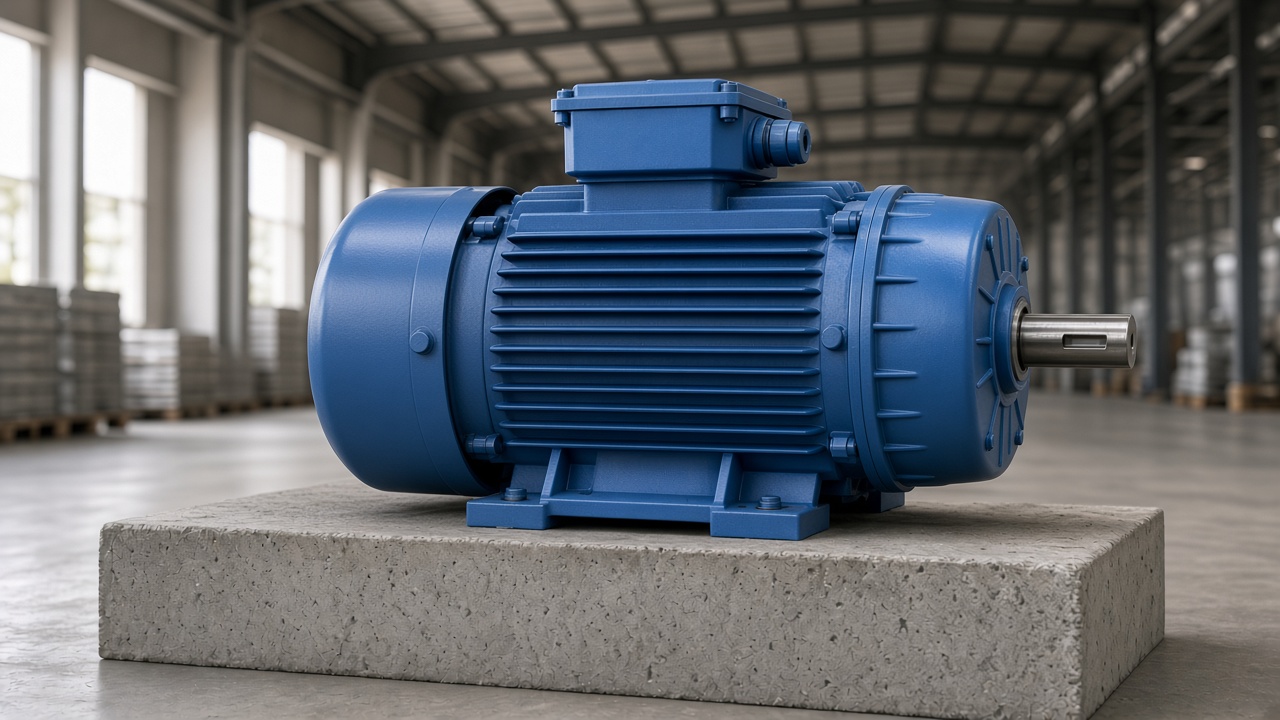
Electromagnetic brake · three-phase
YEJ Series Brake Motors
Three-phase induction motor with a spring-applied DC brake. Locks the shaft when power drops. 0.75–45 kW, poles 2, 4, 6 and 8, IEC frames 80–225, 220–690 V. Rectifier in the terminal box, manual release lever, brake torque set on the springs.
0.75–45 kW · 2 · 4 · 6 · 8 poles · Frames 80–225 · Braking ≤ 0.20–0.45 s
Where YEJ goes
Lifting
Vertical lifting and hoisting, where the load has to stay where the power died.
Positioning
Automated assembly lines, stacker cranes, packaging machinery and elevators, where the shaft has to stop without overshoot.
Emergency stop
Automated warehousing, conveyors and other machines where coasting is the problem the brake is there to end.
Industry pages: Material handling · Woodworking · Manufacturing
Send the stop
Tell us whether the brake is holding a lifted load or stopping a moving machine. The more of the duty we see, the closer the first quote.
- Kilowatts, poles and frame, or the model code from the old nameplate
- Voltage and frequency
- Vertical load or horizontal motion
- Braking time or stopping distance the machine needs
- Starts and stops per hour
- Direct-on-line, soft starter or frequency converter
- Mounting: B3, B5, B35 or V1. The factory also builds B14, B34, V3 and V5.
Jiangxi Jiawang Special Motor · +86 199 0684 4761 · [email protected]
Before the quote
What is a brake motor?
A three-phase motor with a brake mounted on the motor itself, usually at the non-drive end. On YEJ it is a DC electromagnetic brake. The coil holds the brake open while the motor runs. When power is cut, springs close it and the rotor stops and is held.
What happens to a YEJ brake motor in a power failure?
The brake applies. It is a power-off design, so losing the supply locks the shaft. Lifted loads do not free-fall and conveyors do not run on. The manual release lever frees the shaft if it has to be turned during the outage.
How fast does a YEJ motor stop?
The catalog gives a maximum braking time by frame: 0.20 s on frame 80, 0.25 s on frames 100 to 132, 0.35 s on frame 160, and 0.45 s on frames 200 and 225. The real stop depends on the load inertia and the brake torque setting.
How much brake torque do I need?
At least the motor’s rated torque, which is 9550 × kW ÷ r/min. Vertical loads need extra margin for holding against gravity. Very high torque on a heavy horizontal mass can overload gearboxes and couplings. YEJ brake torque is adjusted on the pressure springs. Send the load and the stop you need, and we will check the setting with you.
Can a brake motor run on a frequency converter?
Tell us at the quote stage. On a converter the brake coil should not be fed from the converter’s variable output, and the release and apply sequence has to match the drive ramp. We will confirm the wiring for your model.
What sizes does YEJ cover?
0.75–45 kW in IEC frames 80–225. 2-pole and 4-pole models run to 45 kW, 6-pole to 30 kW, 8-pole to 18.5 kW. Voltage on the series page is 220–690 V.
Can I adjust or service the brake myself?
Yes. Brake torque is set on the pressure springs, and the air gap should be kept between 0.2 mm and 0.5 mm. As the lining wears, the gap opens. Check it at maintenance and reset it to keep the stop consistent.