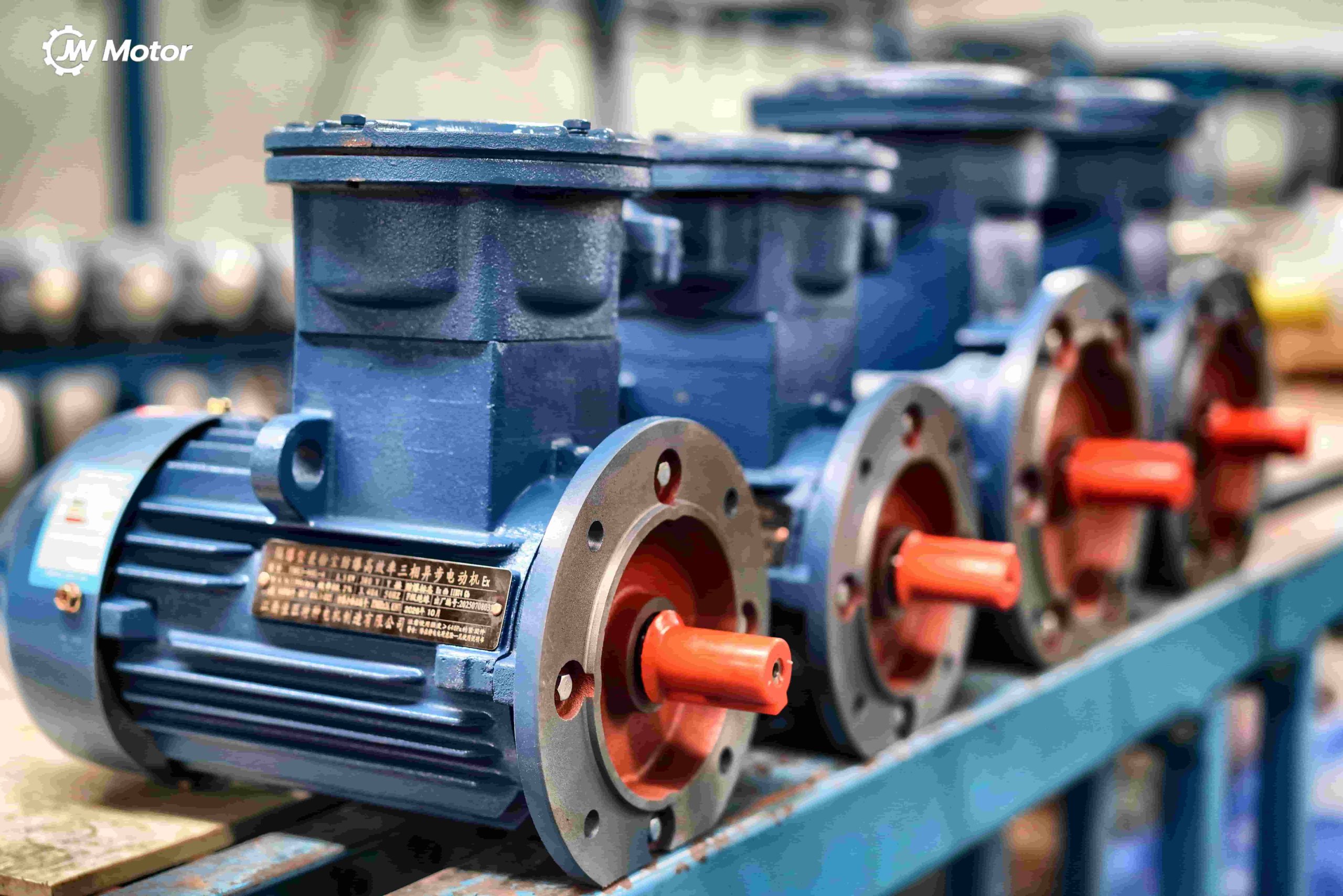
YD · Dahlander · 2 or 3 speeds
Pole changing motors
The stator connection sets the pole count, typically a Dahlander winding. Contactors select 2 or 3 fixed speeds. Speed stays on the supply frequency. YD is 0.45–82 kW, frames 80–280.
The connection sets the pole count
Speed variation is the stator winding connection. The YD page names a Dahlander connection, switched by contactors. One worked step is 4 poles to 8 poles, 1500 rpm and 750 rpm.
01
Supply frequency
Speed is locked to the grid frequency. The new pole count is the new speed.
02
Contactors
Dual-speed control uses contactors. The motor is copper and silicon steel, built for dust and heavy vibration.
03
Harmonics
The YD series produces no high-frequency harmonics. That suits laboratory equipment and auxiliary drives on precision machine tools.
The pairs on the series page
A two-speed motor is one of 2/4, 4/6 and 4/8. A three-speed motor is 2/4/6 or 4/6/8. Each speed has its own kilowatts.
| Poles | Speeds | What the YD page publishes |
|---|---|---|
| 2/4 | 2 | One connection for the high speed, one for the low speed |
| 4/6 | 2 | One connection for the high speed, one for the low speed |
| 4/8 | 2 | The worked example: 1500 rpm and 750 rpm |
| 2/4/6 | 3 | Three connections, three fixed speeds |
| 4/6/8 | 3 | Three connections, three fixed speeds |
1500 rpm and 750 rpm are the speeds in the 4/8 example. The pairs 2/4, 4/6, 2/4/6 and 4/6/8 are listed with their own kilowatts. Altitude is up to 1,000 m, with a power derating above that. Voltage tolerance is ±5%. Class H insulation is available.
Speed stays nearly constant as the load changes
The speed-torque curve is hard. Drill presses and milling machines use that for a consistent cutting speed. The series page also names machine-tool cutting, mixers and conveyors. The FAQ names marine and mining, including winches, drilling machines and lathes.
Fans and pumps use the same pole change
YDT publishes the same pairs, the same 0.45–82 kW and the same frames 80–280. The winding is variable torque: torque follows the square of speed, for centrifugal fans and pumps. Halving speed drops power to about one eighth.
Open the YDT pageSend the pair and the kilowatts at each speed
The pole pair is the motor. Power is quoted at every speed on that pair.
- YD or YDT
- Pole pair: 2/4, 4/6, 4/8, 2/4/6 or 4/6/8
- Kilowatts at each speed
- Voltage and frequency
- Frame
- Mounting: B3, B5, B35 or V1. The factory also builds B14, B34, V3 and V5.
Jiangxi Jiawang Special Motor · +86 199 0684 4761 · [email protected]
Before the quote
How does a pole-changing motor change speed?
The internal winding connection changes. The YD example is 4 poles to 8 poles, 1500 rpm and 750 rpm. Contactors make the change. Speed stays on the supply frequency.
Which speeds are 1500 rpm and 750 rpm?
Those two speeds are the 4-pole to 8-pole example on the YD page. The other pairs are 2/4, 4/6, 2/4/6 and 4/6/8. Each speed has its own kilowatts on the nameplate.
What if the speed has to move in a band, not in steps?
That duty is YVF2. It runs from a converter, constant torque from 5 Hz to 50 Hz and constant power from 50 Hz to 100 Hz, with an independent IC416 fan.