Torque from the catalog · RFKS · YVF2
High torque motors
JWMotor does not sell a separate “high torque” series. Torque at the shaft comes from three things you can choose in the catalog: the pole count, a gear reducer, and converter duty at low speed. Every model lists its rated torque, and the RFKS tables also list starting and breakdown torque.
Same power, more poles, more torque
Torque is power divided by speed. At the same kilowatts, a motor with more poles turns slower and gives more torque. These five RFKS motors are all 45 kW.
| Model | Poles | Rated speed | Rated torque | Starting torque Tst/Tn | Breakdown torque Tmax/Tn |
|---|---|---|---|---|---|
| RFKS 225M-2 | 2 | 2975 r/min | 143 N·m | 2.0 | 2.3 |
| RFKS 225M-4 | 4 | 1485 r/min | 287 N·m | 2.0 | 2.3 |
| RFKS 280S-6 | 6 | 990 r/min | 430 N·m | 2.0 | 2.0 |
| RFKS 280M-8 | 8 | 740 r/min | 573 N·m | 1.9 | 2.0 |
| RFKS 315S-10 | 10 | 590 r/min | 716.2 N·m | 1.5 | 2.0 |
Catalog figures at 380 V, 50 Hz. More poles also means a bigger frame for the same power, and the starting-torque ratio is lower on the 10-pole model. Across the RFKS tables, Tst/Tn runs from 1.3 to 2.4 and Tmax/Tn from 1.8 to 2.3. The highest starting ratios, 2.3 and 2.4, are on the small frames 80–100.
Starting torque and low speed
A heavy load needs torque in two places: at the start, and while it runs slowly. The catalog covers both.
01
Starts under load
The RFKS rotor slot profile is made for high starting torque, for hoists and conveyors that start loaded. A simulated locked-rotor test verifies starting torque and winding strength.
02
Torque at a crawl
On a converter, YVF2 holds its rated torque from 5 Hz to 50 Hz, with a separate IC416 fan so it stays cool at low speed. The catalog notes strong overload capability.
Torque through a gear reducer
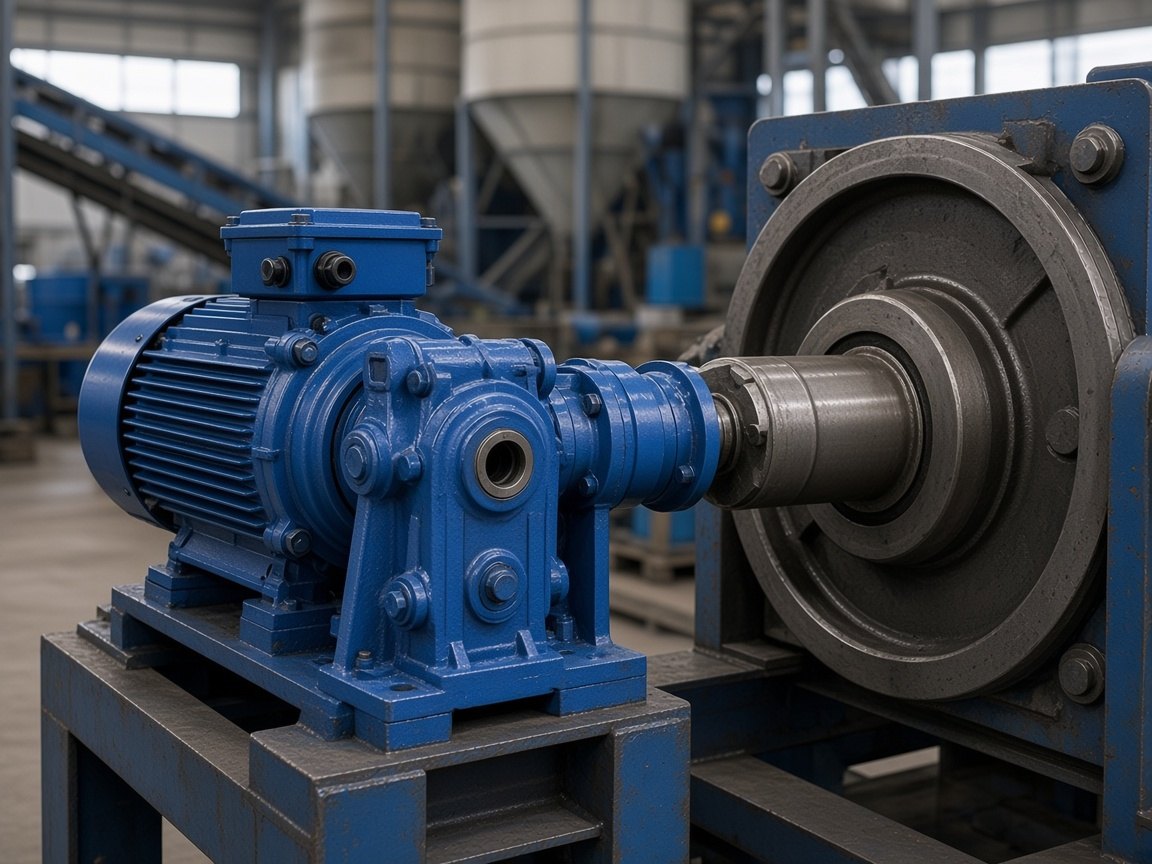
For the most torque at the lowest speed, the motor drives a gear reducer. The reducer multiplies the motor’s torque by its ratio, less its own losses. RFKS motors are made to go straight into R, F, K and S reducers.
03
Built for low speed and heavy load
The catalog describes RFKS with heavy-duty windings and upgraded bearings for long hours of low-speed, high-torque operation.
04
No coupling to fail
The motor shaft enters the gearbox and works as its first-stage pinion. No coupling, no flange adapter, and no vibration from coupling misalignment.
05
K or S
The product page gives K (helical-bevel) gearboxes efficiency up to 95% and longer life on heavy duty. S (helical-worm) costs less and is self-locking. The 95% is the gearbox, not the motor.
06
The ratio is yours
This page gives no gearbox ratios or output torque. Send the gearbox plate, or the output speed and torque you need, and we will size the motor.
The RFKS series
The motor range for gear reducers, with rated, starting and breakdown torque published for every model.
Gear reducer motors · IE3
RFKS Series Motors
Three-phase motor for direct insertion into R, F, K and S gear reducers. Rotor made for high starting torque, heavy-duty windings and upgraded bearings for low-speed duty, FKM oil seals in the end shield.
0.18–630 kW · 2–10 poles · Frames 80–400 · IE3
Where torque is the problem
Loaded starts
Hoists and conveyors that start under load. RFKS, sized on starting torque.
Slow and heavy
Conveyors and hoisting at low speed on a converter. YVF2, constant torque from 5 Hz.
Geared drives
Automated lines, conveyors and packaging machines on an R, F, K or S reducer.
Industry pages: Material handling · Mining and aggregates · Manufacturing
Send the load, not just the kilowatts
A torque problem is solved from the load side. Give us the numbers you have.
- Torque and speed needed at the driven shaft
- Starting conditions: loaded start, inertia, starts per hour
- Gearbox family, size and ratio, if there is one
- Speed range, if it runs on a converter
- Supply voltage and frequency
- The old motor nameplate, if this is a replacement
Jiangxi Jiawang Special Motor · +86 199 0684 4761 · [email protected]
Before the quote
Do you make a dedicated high torque motor?
No separate series. Torque is chosen through the pole count, a gear reducer with an RFKS motor, or a YVF2 motor on a converter. Send the load and we will tell you which route fits.
How do I get more torque at the same power?
Use more poles. A 45 kW RFKS gives 143 N·m with 2 poles and 716.2 N·m with 10 poles. Or keep the motor and add a reducer, which multiplies torque by its ratio.
What starting torque do your motors have?
The RFKS tables list Tst/Tn for every model, from 1.3 to 2.4 times rated torque. Breakdown torque Tmax/Tn runs from 1.8 to 2.3. Check the model you need on the product page or ask us.
Can a converter give full torque at low speed?
YVF2 holds its rated torque from 5 Hz to 50 Hz, and its separately powered fan keeps it cool at low speed. A standard self-cooled motor loses airflow as it slows.
What gearbox ratio do I need?
That depends on the output speed and torque. We do not publish gearbox ratios here. Send the gearbox plate or the output figures, and we will size the motor to match.